
Five marketing lessons from football’s biggest tournament


Football’s biggest tournament spanned five weeks, 104 matches and three host nations, creating enough mobile data across seven markets to test a theory: that a global event this size turns phones into a constant second screen. It didn’t. Because AppsFlyer measures billions of customer journeys every day, we rarely see consumer behaviour at a single moment or in a single channel. We see how it shifts across markets, platforms, and touchpoints. Few events exposed those patterns as clearly as this tournament.
Scoring Big, our pre-tournament report, correctly predicted the surge in mobile engagement. What it couldn’t reveal in advance was how uneven that surge would be: engagement came in three-minute bursts, purchases clustered at halftime rather than kickoff or the final whistle, and the same match produced entirely different behaviours from one market to the next. Those patterns offer lessons that extend far beyond football. This article explores the five most important ones.
TL;DR
- Mobile engagement came in predictable bursts, not continuous second-screen scrolling. The biggest spikes lasted around three minutes before fading.
- Attention and purchasing are different behaviors that show up in different signals. Goals drove app sessions. Halftime consistently drove purchases.
- Emotional stakes mattered more than audience size. Finalists produced engagement swings two to five times greater than host markets, final included.
- One global event needed multiple local playbooks. Regulation, digital infrastructure, daily routines, and audience behaviour rewrote the pattern market by market.
- The customer journey doesn’t end at the final whistle, most of that value came after it, and it went to whoever kept measuring.
1. Attention is fragmented, not continuous
Across the semi-finals, third-place match, and final, app sessions rose in short, predictable bursts lasting around three minutes before fading within six to nine. Rather than second-screening for 90 minutes straight, fans stayed locked on the action and only reached for their phones when something meaningful happened.
Goals consistently triggered sharp increases in app activity, as fans celebrated, debated, shared reactions, or checked scores. But not every spike came from the scoreboard: the tournament’s newly introduced hydration breaks and halftime also became reliable moments where audiences shifted attention from the match to their phones.
Perhaps the biggest surprise: the tournament’s highest engagement didn’t come from the final. It came from the ten-goal third-place match between France and England, which posted a +21.7% activity lift compared to just +6.3% for the final. More goals, more twists, and constant momentum outpulled the tense, scoreless final, where fans stayed glued to every minute of play instead of reaching for their phones. If you only measured audience size, you’d have missed where engagement actually peaked.
2. Attention and revenue are two different signals
Major live events create something every marketer wants: concentrated moments of consumer attention. The second lesson is that attention doesn’t automatically translate into revenue, and each needs its own clean signal to measure it properly.
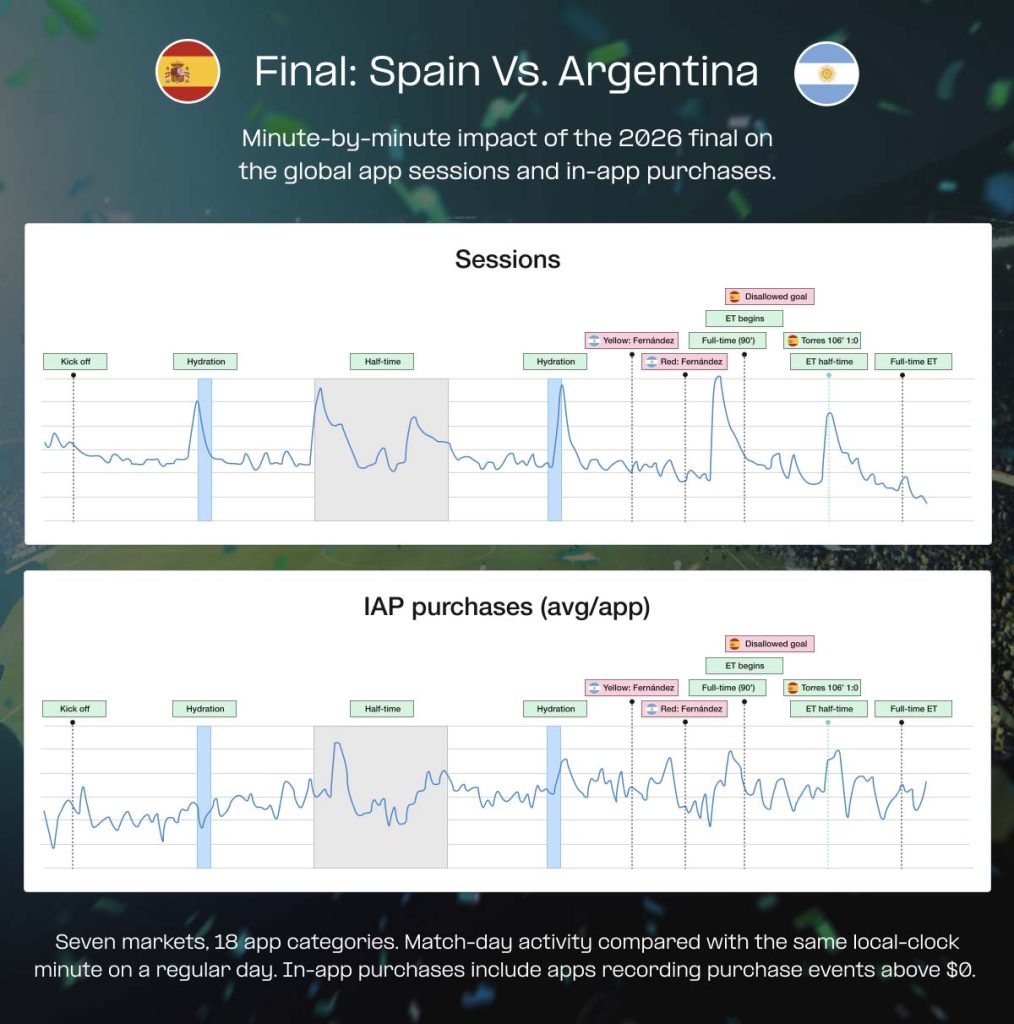
Purchases followed a different rhythm than sessions. Across all seven markets analysed, in-app purchase activity consistently peaked during the same pauses that drove attention, halftime and hydration breaks, giving fans time to browse, complete transactions, and return before play resumed. Spain’s semi-final against France illustrates this well: fans stayed locked on the match while the ball was in play, with purchasing rising primarily during the pauses rather than the game’s defining moments.
The distinction matters because engagement metrics don’t always reflect commercial outcomes. A campaign optimised to maximise reach during the biggest moments of the match can generate strong visibility without driving conversions. Brands looking to influence purchasing should instead align promotions, offers, and frictionless purchase experiences with the moments consumers are most likely to act, not the moments they’re most likely to look up.
At the heart of modern marketing attribution is a simple reality: no single metric captures the full picture. Treat attention and conversion as the same signal, and you lose the ability to optimise either. As attention fragments into ever shorter windows, measurement must keep pace, turning live signals into action before the opportunity passes.
3. Global reach doesn’t mean global behaviour
Global sporting events create global reach. The third lesson is that they don’t create global consumer behaviour. Across the tournament, the same matches produced very different engagement patterns shaped by regulation, digital infrastructure, daily routines, audience maturity, and language.
- Regulation creates market opportunity. Brazil showed how policy changes can transform an entire market. Betting apps were illegal during the previous edition of the tournament; legalisation turned the country into the single largest betting market tracked globally during this cycle. Brands with established local payment rails, partnerships, and consumer trust were best positioned to capitalise on the shift.
- Digital infrastructure enables conversion. Across Latin America, digital payment adoption shrank the distance between intent and action. Tap-to-pay transactions increased 55% year on year, with Brazil, Colombia, and Argentina recording the highest volumes among travelling fans. For retail, travel, and hospitality brands, stronger payment infrastructure meant engagement could convert to purchase with fewer barriers in the way.
- Daily routines shape category demand. In Mexico, kickoff time mattered as much as the match. With the final starting at 1pm local time, halftime landed on lunchtime, and food delivery app sessions rose 68% during the match, a pattern that didn’t show up in European markets where kickoff came after dinner.
- Audience maturity sustains engagement. The UAE revealed a different kind of football audience. Over half of local and Arab viewers watched fewer matches than in 2022, yet engagement stayed concentrated around the tournament’s most consequential fixtures. More than a third reported staying up late or waking up early to watch, suggesting the significance of the match, not the volume of matches, sustained attention.
- Language and cultural affinity expand reach. In the United States, Spanish-language broadcasts pulled in millions of viewers, including a growing share of English speakers (around one in five identified English as their primary language), highlighting how cultural affinity can expand an audience beyond language alone.
These examples illustrate the same lesson at the market level: the same event, viewed through five different local contexts, produced five different behaviours. A global media buy can’t account for that on its own. Brands that understood the behavioural drivers behind each market tailored creative, timing, channels, and measurement accordingly, instead of running one global campaign and hoping it translated.
4. Emotion beats scale, so audience size is the wrong proxy
One of those behavioural drivers turned out to matter more than audience size itself: emotion. The fourth lesson challenges a common assumption, that the biggest event should generate the biggest response. This one didn’t.
Lesson one already showed the headline version of this: the third-place match out-engaged the final. That’s not a fluke, it’s the pattern. Unpredictability beats prestige whenever attention is on the line.
The final makes the case from the other direction. When Torres finally scored, it produced another strong bump in activity, but the anticipation drew a bigger crowd to their phones than the goal itself did.
That split shows up market by market too. Spain saw app activity spike 131% the moment the winning goal went in, fans watching their team lift the trophy in real time. Host markets with no team left in the competition, like the United States, stayed far more restrained despite the size of the audience watching.
Audience size alone is an incomplete proxy for marketing opportunity. The moments that drive the strongest response are the ones with the highest emotional stakes: a comeback, a twist, the uncertainty of what happens next, not necessarily the ones with the most eyeballs on them.
For marketers, that means planning around moments of maximum emotional intensity, not simply moments of maximum reach.
5. The funnel doesn’t end at the final whistle
Today’s fans live in an omnichannel world. They move between live broadcasts, social, messaging apps, sports platforms, food delivery, betting, and retail before, during, and long after the match. That’s the fifth lesson: the customer journey doesn’t end when the final whistle blows. The live broadcast is only one touchpoint in a journey that continues well after the game, into the stage where most measurement still stops.
That fragmentation is both an opportunity and a challenge. Capturing attention during the match is only the first step. The brands generating lasting customer lifetime value are the ones continuing the conversation afterward, through highlights, social content, personalised messaging, and timely re-engagement.
The same principle applies to any major event. Whether it’s a retail peak, a product launch, or an entertainment premiere, customer journeys rarely end when the event does. Consumers continue discovering, sharing, researching, and purchasing long after the event ends, and brands that only plan for the live event miss a meaningful share of that engagement.
For marketers, that reinforces why measuring the entire journey, not isolated interactions, matters more every year. As consumers interact across channels and devices, understanding how each touchpoint contributes to the journey becomes the foundation for better decisions. It’s also what allows AI to optimise effectively, because intelligent optimisation depends on a complete view of customer behaviour rather than disconnected, self-reported signals.
What these five lessons add up to
Taken together, these five lessons point to a broader shift. Winning the next major cultural moment isn’t about being present during the biggest minute. It’s about knowing which moments matter and building the measurement to catch them as they happen, not after the fact.
Football made those behaviours impossible to miss. But they extend well beyond sport. Whether it’s a retail peak, a product launch, or an entertainment premiere, the brands that outperform aren’t the ones with the most data. They’re the ones who’ve already worked out, before the event starts, which signals to watch and what they’ll do the moment those signals move.
Ready to close the gap between attention and action at your next big moment? Speak to our experts to learn how AppsFlyer can help you turn fragmented, high-stakes moments into a connected view of the customer journey, from first session to last purchase.