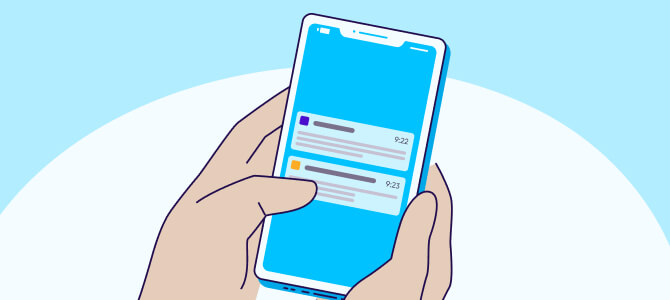
Push notifications are clickable, pop-up messages sent by an app to your mobile device or desktop. They’re designed to grab user attention and convey important messages, even when the app isn’t open.
What are push notifications?
Push notifications, also known as server push notifications, are short messages sent from apps to mobile devices. They’re similar to SMS messages or mobile alerts and appear as a full screen or as a top or bottom banner, depending on the notification’s function or goal.
Push notifications arrived on iOS in 2009, with Android following around a year later, and have since gained massive popularity. They’re a quick way to share vital information or time-limited offers with users. What’s more, you can send them at any time, as the user doesn’t need to be actively using their phone or app.
The anatomy of push notifications
Push notifications need to grab attention and inspire action. They have several elements, which must fit within the required character limits:
1. Icon: Must be PNG, JPG, or GIF (not animated). Once set, you can’t change it for individual messages.
2. Title: A short, attention-grabbing one-liner.
3. Content: A concise summary of the offer, written to entice the user to take the intended action. It can include an image or URL.
4. Call to action: The action you want the user to take, such as ‘Watch now’ or ‘Reserve your spot!’
The importance of the opt-in
An opt-in message is your first-ever notification to users, seeking explicit permission for you to send them push notifications.
It should communicate the value of your push notifications and ask users if they want to continue hearing from you in the future. This is an opportunity to build trust in your brand —for the best chance of success, customize your message to reflect the benefits of opting in.
Once users agree, you can add them as subscribers and start engaging with them to encourage their return to your app.
Push notifications vs SMS messages
SMS (text) messages share some similarities with push notifications, but here’s why they’re actually distinct marketing tools:
- Audience: push notifications are only sent to app users, whereas text messages are for anyone who has opted in to receive them.
- Delivery: users need to install the app to receive a push notification, whereas opting into SMS usually involves texting a specific phrase to the relevant number.
- Intent: a push notification is typically promotional, educational, or location-based, while an SMS is primarily transactional and used to convey urgent info.
For example, if you have an eCommerce app, you could use a push notification to announce a surprise sale on footwear. You could then follow this up with a delivery update via text.
In-app notifications vs. push notifications
In-app notifications are short, in-app messages designed to draw user attention to new features, highlight special offers, and onboard new users.
Here’s how they differ from push notifications:
- Audience: push notifications can be received at any time, whereas in-app notifications only reach people actively using the app.
- Purpose: because push notifications work from outside the app, they’re ideal for bringing in inactive users. In-app notifications, on the other hand, guide users inside the app.
- Notification disablement: users can turn off push notifications, but not in-app notifications.
For example, you could use a push notification to alert users to an app update, and an in-app notification to demonstrate specific features within the app.
The benefits of push notifications
Here’s a quick rundown of the key benefits of push notifications:
1 – Reach users anytime, anywhere
You don’t have to wait for users to engage with your app to see the message, making it easier to cut through the noise and stand out from the competition. Plus, you can achieve broad reach without breaking the bank.
2 – Engage and retain users
Think about it: you’re talking to an audience that’s already interested enough to download your app. Push notifications are your chance to remind them of the app’s benefits and keep them coming back, through personalized messages that address their immediate needs.
Support them with onboarding, remind them to complete an action (like a free trial or a purchase), provide timely news updates, or offer discounts to reward their loyalty.
3 – Boost conversions
As mentioned above, you’ve done the hard part in terms of user acquisition. Now, you have an engaged audience that’s ready to take action — as long as you can reach them with the right message at the right time.
Because it’s so easy for customers to jump from the message right into your app, push notifications are a great way to encourage purchases and sign-ups.
4 – Drive traffic
Push notifications also help drive traffic to your mobile app or website while getting users to continuously engage with your content.
For example, gaming platform GoGy Games launched automated push notifications to send alerts about trending and relevant games according to users’ time zones. This brought in thousands of new users and prompted players to stay longer.
5 – Create monetization opportunities
Push messages are guaranteed impressions, as users can’t miss them on screen. This makes them a powerful monetization tool that increases revenue and provides value to advertising partners.
For example, an apparel brand could sponsor a shopping app’s push notifications to send audiences info about special offers or new products.
Types of push notifications
In this article we’re focusing on mobile app push notifications, which are triggered by an existing app on a user’s device.
Besides the traditional alerts that stay on screen until the user manually deletes them, mobile app push notifications can also be styled as a banner or badge:
- Banner notifications are brief messages that pop up on the screen shortly before disappearing. They contain the beginning of a message (like in WhatsApp) or alerts for time-sensitive events.
- Badge notifications appear as a red badge on the app’s icon. They usually have a number to indicate, such as the number of unread notifications in the app.
Interestingly,mobile push notifications look different for iOS and Android users.
For iOS devices, a push notification first appears on the lock screen. Once the device is unlocked, it moves through the Notification Center. Android users have more control: they can set push notification priorities, group them into types, and determine how they appear on their devices.
As well as app notifications, you can also find:
- Web push notifications: these appear on desktop or mobile websites, encouraging users back to your site to drive conversions.
- Desktop push notifications: these are driven by products the user has already installed on their desktop.
- Wearable push notifications: appearing on smart watches and similar devices, these messages need to be super concise to fit the small screen size. Users can manage their settings to control which apps can send them notifications.
Types of push notification campaigns
Push notifications are the digital equivalent of hand-written notes that aim to pique your audience’s interest.
Use them to keep your users engaged and interested through the following campaigns:
- Time-bound push notifications: tell your audience about time-limited events, like exclusive previews and flash sales, to create a sense of urgency and inspire action.
- Reminders: send users a friendly nudge about an important moment in their day — like time to meditate, study, or set an alarm for their morning run.
- Triggered push notifications: create campaigns based on the user’s real-time behavior in the app. For example, send congratulations to users who have been using your app for seven consecutive days.
- Transactional updates: it’s helpful to update users on the status of their transactions — think order updates and payment reminders.
- Abandoned cart notifications: re-engage users and gently encourage them to purchase products left in their carts: “Hey, your favorites in your cart are now on sale. Get them today!”
- Rich push notifications: include images, audio, videos, and other interactive elements to engage users, enticing them to return to your app or website. Examples include sending weather updates or price alerts.
What are push notifications used for?
Push notifications have a number of uses:
1 – Customer engagement and retention
Push notifications keep your app top of mind through personalized offers, reminders, and notifications.
They can also play a key role in onboarding, encouraging recent installers to get familiar with their new app and its benefits. Sending one push notification to a new user in their first week can increase retention by 71%.
2 – Action-based marketing
Push notifications make it easy for users to take a specific action, say, checking out their abandoned carts or completing onboarding. They also serve timely reminders to re-engage with the app or website.
When your notifications are well timed and personally relevant, they can be a highly effective part of your mobile marketing toolkit.
3 – Identity authentication
Push notifications are one of the most convenient forms of security authentication. Healthcare and online banking companies often use them as an authentication factor before granting users access to the app, website, or sensitive data.
4 – Civic communication
With the average American receiving 46 push notifications per day, it’s not surprising people are selective about which ones they’ll allow. Users have to trust the sender, and find the notifications genuinely valuable.
Enter local government bodies and utility agencies, who effectively use push notifications for timely updates or urgent news. Common examples include traffic, weather, and power alerts that help people stay safe.
5 – Connected user experience (UX)
Push notifications bridge the gap between online and offline channels. They help reduce friction along the customer journey by sending real-time transactional notifications to keep users informed about their purchases, creating a consistent experience across channels.
This will help you grow a loyal, engaged customer base, drive conversions, and scale your business.
How do push notifications work?
Before we dive into the mechanics, you need to understand some key terminology:
- Operating system push notification service (OSPNS): Each mobile operating system (OS), such as iOS and Android, has its own service.
- App publisher: After enabling their app with one or more OSPNS, the publisher (app owner) uploads it to the app store.
- Client app: An OS-specific app installed on the user’s device that receives all push notifications.
These elements work together in four key stages:
Phase 1: OSPN registration
- The app publisher registers with the OSPNs.
- Each OSPN gives the app publisher an application programming interface (API) to allow the app to communicate with the service.
- The app publisher adds a software development kit (SDK) to the app, which is a code library specific to the OSPNS.
- The app publisher adds the app to the app store.
Phase 2: App installation
- The user visits an OS app store and installs the app.
- Once the user opens the app, unique identifiers (IDs) for both the app and the device are registered within OSPNS.
- The OSPN passes the IDs back to the app and sends them to the app publisher.
- The app publishers store the registration details, including the IDs.
Phase 3: Sending push notifications
- The app publisher creates a manual message through a message composer user interface (UI). Alternatively, they can set up an automated message and send it via the API.
- The app publisher defines the audience to receive push notifications, and decides whether to send the message immediately or schedule it for later.
Note that you can personalize push notifications to different segments in your user base. First, you’ll need to gather user ID data and install a specialized interface for writing, segmenting, and sending messages.
Phase 4: Opting in
Every OSPN has different opt-in processes. On iOS, users have to give explicit permission to receive push notifications. Historically, Android opted users in by default and let them opt out manually. Since Android 13, Android also requires explicit opt-in, the same as iOS.
Once the user agrees to receive push notifications, you can start engaging them to bring them to your app.
How to deep link from push notifications?
AppsFlyer supports measuring push notification campaigns from any push provider, as well as campaigns built directly on Firebase Cloud Messaging or APNS. There are two integration methods so pick one and don’t mix them.
Prerequisites
Your app needs the AppsFlyer SDK integrated and able to receive push notifications before any of the steps below will work.
Method 1: OneLink-based (recommended)
- Create a OneLink link and set it up for retargeting. Both short and long OneLink URLs are supported.
- Add the OneLink to the push notification’s custom data, under a custom key your team names (e.g. af_push_link). The exact payload key varies by provider.
- Tell your app developer the custom key’s name so they can configure the SDK to resolve it. When the OneLink is itself configured to route to a specific location in the app, the regular deep-linking flow fires automatically on top of attribution.
Method 2: JSON-based (legacy — backward compatibility only; don’t use this for new integrations)
- Add a custom key called af to the push notification, containing a JSON object.
- That JSON object must include three required parameters: pid, is_retargeting.
Method 3: Measure push taps as re-engagement
- Add
is_retargeting to your link’s parameters, as in the example above. AppsFlyer then counts the tap as re-engagement of an existing user, not a new install.
- Set the re-engagement window under Settings > App Settings, and make the matching per-partner setting under each integration, both are required. Then compare sessions and post-acquisition events by campaign to see which push campaigns are driving results.
Method 4: Fix links your provider wraps
- Some providers wrap your link in their own redirect domain, so your app receives the wrapper instead of your deep link. AppsFlyer’s SDK handles this with
setResolveDeepLinkURLs, passing in your provider’s redirect domains so the SDK resolves and unwraps them before the deep link continues. This is documented for wrapped ESP (email) links specifically; applying the same fix to a push provider’s wrapping domain is a reasonable extension of the same mechanism, not something I found stated for push notifications by name.
Testing
Trigger a push notification in the campaign you set up. If everything’s configured correctly, the SDK will listen for the push, process the attribution data embedded in it, and, on the OneLink method, proceed into the regular deep-linking flow.
Viewing results
The source material describes this two ways that don’t fully reconcile with each other: its overview says conversions display in “the Overview dashboard, in the retargeting or unified views,” while its step-by-step instructions separately point to “the Retargeting dashboard.” Confirm against the actual product UI rather than treating these as the same place. Either way, AppsFlyer deduplicates this data: if an identical payload is received more than once, only one is counted.
8 push notification best practices and strategies
Before you start firing out push notifications, check out our top tips for success.
1 – Create compelling content
Find out what questions your users are asking, and create content that answers them. Make your copy persuasive through clear, crisp one-liners and CTAs.
Creating a sense of urgency can also tempt users into completing an intended action.
2 – But keep it brief
Studies show that push notifications with 10 words or fewer achieve the best click-through rates — and clicks go down as the messages get longer. So get to the point and make every word count.
They say a picture tells a thousand words. Maybe that’s why emojis score so well in push notifications, generating significantly more engagement.
3 – Use social proof
Share positive experiences from your existing users to encourage new users on board. Use your social media channels or website to spread the word and build your community.
4 – Segment and customize wherever possible
By segmenting users according to relevant parameters (age bracket, location, average spend, and so on), you can create personalized messages that drive engagement.
Use A/B testing to work out which message types have the biggest impact.
5 – Work on your opt-ins and opt-outs
Whether users have to opt in or out of your notifications depends on their operating system. Either way, it’s your job to make the process as easy as possible.
When asking people to opt in, be sure to make the value of your notifications clear. And take the inevitable opt-outs in your stride. Look at these as making room for more engaged users who are more likely to click and convert.
6 – Route users directly to the screen you promise
A major attraction of push notifications is their convenience: users are just one tap away from taking your desired action. But that tap only pays off if it lands the user in the right place.
Build deep links into your push notification messages so that each tap opens the exact product, cart, or offer your messaging promised, and not a generic homepage. Users skip any manual navigation and get to where they, and you, want to be, faster.
7 – Optimize for different devices
Remember earlier, we said that push notifications display differently on iOS and Android phones? Well, that’s why it’s so important to test yours on both device types to be sure all users get a positive experience. For example, you don’t want your message cut off in the middle of a crucial word.
Display can even change depending on the model of phone. You’ll want to test other devices too, like tablets and wearables.
8 – Take privacy seriously
In today’s privacy-centric world, users are rightly concerned about what data can be obtained from push notifications and how it’s used and potentially shared.
To make sure you’re operating ethically, and complying with regulations including GDPR and CCPA, think: transparency, consent, limitation, security, retention.
In other words, you need to make clear to users at the opt-in stage what user data you’ll measure and use, why you need this data, how you’ll store it safely (and for how long), and who can access it, and, crucially, obtain their consent.
Common push notification mistakes to avoid
We’ve all been on the receiving end of bad push notifications. They can drive you to unsubscribe, or even uninstall the app. To prevent that happening to you, watch out for these common pitfalls:
- Message overload: when it comes to push notifications, think quality rather than quantity. The right frequency will vary according to your industry and app type, so be selective and perform A/B tests to understand what “too few“ or “too many“ looks like for your business.
- No personalization: every user is different, and your content should reflect their preferences. Segment your subscriber base based on behavior and characteristics and then personalize messages accordingly.
- No onboarding: push notifications familiarize new users with your app. When sent at appropriate intervals, they make it easier for users to effectively explore the app and understand its features, so they’re kept engaged for the long haul.
- Manual distribution: : schedule your messages for a certain date and time to achieve maximum engagement. Users will be more receptive, and you’ll save valuable time.
- Lack of measurement: look beyond click rates to be sure your push notifications are delivering bang for your buck: think form completion, free trial signups, and purchases, for instance.
Speaking of which…
Push notifications analytics and performance metrics
Properly analyzing the performance of your push notifications is vital if you want to optimize your campaigns and create the best user experience. But there’s more to it than meets the eye.
There’s a number of key performance indicators you can measure, and your focus might shift according to your campaign goals. Here are five which, taken together, help you see the bigger picture.
1 – Opt-in rate
This indicates the number of people subscribed to your push notifications. It’s the difference between the number of people who visit your app or website and the number of people who subscribe.
Opt-in rate tells you how your audience responds to your opt-in message and gives you insights to configure it so it resonates better with your users.
2 – View rate
This metric refers to the number of people who saw your notification out of the total number of people who received it.
While viewing isn’t the same as clicking, view rate is still a valuable metric to know whether your users notice your messages. If they don’t, consider how you could make them more attention-grabbing.
3 – Click-through rate
The click-through rate (CTR) indicates the percentage of people who saw and clicked on your push notification to check out your content. Click-through rates for push notifications vary widely by industry and definition, commonly cited figures range from roughly 3% to over 30%.
4 – Push notification revenue
Increased revenue is often your primary marketing goal, so it makes sense to measure how much revenue each notification generates, especially if you own an eCommerce app or website.
5 – Opt-out rate
This metric shows how many users unsubscribe from your push notifications, helping you gauge the effectiveness of your content and timings of your campaign.
Unsubscribes will happen, so focus on keeping the number under control. If it remains low, don’t waste your time trying to achieve a zero rate.
Push notification trends: recent shifts worth knowing
Push notifications have been around for years, but what does the future hold for the channel? Let’s look at some forward trends:
The rise of AI
Artificial intelligence (AI) and machine learning are game changers for push notifications. You can already use creative AI tools, like the ubiquitous ChatGPT, to quickly come up with effective messages within a limited character count.
These technologies are also enabling greater personalization. With detailed segmentation and predictive analytics, you can forecast user behavior based on their preferences and previous patterns. That way, you can send users the right message, at the right time, for maximum results.
Location-based notifications
Technology is also opening doors for geolocation targeting: when users turn on location sharing, they can receive notifications based on their location. Let’s say a user visits a lake popular with paddleboarders: your sports brand could seize the moment to recommend some new kit. If they’re at the mall, your coffee chain could provide a coupon for the nearest outlet.
Richer messaging
It’s already possible to incorporate rich media into push notifications, but most companies have so far played it safe, sticking to text and the occasional emoji. But, as more businesses cotton on to the engagement potential of images and videos, tailoring them to user interests, we can expect push notifications to get more exciting.
Deep links
Users expect a tap to land on the screen the message promised, not a generic landing page. Deep links allow brands to ensure users reach the content they expected to see when they first tapped on the notification. Expect more teams to link each notification to a specific product, offer, or in-app moment, and to measure what happens next.
Frequently asked questions
What are some push notification examples?
Examples of push notifications include time-bound alerts for sales, reminders for daily activities, triggered messages based on user behavior, transactional updates on order status, abandoned cart prompts, and rich notifications with multimedia elements to enhance engagement.
How do push notifications differ from SMS messages?
Push notifications are sent only to users who have installed an app, whereas SMS messages can be sent to anyone (in both cases, the user must have opted in). Whereas push notifications tend to be promotional, SMS messages typically convey urgent or transactional information.
How do push notifications differ from in-app notifications?
Push notifications can be received anytime and are ideal for re-engaging inactive users. In-app notifications are shown to users already active within the app, guiding them towards specific actions.
What are the key benefits of using push notifications?
Push notifications enable you to reach users anytime, enhance engagement and retention, boost conversions, drive traffic, and create monetization opportunities through direct communication with users.
How do push notifications work?
Push notifications involve an app publisher registering with an Operating System Push Notification Service (OSPNS), which then allows the app to communicate with opted-in users through unique identifiers, enabling targeted messages to be sent.
What are some best practices for push notifications?
Effective push notifications require compelling, concise content, personalized messaging, optimized opt-in/opt-out processes, deep linking for easy navigation, and testing across different devices for optimal display.
What are some mistakes to avoid with push notifications?
You should avoid overwhelming users with push notifications or sending messages that aren’t personalized. Other common mistakes include neglecting onboarding opportunities, manually distributing messages without strategy, and failing to measure the impact of notifications.
Key takeaways
- Push notifications are short messages sent from app publishers directly to users’ mobile devices. Users don’t have to actively use the app or their phone to receive them.
- Push notifications help brands convey important information effectively and promptly.
- Users can choose to opt in or out of push notifications. To encourage users to consent to receiving messages, be clear on the benefits and transparent about how any data will be used.
- Push notifications can be used mobile, web, desktop, or wearable devices. They’re commonly used to engage users, drive action, and create a smooth customer experience.
- A key benefit of push notifications is the ability to reach and engage users wherever they are. They can help you drive traffic, boost conversions, and monetize your app.
- The best push notifications are compelling, but brief, and customized to the audience. Incorporating social proof and deep links, optimizing for different devices, and automating sends will also boost your success.
- Be wary of sending too many push notifications, or ones that aren’t personalized. And remember to measure the right KPIs, like opt-in rate, view rate, click-through rate, revenue, and opt-out rate.
- Looking ahead, we expect push notifications to become even more popular, with AI, geolocation and rich media shaping a more personalized experience.