
AI or Die: Shelly Palmer on Agentic AI, Super Automation & the Data Elite
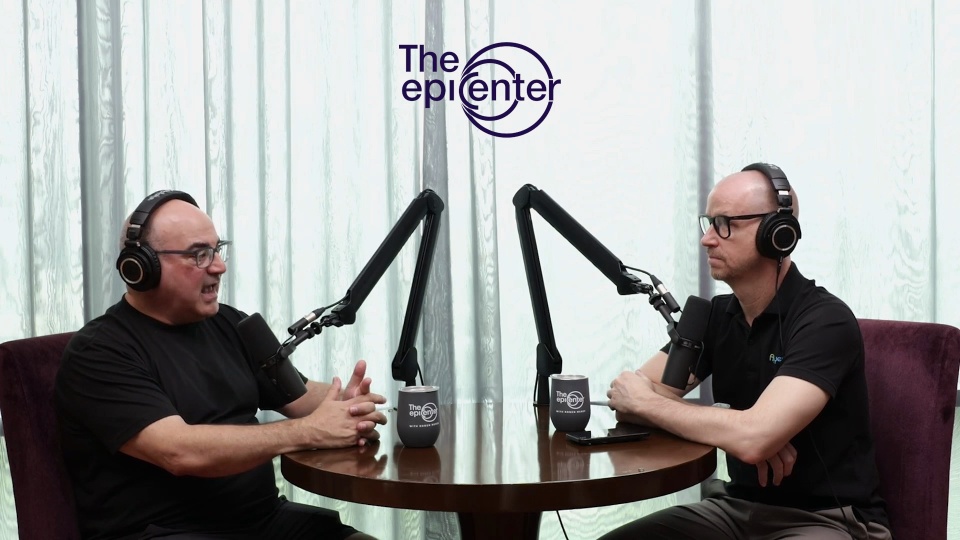
Shelly Palmer
0:00
0:00
Featuring

Shelly Palmer
AI Thought Leader, Business Strategist, Professor, Author

Episode summary
In this episode of Epicenter, Ronen sits down with Shelly Palmer—one of the most influential voices in AI, media, and technology—to unpack what “AI or Die” really means for modern businesses. Shelly traces his journey from pioneering digital audio and interactive television to becoming a leading advisor on AI transformation, revealing why today’s AI moment is not a trend, but a permanent shift in how power, productivity, and value are created.
The conversation goes deep into the existential impact of AI on search, media, advertising, and aggregation-based businesses, the rise of the “data elite,” and why regulation is already years behind reality. Shelly also shares a practical framework for executives: stop talking about AI as a technology and start focusing on business outcomes and super-automation. The episode closes with powerful guidance for leaders, educators, and young professionals on how to thrive in an AI-amplified world—where thinking, judgment, and cultural depth matter more than ever.
Key highlights
On AI as an existential business shift:
“Everything we think we know about search, aggregation, and content is fundamentally under threat. It’s adapt or die. It’s AI or die.”
On how leaders should approach AI:
“AI is not the outcome. The business outcome is the outcome. AI is just a means to get there.”
Episode Timestamps:
*(01:02) Why this moment is “AI or Die”
*(02:00) Shelly Palmer’s origin story: from music and synthesizers to AI
*(07:38) Computer-controlled instruments and early machine learning foundations
*(12:30) Interactive TV, Disney, and early digital transformation
*(17:00) Why ChatGPT changed public perception of AI overnight
*(19:20) From “What is AI?” to execution and automation
*(20:45) AI as an existential threat to search, media, and aggregation businesses
*(26:15) The rise of the data elite and why distribution wins
*(30:10) Multi-agent systems and the future of personal assistants
*(36:00) Why regulation is already too late
*(42:30) Big tech, regulatory capture, and competitive moats
*(47:00) A practical AI framework for executives
*(53:15) AI as a leadership problem, not a tech problem
*(55:00) Advice for 20-year-olds entering an AI-driven world
*(01:01:00) Legacy, learning, and quick-fire questions
Transcript
[00:00:00] Ronen: Welcome to another episode of Epicenter. Um, this is an in-depth [00:00:15] series of interviews, which we feature business leaders and industry influencers who are shaping today and tomorrow’s digital economy. Um, I’m here with Whew, Shelly Palmer, AI thought leader, [00:00:30] business strategist, professor, inventor, composer, author, philanthropist, husband, father, grandfather.
[00:00:40] And one of the most amazing keynote speakers that I have ever heard in my life. [00:00:45] Shelly, welcome. Thank you to Epicenter.
[00:00:47] Shelly: Wow. I I, I’m humbled by that intro. Thank you so much, Ron. I appreciate it.
[00:00:51] Ronen: Did I cover everything or is there a couple more boxes? I’m not sure.
[00:00:54] Shelly: I’m not sure I meet up. I can even live up to that, but thank you.
[00:00:58] Well, I think you can, um, [00:01:00]
[00:01:02] Ronen: in, in, in the theme of, uh, ai, today’s topic is AI or die. And, uh, I think it’s, it’s pretty relevant to, uh, where we are today in the world. Yeah, for sure. [00:01:15] So let, let’s kind of frame this because. We have a predominantly Asian, uh, audience. Mm-hmm. And, um, many people don’t know Shelly Palmer yet.
[00:01:27] They will after this week, that’s for sure. [00:01:30] Um, but clearly you’re one of the most in demand humans, um, when it comes to everything, AI and how companies must basically have a strategy around it. Yes. But I’m guessing that you were not always an AI guy, right? No, no. Tell us a bit [00:01:45] about, you know, Shelly and how you came to, to this.
[00:01:48] We got a lot of time. Don’t worries.
[00:01:51] Shelly: Uh, the origin story is, I, I guess, kind of relevant in, because people often ask me, um, [00:02:00] you know, how did you go from composer producer to ai? Tech guy and it’s, um, actually a direct straight line, but you wouldn’t know it unless you understood really the, the nature of, of how AI [00:02:15] came to be in the, I guess the public, uh, spotlight.
[00:02:20] Uh, my mother and father, uh, they met at Julliard and they opened up music stores, uh, a music store and then ultimately more than one. And I grew up in a family of music educators and [00:02:30] they owned retail music stores and there was a wholesale group and a mail order group, and I got to work like all kids, uh, back when I grew up you worked in the family business.
[00:02:39] So I literally got to do everything from packing boxes to moving pianos and uh, that was how I got my allowance [00:02:45] and what have you. But I was about 12 years old. Something magical happened and it was defining, it was a defining moment in my life. And it was what you, you often, when things happen to you, you don’t know that they’re gonna change the [00:03:00] trajectory of how you’re going to be.
[00:03:02] But this was clear, uh, there is a, an electronic musical instrument that was invented in the sixties and seventies, a group of them, and they were called synthesizers, and they were analog instruments that [00:03:15] created musical sounds. There had always been some kinds of electronic music, but remember, audio tape and guitar pickups are all happening in the forties, fifties, and sixties.
[00:03:26] The music is transforming, and my mom and dad [00:03:30] were classically trained. They met at Julliard. They, to them, pop music was a Broadway show. It wasn’t rock and roll, and The Beatles were the devil’s music at that point, right. They just had no interest in that kind of stuff, although they didn’t mind selling an electric guitar or two Anyway.
[00:03:44] [00:03:45] Into my dad’s music store, uh, rolls Bob Mogue, um, with, uh, a bunch of synthesizers basically in the back of his station wagon as I remember it. It wasn’t quite that quaint, but at the end of the day, we got to to hear the very [00:04:00] first demonstration in person demonstration of a, of a Moog synthesizer. Now, I’d been brought up with, you know, good old fashioned symphonic instruments and classical, uh, music generally was playing in my house all the [00:04:15] time.
[00:04:15] And all of a sudden this thing makes, sounds you’d never heard. Now, I don’t know how to describe it because like, how many of us get to a, a, a moment in our life where we literally [00:04:30] hear something we’ve never heard before. Mm-hmm. Everybody knows what these sound like now. Everybody living there, your phone will make the sounds, you can find them sampled everywhere.
[00:04:37] Sampling didn’t exist so. The demonstration that was put on for me changed my life. It changed everything. I couldn’t believe what I [00:04:45] was hearing and I needed to be part of it, like whatever it was. Mm-hmm. Now, what’s crazy is this is 1970, the device that was, uh, on offer was about 8,000 us. Wow. For context, [00:05:00] the car my father was driving was $6,500.
[00:05:03] The house we lived in was $35,000. The entire house, like this is, you know, like this is money. You don’t have, um, a very expensive Fender Stratocaster guitar [00:05:15] or a Les Paul custom would’ve been 150 bucks. Like, that’s the context. Yeah. For just the, the sizing of this thing. My father didn’t believe it would ever sell.
[00:05:26] He’s like, this will never sell. Well, who’s gonna buy this for, you know, I mean, grand pianos [00:05:30] cost less. And he’s right. It never sold because I took it home. Hmm. And I started to learn how to play it and it became obvious to me, um, by, I guess by the time I was around 17 years old, um, the Motorola is [00:05:45] 6,500 processors, actually.
[00:05:46] 65 0 2 had come out. Mm-hmm. And it was readily available at Radio Shack. So I’m about 17. I’m walking through Radio Shack and there he is on the shelf. Uh, a little book for 79 cents that says, uh, CFS and VCAs. [00:06:00] Which stands for voltage control filters and voltage controlled, uh, amplifiers. And there was another book about voltage controlled oscillators, and I asked the guy behind the counter if these were the same amplifiers, oscillators, and filters that were in my synthesizer, and he had no [00:06:15] idea what I was talking about.
[00:06:17] I walked outta there with about $45 worth of parts. And took this down to, uh, my dad’s music store, which is just down the block. And I dumped the whole bag of parts onto the workbench of the Guitar [00:06:30] and Amplifier repair guy. And I called my mom and I said, could you bring those two big cases on the piano down to the store?
[00:06:37] And we only lived a few blocks away, and she threw it in the car and she brought it over. And Walter the guitar and amplifier repairman said, what? What are we [00:06:45] doing? Yeah. And I said, we are gonna computer control this analog synthesizer. Whoa. And he was like, how are we gonna do that? I said, I don’t know, but I got a couple books here.
[00:06:52] We’re gonna figure it out. And we started breadboarding and soldering stuff. And my goal was to be able to take these knobs, these potentiometers [00:07:00] and quant quantize them so that rather than being continuous, they would have 256 different gradations so that I could dial in the sounds rather than have them, um.
[00:07:13] Be like [00:07:15] arbitrarily found and tuned. And when the people at Moog saw this a, a year or so later, uh, at a show, uh, it might have, I, I don’t remember if it was a show at my, my dad’s store, [00:07:30] they told me it had to be patented uhhuh. And that was my entry into this idea of con computer controlled musical instruments.
[00:07:38] Well, the analog instruments only went so far. They, they, and at just a few years later, the [00:07:45] first digital or additive synthesis, uh, synthesizer started to be made at and t and Yamaha put together this, um, wonderful idea of, of additive synthesis as opposed to analog, which is subtractive. You filter, you start with a big, rich wave and you subtract down.[00:08:00]
[00:08:00] Once you understood that you could do additive synthesis, it was not a big leap to start thinking, well, if we can build sounds that way, we could sample, uh, audio. You could digitally record, um, and playback. And [00:08:15] so started this journey into building the first digital audio workstation. And it is from that that all of my machine learning knowledge comes all the math that I needed to do to understand, um, fast foyer transforms and [00:08:30] wave smoothing and all kinds of audio wave functions and the ability to, to have, um, the, the machine figure out what had to happen in near real time.
[00:08:44] And there wasn’t a [00:08:45] lot of RAM available and there wasn’t a lot of RAM available and there wasn’t a lot of hard dry space available. In fact, the original. Uh, digital audio workstations were sampling to disc because the seek time of a rotating [00:09:00] disc
[00:09:00] Ronen: mm-hmm,
[00:09:01] Shelly: was about four milliseconds, and memory was slower than that because of the way the motherboards were laid out and the way memory boards had to be set.
[00:09:08] It was just for technical reasons. Literally this idea of sampling to disc was a better thing to do. So I lived through that [00:09:15] entire process and we’re all the way now into the mid eighties. In 1986 in April, we put the very first ever fully tapeless recording studio online at 19 West 36th Street in Manhattan.
[00:09:29] And we did the first [00:09:30] ever commercial recording session that was, that had no tape. So this was digital, all digital, a hundred percent digital in 1980s, 86, 19 86, 6. And it was kind of like a moment that went by that none of us noticed or understood as that [00:09:45] moment I didn’t understand as pivotal in the world.
[00:09:47] Right. Whereas, you know, learning about analog synthesis for the first time and hearing those sounds, that was instantly obvious to me that the world, my world was gonna change. We did this, um. [00:10:00] We built a recording studio and we were working on what we thought was the cutting edge of technology and we just never stopped doing it.
[00:10:07] Well, it turns out, Ronan, that the math you use to do everything we were doing in digital audio workstations and digital video workstations is [00:10:15] the same exact math that you use to analyze all the data there is in the entire advertising world. Mm-hmm. And one of the, um, things that I was doing full-time as a composer, producer was a, a zillion, and that’s probably a technical term, [00:10:30] commercials.
[00:10:30] I, I think if I took the job this year, um, I’d probably do the music for my 5000th television commercial. Wow. I was pretty prolific. And so, uh. You know, the, this idea of sitting in a room with some of the advertising [00:10:45] industries, most brilliant people who were busy talking amongst themselves while you are, you know, working on making the commercial, you’re working on scoring the commercial or mixing the commercial, adding voiceover and sweetening, like we were doing all this kind of stuff.
[00:10:59] And you would [00:11:00] have luminaries like Barry VIII or Jerry Dela fina, I mean, legendary people, Mary Wells Lawrence, sitting in the back of the control room talking about the ad with the client. And if you wanna know what a master’s degree in advertising is, you spend. [00:11:15] 10 years listening to the best advertisers in the world and the most demanding clients go at each other and you are doing what they’re telling you to do.
[00:11:23] Like, you’d have to be a moron not to absorb all of this. And so when it got to be time in the [00:11:30] world for ad tech to happen, right? We were there and we just, we were just there. We were, I was there with personal knowledge of what it was clients were seeking, where the inadequacies were with respect to, um, what the TV industry could [00:11:45] bring the difference between what the fledgling, you know, now we’re talking 2000 ish, what the fledgling, um, online business would, would be capable of.
[00:11:53] Mobile doesn’t exist till, you know, probably five to seven years later, you don’t really get mobile till from between 2005 and 2010. Yeah, like somewhere in [00:12:00] there mobile starts to evolve. Zuck didn’t even think much about it till till that point. So I was in this really unusual. Place to just be able to use, to build on my own skills.
[00:12:12] And to, to be fair, I had to learn a lot more and still [00:12:15] do. But, but all the things we were doing sort of pointed and built to, to that. And, um, I did a, uh, I, I, I did, I wrote a patent in 1993, uh, which Disney came to [00:12:30] buy in 2000.
[00:12:31] Ronen: Mm-hmm.
[00:12:32] Shelly: And it, it taught this concept of ocap, the open cable application protocol.
[00:12:36] And what it did was it turned cable head ends into, and, and set top boxes into client servers and allowed you to, um, [00:12:45] do things at the set top box level or with the remote control that we would call interactive. So the, the earliest interactive TV patent and that patent was fascinating. Disney wanted it.
[00:12:56] Because they, uh, were working on what they were calling enhanced [00:13:00] television. Mm-hmm. At the time, uh, enhanced tv. And so, uh, people remember back that far. We’re talking now, oh, you know, the beginning of the century. Um, who Wants To Be a Millionaire was a very popular show back then. My technology was used [00:13:15] to allow people to play it at home in sync with the television broadcast.
[00:13:18] Uh, and Monday Night Football, if you’re playing fantasy football on watching on ESPN and a bbc, you could, you could play your fantasy football game along in sync with the football game. Uh, celebrity Mole. [00:13:30] Yucatan Celebrity Mole was a show back then to the, all these reality shows are starting to happen, and there were game shows and people got to play along with it.
[00:13:35] So this technology, uh, Disney really wanted. And so they came and they, uh, they infringed on my patents and they came and bought it. But what was interesting about that [00:13:45] is I was sort of a little bit bored with the music business at that moment. And the.com bubble was unbeknownst to me about to burst. I didn’t know at the time that ev we weren’t gonna be all in the documents.
[00:13:55] Ronen: So where are they? 2000 right now. Yeah.
[00:13:56] Shelly: Yeah. And I had no idea we were gonna be, so I’m listening to these guys and thinking, [00:14:00] wow, this is a fascinating idea. Maybe. So anyway, long story to shorten it as much as I can. I decided to take a, to. Close my production company mm-hmm. And take a consulting job with the Disney organization.
[00:14:13] Mm-hmm. Um, we didn’t [00:14:15] ultimately close the production, uh, company. We just sort of just kicked it over to the side a little bit, but I, I, I. Took a consulting project with them to watch them turn my patent into to realize the patent, turn it into real technology. It was so cool to see the [00:14:30] Disney people, the Disney engineers, like real engineers, Uhhuh, do like real work with like real stuff.
[00:14:35] It was on paper for me, right? I had invented this thing on paper and they made it absolutely real. In a way with Disney money. It was so, it was like real, like [00:14:45] everything about it was real. And, and it went from something that I’d been thinking about for years, uh, in the early nineties. And here they were making it happen.
[00:14:53] It was very cool. So they brought your idea to Life Co. Completely brought it to life. So cool. And, and that sort of set me on a path, [00:15:00] um, wrote a book in 2006 called Television Disrupted, the Transition from Network to Networked tv. And it talks about how the transition from broadcast to streaming is gonna go and the audience of one to many to the audience of one-to-one and what that’s gonna mean.
[00:15:14] That got a [00:15:15] lot of people’s attention. And I had a, I’d been in the Emmy organization for. My whole, since college, basically since NYU film school. And so I got an opportunity to, uh, become technology chair of the Emmys and ultimately president of the, uh, New York Emmys. It [00:15:30] was a, it was like a bizarre path, and we started this thing called the Advanced Media Emmy Awards, basically so I could figure out who was using the patented technology that we had.
[00:15:39] Disney pulled a fast one on all of us. That was kind of funny. They contributed the patent to a massive [00:15:45] patent pool. Mm-hmm. So that, um, to end all the lawsuits against Disney for enhanced tv. So I’d never really made a lot of money off of that patent in royalty, although Disney was kind enough to pay me for the patent.
[00:15:56] Yeah. Which, you know, was better than a stick in the eye, I like to say. [00:16:00] But, but they gave, they gave the, they put a lot of patents in this patent pool in order to stop everybody from suing them over this, you know, enhanced television, uh, division that they had started. And for other reasons too, I assume, uh, in the mind of Disney, they do whatever they do.
[00:16:13] But what was beautiful about that is [00:16:15] it sort of changed the trajectory of my career. And I was, you know, still writing a little music, but what I was mostly doing was technology consulting about advanced media and ad tech and MarTech were just starting to get really important. Mm-hmm. And it was just a wonderful time to sort of [00:16:30] transition.
[00:16:30] And the rest of they say is history. We’ve been doing, uh, work with machine learning and ai, I guess literally since 19 17, 9, that’s when I started my, I wrote my first machine learning algorithm and. The, [00:16:45] you know, transformers come out, I’m gonna say 17 is when a Burt came out before that, but like generative pre-train transformers, the attention’s, all you need.
[00:16:53] White paper. I think it’s 2017, and then God bless Sam Alman. Mm-hmm. Like [00:17:00] chat, GPT, like nobody cared about ai, uh, uh, other than in science fiction movies, right? And whatever until November 30th, 2022. Right. That day they, they launched ChatGPT into the public consciousness. And, and the funniest thing is that, um, [00:17:15] at teach at, at the New House School of Public Communications, and this technology becomes available on November 30th, December 6th, the final projects were due for my master’s class.
[00:17:25] The, the graduate class I was teaching in advanced media business. And every student had [00:17:30] used it to write their final essay, every single one. And I’m like, and it was so obvious, like, there I had, you must have been proud of them in many ways. Yeah. And also, you know, I, I, I, early adopters, I would say, but the funniest thing happened just a few weeks later in, in mid-December, just before Christmas, I [00:17:45] get a call from one of our CEOs and he says, have you seen this thing?
[00:17:49] This thing? Yeah. Like, yes. What, whatever do you mean? ’cause you know, you can, like, I made a packing list for my trip and, and my wife wrote a birthday card for our kid. Like, this is amazing. And I’m like, [00:18:00] would it surprise you to learn that we have four transformer models running on the premises of your organization?
[00:18:04] He’s like, what? Can it make a packing list? I said, oh, Jesus. Oh no, no. It, it probably could. We don’t quite have it set up that way. That’s this amazing interface that they’ve done in OpenAI, this [00:18:15] wonderful chat interface. But we’ve had auto complete running in like, in literally in four different instances of auto complete running with, with Da Vinci.
[00:18:21] Three was running on, on their premises, which is really funny. No one cared about AI until, uh, until OpenAI brought out ChatGPT and now hell, [00:18:30] half of my clients believe, maybe more believe that AI was invented. You know, on November 30th, 2022, it’s like, oh, they invented ai. It’s like, great. And the good news for us is that we were so associated with it over the, over the, you know, past 20 years that, [00:18:45] um, ev everybody just started calling up and saying, Hey, you know, can you help us do this outta the next thing?
[00:18:49] So the consulting, um, business has kind of exploded into one subject only.
[00:18:54] Ronen: Mm-hmm.
[00:18:54] Shelly: All ai all the time. It used to be called digital transformation. Now it’s. [00:19:00] AI transformation. I don’t know what else to, it doesn’t have a name yet, but it’s like, hi, what would you like to talk about? Ai? What do you wanna do?
[00:19:06] AI do, do you have a business outcome in mind? Ai. So that’s not a business outcome, that’s a technology. Yeah. It’s a means to get you, how do you apply it? Yeah. Like what, what’s the business outcome you’re looking for? And [00:19:15] so, um, I think we’ve just crossed the Rubicon in, I’m gonna say the last three months.
[00:19:21] Our, the bulk of our business has moved from, what is it? Is it here to stay? Is it a fad? Is it a bubble? Tell us what it [00:19:30] does. Tell us what it doesn’t do to, Hey, we’ve got some business outcomes. We wanna super automate them. How do we do it? And what are the practical steps? Who’s doing it? Be like, everybody’s now executing.
[00:19:42] Whereas for the last basically two years, everybody was, [00:19:45] what is it? Who is it? How is it, what does it do? Is it like, so we’ve got, we’re still doing a fair amount of that, to be fair. Um, uh, a lot, a lot more of it, I think than, than you’d suspect this late in the game. Yeah. Because people are just now coming around to, to the, [00:20:00] that it’s a, a usable technology.
[00:20:02] Ronen: Don’t, don’t they see it? Like many, I I, I would guess that many companies, business leaders, they see this as almost like an existent existential threat to their business in some way, because [00:20:15] they’re starting to do it right now. They don’t know if they’re ahead behind where they are in the curve. Right.
[00:20:20] And, and I think it, it’s, for me, it’s quite, I mean it’s quite interesting, like why has it all of a sudden become, like, like you said, it’s not digital [00:20:30] transformation, it’s AI transformation. No, it’s AI application. How like AI outcomes.
[00:20:36] Shelly: So it’s existential to the companies that aggregate, like what we understand about the worldwide web mm-hmm.
[00:20:44] Is [00:20:45] fundamentally under threat. Fundamentally under threat. Oh yeah. Search link based search. Any, any way that you think about, uh, if you’re a travel site and your job is to find the best price, your days are numbered. Uh, [00:21:00] anybody who’s doing any kind of aggregation like that, why? Well, unless Tim Cook has fallen asleep.
[00:21:08] Mm-hmm. Apple is gonna make deals with every hotel chain directly and every airline directly. And when Siri doesn’t suck, [00:21:15] and I think, you know, they’ll, they’ll, they’ve already made deals with, uh, anthropic to put Claude into the iPhone, but at a certain point. You are going to exhibit behaviors that inform the AI running [00:21:30] locally on your iPhone.
[00:21:31] Mm-hmm. That you need to make a reservation to do something with travel. It’s going to recommend specifically and exactly what you should do based on your behaviors and your preferences. Not that you selected, but that it intuited from your behaviors [00:21:45] and it’s gonna have the power to go and make that deal directly.
[00:21:48] And that has nothing to do with a travel site or a hotel site. That’s not the actual hotel or the, and the reason is, um, and I think people misunderstand this dramatically. [00:22:00] The, in the public internet is like one nine of service. Do you know the nine thing right? 1, 9, 2. 9, 9, 9. Yeah. Yeah. Nine. Nine. Right. So, so it that’s levels of uptime, if you will.
[00:22:08] Right? It’s but it’s used kind of. I’m very familiar with that. No, but I mean, but it’s used kind of for everything, right? People, you know, we will talk about two nines of service or three [00:22:15] nines of service. The public internet is like one nine of service. Yeah. And, and if you’re going to scrape a site or if you’re going to a public, API, it’s not the site itself that, that’s standing in your way so much as the Internet’s kind of like not built for you to do great.
[00:22:29] [00:22:30] Especially if you’re doing something that’s time sensitive. That’s why people have private networks and VPNs and all kinds of other, you know, different solutions. So is it in, and I’m not gonna name a travel site ’cause I don’t want them to feel bad about themselves, but is it in the travel site’s best interest to give Apple [00:22:45] API, uh, access direct API access?
[00:22:48] No, because it’ll put ’em outta business, so they’re not gonna do that. But let’s say that. Apple who makes, who’s big enough to make deals with everybody. And I have no idea if that’s their plan or not, but I’m just saying if I’m, if I’m thinking about the [00:23:00] future and Apple goes ahead and makes deals with every travel company directly and has real API access directly into the reservation systems and booking systems, and in your iPhone is your PII is your credit card information with Apple Pay, so it can actually make the transaction [00:23:15] and up again, I’m up against somebody who decided, well, I’m gonna do this thing over the public web.
[00:23:20] I’m gonna go either scrape or make a deal. Like there’s no way from a time sensitivity perspective if I go out on the public web and do this, or even public, public facing [00:23:30] APIs from aggregation sites at one nine of service about. You need, like, call it 10 sites to aggregate the, the full travel itinerary about you’re gonna fail about one in five [00:23:45] times.
[00:23:45] Who’s putting up with a 20% failure rate trying to make a resi? Apple doesn’t directly, they’re gonna be spot on every time. It’s like the experience is gonna change and, oh, yeah. And so everything we think we know about the things we know about, and this includes search in every [00:24:00] way. These, these bots are not going to click on ads, at least not the way we understand ads.
[00:24:05] They’re not gonna interact with content the way we understand content interaction, nor are we gonna need it. And even today, if you’ve got, um, uh, ChatGPT installed in your [00:24:15] phone and you are in Bangkok where we are right now. Yeah. And you say Bangkok. Yeah, but I, hello Bangkok. But I, I just visited a temple.
[00:24:23] I forgot the name of it. It’s got a, a jade boot in it that the king changes its outfit once every season. [00:24:30] Boom. That’s not Google. I didn’t ask Google that question. Yeah, I asked that question directly to ChatGPT and it just, I had the answer. I had everything I wanted spelled out, transliterated, got the history on top, like what website did I go to?
[00:24:43] If you are a travel [00:24:45] site here in Bangkok, who makes their living selling tours and doing whatever, you’re in serious trouble. Now, my behavior’s changed. I would, I will never go to Google and ask that question. It would never occur to me to go to Google to ask that question. So, and that anymore, right? And, and it’s gonna [00:25:00] get worse.
[00:25:00] Not better if you’re a, a site owner. So I think those kinds of, when you say existential, it is existential. They’re going to have to, uh, to use the title of this podcast, adapt or Die. It’s AI or Die. Right? Right. You, you, you, you either are going to have to be able to [00:25:15] make, uh, some kind of corp dev deal with an AI organization and it’s gonna be one of the magnificent seven, most likely, uh, or, or more than one.
[00:25:23] Or you’re going to, there’s no way you survive past a point. Mm-hmm. And I’m wondering, and I don’t know the future any more than anybody [00:25:30] else does, but if you look at the way broadcast television has devolved with advertising Right. The way that, or some of the public, um, facing websites of mm-hmm. Let’s just say publishers who may get a little over zealous with ad tech, uh, maybe [00:25:45] one or two, many thousand popups, maybe one or too many thousand tricks where mm-hmm.
[00:25:49] You can’t even tell what you’re supposed to be reading. Right. It’s three lines of the article, add, add, add, add, add, popup, popup, four lines of the article, read more. It’s like that terrible UX [00:26:00] who’s gonna put up with that? Yeah. In the, in the world we’re coming to. So
[00:26:04] Ronen: I, I think
[00:26:04] Shelly: that’s
[00:26:05] Ronen: has to be paid for though, that’s the interesting question
[00:26:07] Shelly: too.
[00:26:07] You know, it, it is an interesting question, but I, I have a, a very strange suspicion [00:26:15] that without government intervention, it’s gonna be very clearly. The owner of the distribution wins.
[00:26:23] Ronen: Mm-hmm.
[00:26:23] Shelly: And in our world, that comes in two flavors right now and domestically, it’s Apple. Mm. In the United States, [00:26:30] xus, it’s Samsung and Android devices.
[00:26:33] Mm-hmm. Although Huawei and some of the other big Chinese manufacturers have, you know, phones at every level. So anything that can run an Android will run an Android. And so, but the distributors, the big phone companies, [00:26:45] the big distributors of phones, they’re gonna have the leg up. It’s, it’s that sort of shift of the balance of power.
[00:26:50] Now, historically, the carriers haven’t done a good job with that, when they’ve had the opportunity to go there, they haven’t. Yeah. And [00:27:00] traditionally, neither Apple nor Samsung has sort of taken that leap. Right. You have Samsung Pay, you have Apple Pay. Uh, it’s not like in Asia where it’s a mobile only in uh, absolutely, you know, culture, uh, in the west [00:27:15] it’s kind of adapted to mobile over time and people don’t, their behaviors are just different.
[00:27:20] They use their handhelds differently. So it’s hard to make a prediction what will happen here. ’cause it, whatever happens in Asia, we’ll be so far ahead of whatever we do [00:27:30] in the United States, like light years ahead of what we do in the United States.
[00:27:32] Ronen: We’ve seen that for a number of years. Yeah, right. Asia has been leading the way in, in mobile transformation and, and how it becomes a mobile first experience or mobile only experience.
[00:27:40] Yeah, mobile only. And, and actually I was just in Australia last week [00:27:45] and it’s pretty interesting that four or five years ago when I was there, most companies were, were talking about their app strategy as, oh yeah, we do have an app, but it’s not really the core of our business Last week. Everyone [00:28:00] was talking about they need their app strategy down.
[00:28:02] They, it’s become the centerpiece for how their customers are engaging with them, how they’re discovering their wallet size, retention. I mean, everything has just become, and that’s Australia is like the [00:28:15] us It’s slow to adapt because they still have, you know, the luxury of multi-screen there. Yes. Today we are one screen.
[00:28:23] That’s all we need, or maybe two on our watch.
[00:28:26] Shelly: And I, I am almost positive that. [00:28:30] When, uh, my generation is no longer with us mm-hmm. That this will no longer be a thing like, you know, in the United States, spectrum’s gonna have to be used differently. Um, behaviors are already so clear. There’s [00:28:45] always been generational divides.
[00:28:46] You know, gen Alpha, gen Z, millennials, uh, gen X boomers. There’s always been sort of technological and even the leading edge and trailing edge of each of those, uh, subcategories. They act differently. [00:29:00] I think every, I’m gonna call it somewhere between 18 and 24 months, there’s a major technological behavioral shift.
[00:29:07] Uh, I have, my wife and I are blessed with four granddaughters, and they are, uh, aged apart. And in, in the, [00:29:15] just watching, uh, the oldest and, and, um, her little sister who’s just basically two and a half years younger. Their behaviors are completely different on their smartphones. I mean, completely different on their handhelds.
[00:29:28] And of course they have different [00:29:30] personalities, but even so, their facility with the devices mm-hmm. Is completely different. What their reliance, the, their level of trust in certain things they see. So I, I feel like we’re broadcast television has a certain expiration [00:29:45] date on it in the United States. Um, free is very pro-consumer, but our needs for bandwidth and spectrum and uh, you know, is it 10 years away?
[00:29:55] Is it 20 years away? It it sometime in the next couple decades as the [00:30:00] boomers start to leave us, um, you’re gonna see a, like a massive shift. And it’s gonna be, I think, accelerated by these. Multi-agent tool, the multi-agent [00:30:15] tools, these age agentic tools that literally will understand what you’re trying to do.
[00:30:20] And this isn’t a GI, this isn’t this mythical like artificial general intelligence, which you know, loosely defined can do what a human can do. You don’t need it. You need. [00:30:30] Some point solutions that are wired together in a multi-agent way, and that can do an outcome. And the outcome I want is, I, I wanna, I want a real assistant.
[00:30:38] Like, if Siri didn’t suck, like if you could imagine like, what would Siri do if it actually was cool? We might find out very soon. [00:30:45] We might. ’cause that may be, but, but I mean, like fantasy Cool. Right? Science fiction, cool. Yeah. Like it knows when you’re supposed to go to the dentist and have your teeth cleaned, it knows, because it has your PII it knows that you haven’t walked enough and it’s starting to coach you, not the way an app would ’cause plenty of apps that [00:31:00] do that.
[00:31:00] Yeah. But literally the way that, like Apple Health would torture you if it knew you hadn’t slept enough and it would sort of, you know, go ding, ding, ding. You have to do the following things. You haven’t had this, that, the next thing by, and not by you telling it, not by you coaching it. Mm-hmm. But by [00:31:15] it understanding the behaviors, you actually, your patterns, exhibit patterns.
[00:31:17] Yeah. And I, I feel like. Apple’s uniquely qualified to do that because, uh, I see you’re wearing an Apple watch. Yes, I’m wearing an Apple watch this knows how many beats a minute my heart beats, it knows how often I [00:31:30] breathe it, and I would never give that information to open AI or to Facebook or to Google.
[00:31:36] But Apple has it. You trust Tim, don’t you?
[00:31:38] Ronen: I don’t you have a picture of him on your, uh, side table?
[00:31:42] Shelly: No, I think the old joke is, if you go in my office, it looks [00:31:45] like Steve Jobs threw up in there. Uh, I mean, there’s just Apple stuff everywhere, but, but the, in practice, I trust none of the tech companies.
[00:31:52] Mm-hmm. As far as I can throw them. Mm-hmm. Uh, they, but the good news is, I mean, humbly, uh, I know what their motivations are, right? Which are purely profit. [00:32:00] So wherever they’ll make the most money, that’s where they go. They, they’re pretty predictable. Like no one’s doing anything nefariously, no one’s trying to be evil or any of that.
[00:32:07] It’s, they’re doing what they can do. Um, I, I think most people don’t think about what data [00:32:15] elite really means. Mm-hmm. There are very few organizations on this earth that control, what does it mean? So Facebook has every ounce of my aspirational data. Uh, I [00:32:30] present myself on Facebook, not as I am, but as I wish to be.
[00:32:33] Ronen: Mm-hmm.
[00:32:33] Shelly: And so Facebook, Instagram, all of the, uh, meta family of companies, the data that they have proprietary access to is the presentation of self in everyday life. That’s [00:32:45] aspirational data that they can turn into action or translate into wealth. Everybody’s been logged into Google for 20 plus years.
[00:32:52] They have every keystroke. Google translates the, the currency of intention into wealth. I I never intend to go to Google. [00:33:00] I intend to go somewhere else. I’m telling Google what I need, and it’s translating the intention into wealth for their stakeholders at Google. If I look at Amazon, they have every ounce of, uh, information about what I in the States.
[00:33:13] Mm-hmm. Obviously it’s not global ’cause it’s [00:33:15] really domestic. Yeah. In, in nature. Everything I’ve ever wanted to buy thought about buying, looked at, priced, they know mm-hmm. Precisely what I’m looking for. XUS There are other companies that, uh, that uh, occupy that same space. Um, you know, Baidu, Tencent, Alibaba.
[00:33:29] Yes. Alibaba. [00:33:30] They, they have all the same, I mean, we could be talking about them as well. Yeah. We can
[00:33:32] Ronen: talk about them.
[00:33:33] Shelly: Yeah. I mean, but they are in the same elite league, right? Oh, yes. And if, if you think about, um. What, uh, you know, if you look at the data Elite, you have to think about the full up, [00:33:45] magnificent seven, Microsoft, every desktop and every laptop.
[00:33:49] That’s not a Mac.
[00:33:51] Ronen: Yeah.
[00:33:51] Shelly: Right? And then our buddies at Apple who have, you know, every high end Apple is insidious because they make the most expensive hardware in the world. And therefore, by [00:34:00] definition and default, their customer base are the richest people on Earth and
[00:34:03] Ronen: they’re
[00:34:04] Shelly: elitist. So that’s the data elite.
[00:34:07] Tho those are the organizations that literally have Tesla. You might love or hate Elon, and I’m not gonna make a comment about whether you [00:34:15] should or shouldn’t. Tesla has optical image, imagery, video of every mile ever driven by a Tesla plus the times the number of cameras in the car, which is voluminous.
[00:34:25] Accelerations, high speed. What? You listen to the games, you try to [00:34:30] play everything. Ev every tweet ever tweeted in the history of tweeting. Oh my God. Because he owns it outright. No public, you know, money. Thank you. It’s mine. Mine. All mine. Um, they have this constellation, I think there’s 4,000 starlings out [00:34:45] there already that just put another bunch up.
[00:34:47] The goal is to have a constellation of 43,000 satellites circling the earth. And you know, in 22 they made a deal with T-Mobile to be the exclusive, um, satellite phone provided for a while, and then they’ll make deals [00:35:00] with others. He just, this week, I think, announced that, you know, he’s gonna start and do a year with tmo and then, um.
[00:35:07] Bring in, you know, the other, the other carriers, uh, God bless you. Oh, pardon me, I’m sorry. Um, I’m allergic to something. [00:35:15] Um, so he, he said that he, he said that he would ultimately make deals with the carriers. So when you think about it, um, not only does he have Twitter, he’s gonna have this massive CDN, this massive content [00:35:30] distribution, this ma a massive content management system circling the globe.
[00:35:34] Then he is gonna have like data communication and voice communication. If that doesn’t scream data elite globally, I don’t know what does, you know, what,
[00:35:44] Ronen: who else has [00:35:45] this? Like, you know, you know how the expression of the, uh, the bird’s view and the serpent’s view? Yeah, that’s Tesla. That’s even right. Yeah.
[00:35:51] You can see from the top all the way down. That’s
[00:35:54] Shelly: a hundred
[00:35:54] Ronen: percent.
[00:35:55] Shelly: So look, at the end of the day, that’s the data elite there is be, because look, the, the, the. [00:36:00] The public internet, there’s a lot of talk about ethics and and training, and you scrape this, you scrape that you’re allowed to do this, you’re allowed to do that.
[00:36:10] Let’s be very clear. The entirety of the public internet [00:36:15] has been scraped by everyone who wants to scrape it. Asked and answered. You wanted to regulate this, you needed to regulate it in 2015. Like you can’t regulate it in a decade later, it’s done. So the new stuff you can regulate, you can say, well, look, I’m a publisher.
[00:36:28] I don’t want you to take my stuff [00:36:30] now my, you know, current stuff. Which to be fair, if you look at a zian distribution of content, uh, for those of you who don’t know Zian distribution, it’s, it’s a, a power curve. One over n. So the first thing is super popular. The second thing is one half is popular. The third thing’s, the third is popular.
[00:36:44] The fourth thing’s, the [00:36:45] fourth is popular. And, you know, that’s what the top 10 list looks like. It’s a kind of a it’s a curve. Yeah. And it, it’s what the long tail was about. They call it the long tail. And so if you look at a power curve like that. Um, y the most, the most current, most popular stuff [00:37:00] really is the most valuable right now.
[00:37:01] The rest of it, you know, tails off into oblivion and maybe if, you know, it’ll come back for a minute. If it’s all digitized in a way it can be found and searched, well, Wellnet attacked. Mm-hmm. So I think there’s an argument for, okay, how do we protect ourselves now with our current content? [00:37:15] Mm-hmm. I think that’s, I think that’s real, but I also think that anybody who’s sitting back and saying, well, you know, we’re gonna regulate these guys in the large language models.
[00:37:23] There’s a, a law in California about to go into effect. If Governor Newsom signs it, uh, [00:37:30] I think it’s SB 26 0 2 and it’s, it’s on his desk now. Mm-hmm. I don’t know when he’s gonna sign it or if he’s gonna sign it, but if he does, it’s a law that talks about large language models and what you can do with them.
[00:37:40] Mm-hmm. Uh, folks, a hand raise here can call me, call me. What about small language [00:37:45] models that’ll fit on your phone that are already out there and fully open source that you have no control over and you can’t do anything about? Uh, what about that? And the answer is, there’s nothing in the law about it. So what they’ve done is they’ve made the foundational model builders, the guys that have more money than God has time.
[00:37:59] They’ve given [00:38:00] them, they’ve given them the, you know, some restrictions, but they’ve also given all of us restrictions. We could never be that big because they’re that big. We can never get there because of the restrictions and then all the small stuff that’s gonna be insidious and weird and like, you know, three coders in a garage do something [00:38:15] cool with a small little 7 billion parameter model.
[00:38:18] Some fine tuning and some post training of some kind. You, you’re never gonna control that. So what a, a weird word. Like the regulators are so far behind this. I, I just don’t see it.
[00:38:27] Ronen: Shelly. You know this ta is saying when there’s [00:38:30] good, there’s evil. Yeah. And it’s neither good and it’s neither evil that they both must coexist.
[00:38:37] A hundred percent. So we, you said this, you know, in 2015, we should have, like, the regulation should have [00:38:45] come out. We’re now in 24 and, and nine years on, and, and are we too late? What’s gonna happen? How do we regulate this? What are your thoughts on this?
[00:38:56] Shelly: So I think about this [00:39:00] deeply and all of my clients do too.
[00:39:01] Mm-hmm. Because, uh, you know, if you’re publicly traded, which most of my clients are there, you’re very sensitive to ethics and public opinion and rules and regulations of course, as well. In the United States, you can [00:39:15] infringe on someone’s copyright with ai, but you cannot copyright the work product In Japan, you can, and in some other countries you can, but you can’t copyright the work product.
[00:39:24] So this, this now becomes problematic. We’re gonna have to wait for the courts to [00:39:30] decide some of the cases to see how the courts, um, want this to be adjudicated. Mm-hmm. It not so much regulated. That’s where the money’s gonna change. Has the copyright office has made, I think they’re getting ready to make some recommendations to Congress.
[00:39:43] I don’t see Congress [00:39:45] dealing with it in the United States. The Constitution has one line in it, in the first section. I think it’s, um, in Article one, I think it’s Section eight, clause eight, or Clause eight, section eight. I have to look that up and someone can check me on it. But there’s one line about the patent [00:40:00] trademark office.
[00:40:00] There’s one line about intellectual property and those rights are, are granted from, uh, to a human being, not to a machine. And so at the moment, you interpret that the copyright office and the patent trademark office, that they are granting patents and trademarks and copyrights to humans, not to machines at the moment.[00:40:15]
[00:40:15] Uh, the courts on the other hand, are gonna deal with this. Like, does the, you Ronan have, uh, rights to your own? Mm-hmm. Image, name, likeness voice, uh, you know, should you be paid? How much should you be paid? How will you be paid? Like, all those things I think are gonna come out in, in, um, court, [00:40:30] uh, cases from a pure regulation standpoint, uh, throughout history.
[00:40:36] Laws have been woefully behind the technology. Mm-hmm. And to be fair and frank, I, in my whole life [00:40:45] have never seen technology improve at this pace. Mm-hmm. It’s always been like we’ve been in the business of what’s new, what’s next, what does it mean for your business? We’ve been doing that for 42 years, where can do CS every year with all our clients and take ’em around and we talk about [00:41:00] all the cool things that are happening.
[00:41:02] If I don’t read like a 3-4 white papers a week and probably 50-100 Chrome tabs every morning. Mm-hmm. I let two days go by. I, I’m behind [00:41:15] and it’ll take me half a week to catch up. I just have never seen anything come at this speed. And, and I don’t think it’s gonna slow down. I think it’s accelerating.
[00:41:22] Yes. So when you talk about regulation, it what I think people do automatically, I do. Until I force [00:41:30] myself and I literally need to force myself. Like you view the future through the lens of the present, but you shouldn’t, you have to view the future through the lens of the future. Mm-hmm. You need. To assume certain things already exist, even though you know they don’t.
[00:41:44] But [00:41:45] you also know that they will exist. And the question then becomes, what’s the timing of that? Predicting the future is actually really easy. Mm-hmm. Predicting the timing of predicting the future is really hard. Mm-hmm. And everybody’s got some aphorism or some, you know, fun phrase they use [00:42:00] about, well, you know, things happen slower and fat.
[00:42:02] Forget all that. It’s just, it doesn’t happen the way you think it’s gonna happen. But in order to plan for the future, to think about the impact of regulatory on, on the going forward, history does teach us that [00:42:15] big companies love to be regulated. It’s called regulatory capture. They love it. They love it.
[00:42:20] ’cause they write the regs themselves. They, they, to be fair, and I don’t want, don’t yell at me, don’t kill the messenger. Just study history. Mm-hmm. Big [00:42:30] companies spend a lot of money to lobby and they buy politicians and the politicians mm-hmm. Generally let them write the kind of regulations they want.
[00:42:38] Have anyone noticed when Mark Zuckerberg goes before Congress or, uh, Sam Altman goes before Congress or any [00:42:45] big tech, CEO goes before Congress, they beg to be regulated. They can’t wait. Mm-hmm. It’s like, why can’t they wait? It’s because they will be able to deal with whatever the regulations are and they will profit from it.
[00:42:58] Mm-hmm. Or be more [00:43:00] profitable. The competition will never be able to catch them. These companies are so far ahead and everybody’s like, well, you know, anyone can fall. Remember MySpace, remember Friendster, and most people don’t remember Friendster, remember MySpace? You know, Facebook will [00:43:15] go away one day.
[00:43:15] It’s like, yeah, not too soon. Yeah. The Facebook brand might disappear. People’s desire to publish everything about their own lives may change, but if you look at meta and the [00:43:30] breadth of the technology, and I always say to people, okay, I feel you. You know, I get what you’re saying. One of my students the other day said, well, nobody uses Facebook anymore.
[00:43:41] It’s like, seriously? Have you looked at the ARPU of meta? Have you listened to an [00:43:45] earnings call? Do you have any sense of what you’re saying? If you, if you think about it for one second, take out your phone, people listening. If you think Facebook is doomed or meta is doomed, open up Facebook or Instagram [00:44:00] and just open the app.
[00:44:02] ’cause I know you have it and start scrolling, but it’s not to as fast as you possibly can. Just scroll at it and then for a couple seconds then stop. What you’ve just done at 60 [00:44:15] frames a second mm-hmm. Is you’ve just scrolled through a feed that no one else on earth is entitled to. Mm-hmm. It’s custom made for you.
[00:44:23] Coming at 60 frames a second. As fast as you can scroll. Tell [00:44:30] me the tech required to take everything you’ve ever done on that platform, ever since you’ve been logged on from the first day. The location data, the stream, the ambient data around you. Every ounce of data it can figure out about what you’re doing, which is every ounce of data.[00:44:45]
[00:44:45] Create a custom feed for you. And a billion other human beings at exactly the same time. And tell me when those guys are going out of business, tell me the day you think somebody’s building that network. Someone’s building that server farm. I’m making that. [00:45:00] Mm-hmm. Someone’s putting that number of computers and that amount of compute power.
[00:45:05] But like where, where, and same thing with Google and the same thing with Amazon. Yeah. And you go down the list of the data elite. You are so misguided if you don’t [00:45:15] understand, it can’t be done. There isn’t money for it. Mm-hmm. And now you’ve got Elon who’s uh, told us he’s got a hundred billion dollars AI compute ready to go.
[00:45:25] You’ve got Satya and Sam who have said, uh, Stargate, a hundred billion dollars by [00:45:30] 28 launched. Mm-hmm. I mean, we’re gonna live in a world with about $700 billion. Supercomputers. Anybody got extra a hundred billion laying around? ’cause that’s what you need to play. And you need proprietary data because the public data is already taken by everybody.[00:45:45]
[00:45:45] So you can’t differentiate by saying, well, I’ll scrape the whole public internet. It’s been done. So now it’s the public internet plus your proprietary data. Who has enough proprietary data to make the data actionable that if you just knew that and nothing [00:46:00] else, you go along on the magnificent seven and you forget about, there’s not, no one else is gonna, will somebody make a great model?
[00:46:05] Yeah, great. Scientists will make great models. Well, is there some, will we see the first 9-year-old self-made billionaire? Probably. Mm-hmm. Will, will that child be using [00:46:15] some of this technology? Probably. Will they make something completely brand new or two little kids who are like, got into Dartmouth for math early at 12 years old, gonna do something incredible?
[00:46:24] Sure. There will be unicorns. Mm-hmm. There always are. But if you are gonna take a bet on the [00:46:30] future, you’re not betting on 25-year-old infrastructure. You’re betting on the guys that are playing the, the long game and have been investing. Billions annually. Mm-hmm. To stay current. And I, I think that’s the lens.
[00:46:43] When you view regulation, [00:46:45] you need to view it that way. You can’t look at it any other way. Well, what’s the right thing to do guys? We’re so far past what the right thing to do is we gotta figure out what we’re gonna do. Mm-hmm. Like, how do you reign these guys in? And, and that may be very radical.
[00:46:59] Ronen: Can I ask you a [00:47:00] question then?
[00:47:00] Of course. Your podcast. My podcast. That’s right. I ask you answer. Um, you’re sitting in front of a executive of any corporate. Mm-hmm. What’s the framework that, you know, in high [00:47:15] level, how do they approach their own, let’s call it AI or die? Well, we’ve got a ai Do you have a high level framework that
[00:47:22] Shelly: we do?
[00:47:23] Um, it’s interesting too because, uh. We don’t [00:47:30] allow our clients to use any jargon, nor do we use any jargon when having these conversations. Mm-hmm. The way we frame AI to all of our clients is let’s talk business outcome. Mm-hmm. And first, yep. Like, what are the business [00:47:45] outcomes that you, you would hope to achieve and the way we’re going to achieve it, that that’s the strategy.
[00:47:50] What is the business outcome you’re looking for? And the tactic we’re going to use, uh, we call super automation. What workflows and processes would you super automate? And if they could be [00:48:00] super automated, would yield, uh, higher productivity to, to a point where the return on that investment would make sense.
[00:48:09] Mm-hmm. So it’s a really straight up business calculation of, uh, if you think about, [00:48:15] um, the, the most simple of the AI tools, uh, an auto complete model, like one of the chat clients. Mm-hmm. It helps you, right? It helps you do this. That the next thing, everybody uses them slightly differently. So I could teach you to prompt craft.
[00:48:29] Mm-hmm. [00:48:30] Or prompt engineer. And prompt engineering is probably too specific a word. We call it prompt crafting because we’re really just teaching people how to approach a prompt inside of this environment to get the most, to accomplish the goal they were trying to accomplish. So I, in about [00:48:45] 45 minutes of training, we can make anybody somewhere between five and.
[00:48:50] This is gonna sound crazy. 500% more productive. Mm-hmm. If you are great at your job, this is a skills amplifier, and you are, your skills will be amplified. And, [00:49:00] and what will happen is somebody who is able to, who’s like a killer, you know, just a killer is gonna be amplified to be a super killer. Mm-hmm.
[00:49:08] Like, they’re just gonna go for it. So those people can see massive increases in productivity. Mm-hmm. If you’re good at your job, Harvard [00:49:15] says you’ll get 40% more productive. And I think that’s probably right. Somewhere between five and 40% more productive. Mm-hmm. And if you suck at your job, you’re still gonna suck.
[00:49:22] I mean, there’s no, there’s no you, you’re bad at your job, you’re still be bad at it. But knowing that this amplification happens, [00:49:30] you can’t just slap that on existing workflow and process. It makes no sense. Mm-hmm. Take a good old fashioned Gantt chart like with waterfall moments where it’s like, okay, we’re gonna do this then every we wait for this and we’re gonna do that and we’ll wait for that.
[00:49:41] You don’t do that, you would innovate the workflow and process to [00:49:45] match the increased productivity. So that’s where that, we call that super automation. It’s like what processes inside the workflow? Would you, would you super automate? And I can, it may not be generative ai, it may just be a good old fashioned neural network.
[00:49:59] It doesn’t, [00:50:00] you know, AI is a broad catchall phrase and everyone thinks generative AI does everything, right? It doesn’t. Yes. There are neural networks, convolutional neural networks, there are gans, generative adversarial network. There’s all kinds of networks. I could like bore you with technology all day long.
[00:50:12] At the end of the day, we don’t allow anyone to talk about any of that [00:50:15] in our client environment. What we do is we say a business outcome. What are we trying to do? Oh, well, if our, if we could make our sales department more efficient, we don’t have a sales research department. Uh, we had to cut costs. So we only have three people doing sales research.
[00:50:27] We used to have like 25. Mm-hmm. And we [00:50:30] really need to be better at that. Well, we might be able to super automate that process. Mm-hmm. Let’s talk about the workflow and how to support the sales staff. How do we report, how do, how do we support the revenue generators? Mm-hmm. How do we support, like, and you, you look at each of these areas of the business and then you [00:50:45] really talk about super automation.
[00:50:46] And once you figure out what you’re trying to do, you innovate the workflow and process. Uh, you train the staff in the new tools and you go mm-hmm. And this is an iterative process. And I think the only, uh, [00:51:00] thing we ask our clients to do is understand that we’re in the past when we talked about digital transformation.
[00:51:08] It, it was a project with a beginning, middle, and ending. Mm-hmm. And a rising kind of action, climax and falling action. We’re gonna get, get the data together, [00:51:15] and then we’re gonna do this, this, this, this, this. And then boom, your ad, your tech stack gonna be good. Your ad techs gonna be good. Your MarTech gonna be good.
[00:51:20] Your performance marketing is gonna be like mm-hmm. We’re gonna, it’s gotta, a date will be done. Yeah. That’s no longer true. Now it is. Hey guys, pony [00:51:30] up. Uh, it’s gonna take three to five texts. They’re gonna be here for a very long time. This team is forever. It’s, it’s gonna be start small and we have to triage what’s gonna work, where you’re gonna get the best bang for the buck, the quickest [00:51:45] wins, and get the most return on your investment.
[00:51:47] Because literally you, this is a core, it’s a fundamental core process of the business. It’s a, it, it, it can’t be outsourced. If you think about it, Ronan, if I said, um, let’s build apps, flyers [00:52:00] first synthetic employee. Mm-hmm. Well, are you outsourcing that? Of course not. So what components would you build?
[00:52:08] Like I’m building its arms, I’m building its legs, I’m building, its brain, I’m building. Its like you’re building the, your, the component parts that need to be yours, [00:52:15] which means you need to fund it. That’s what separates the big boy golf from miniature golf. Mm-hmm. In this case, because you, you’re not gonna be able to make a financial commitment.
[00:52:25] Mm-hmm. If you’re not understanding, well, we got a business outcome, we’ve made a financial case [00:52:30] for it. This is what we expect a win to look like. So this is the scorecard. Do, do we hit our numbers? Great. If not, how do we get there? And you build a flywheel around getting there. And that’s the context by which we take each client through their AI journey.
[00:52:44] Mm-hmm. [00:52:45] A lot of other companies do it differently. We, I, I just don’t feel like slapping AI onto something Yeah. Makes a lot of sense. It’s, it’s like a bandaid on, you know, a heart attack. You just don’t do it. Right. You we’re trying to [00:53:00] solve a new problem. You’re, you’re gonna use new tools to solve a new problem.
[00:53:04] It could be an old problem. Uh, but what makes it a new problem is that we’ve, we’ve recreated the way we get from A to B and we’ve recreated it with completely new workflow and completely new [00:53:15] tools. And unfortunately for a lot of people, new skills. And I will say that the reason we drop the jargon, and the reason I don’t allow it in our business meetings is [00:53:30] I feel that this is a leadership problem, not a technology problem.
[00:53:32] Mm-hmm. I don’t think this has anything to do with tech. Tech is gonna keep coming every day. You are not gonna wake up something new every day.
[00:53:39] Ronen: Absolutely.
[00:53:40] Shelly: But when you teach somebody to do something in 30 minutes that [00:53:45] used to take ’em three hours, unless they’re compensated or remunerated or otherwise led and inspired to continue work in minute 31, they’re going out for coffee.
[00:53:55] Mm. How is that a tech problem? That’s not a tech [00:54:00] problem. People problem. That is a human being problem. Yep. Humans. And, and so if you are a leader of humans, you have to lead the humans. And, and it requires new thoughts about how to do that.
[00:54:14] Ronen: Speaking of [00:54:15] humans, humans, imagine yourself now being 20. Okay.
[00:54:24] That takes a bit, you know, you’re, you’re, you’re probably in college, you’re probably approaching life. [00:54:30] And what do you tell a 20-year-old self you, or any other 20-year-old there who faces this changing world? Like, what, how do they, uh, prepare themself for, for, [00:54:45] you know, ai, which I think is, is really, it’s, it’s the biggest shift that we’ve had since.
[00:54:51] I guess smartphone since the internet. I mean, this is, this is major, right? Yeah. What, what does a 20-year-old do?
[00:54:58] Shelly: I’ll tell you what I tell [00:55:00] every parent who asks me, every person who asks me, um, I have the same answer. You want to have an education that Thomas Jefferson would’ve got in 1770 at Oxford or Cambridge?
[00:55:13] Ronen: Mm-hmm.
[00:55:14] Shelly: A little [00:55:15] reading, a little writing, a little theology, natural philosophy. Uh, you, you want the broadest based arts and letters. You want the broadest base education. You could possibly get the highest level of aesthetic, the [00:55:30] highest level of discourse, the deepest Socratic debate. You want to learn to think, hold two things, opposing thoughts in your head at the same time.
[00:55:38] Sadly, America has chosen a very unfortunate 20 years to make it cool to be stupid. Mm-hmm. Now is not the [00:55:45] time for that. This is not even the time for specialists because the tools are specialized, even though you are not. If you ask, uh, what was the influence of the Weimar Republic on the advent of World War ii, you have not read everything about that, but the large language model has.
[00:55:59] Mm-hmm. And [00:56:00] so if you don’t know what you’re expecting back as an answer, it’s gonna give you gobbledygook and you won’t know how to sort it out. Mm-hmm. You just literally won’t as to have an aesthetic, to have a point of view, uh, I’d love to see people take a music appreciation class, an art appreciation class.
[00:56:14] Mm-hmm. Understand the [00:56:15] theater, not because these are things you need to do to be a well-rounded person, because if you don’t understand what the machines are bringing you
[00:56:24] Ronen: mm-hmm.
[00:56:25] Shelly: Then they will amplify your mediocrity in a way so powerful. [00:56:30] You will not be able to hide, and there will be no place for you because somebody with.
[00:56:36] Better aesthetic, better understanding of the world. Deeper philosophical commitment to learning will have 3 to [00:56:45] 500% amplification of their productivity while you are sitting there submitting stuff that is substandard to them on the same tool set. Now everyone performs according to their gifts.
[00:56:55] Mm-hmm. So we’re never gonna be equal. But what you can do is [00:57:00] you can be sure to, to self-educate and to put yourself in a place where you are learning the deepest level of cultural aesthetic you possibly can. And it could be in your own interest group. It doesn’t need to be broadly based, right. You might like street art.
[00:57:14] Well then be the best at [00:57:15] that in the world. Mm-hmm. You may love hip hop music then, then understand that more deeply. Mm-hmm. Than anyone else that’s ever understood. Hip hop. Mm-hmm. You must go super deep. The understanding of what you’re seeing, and most people have not been [00:57:30] educated that way. Our, certainly our school systems don’t work that way.
[00:57:32] Everyone’s scratching the surface and barely, and then testing on Did you memorize this? Yeah. Not a good thing. No. So, so I would, my, my shorthand for that mm-hmm. Is whatever they taught at Oxford and [00:57:45] Cambridge in the 1770s, which was total, the total body of knowledge of mankind in 1775. Mm-hmm. Like that’s every, like, you go to college there, the university pretty much that library was the library.
[00:57:55] Mm-hmm. Every book there was every book Yeah. That you needed to read. [00:58:00] So yeah. Go there. Now it’s a much larger world with a lot more information, but that doesn’t mean you can’t come to it with this solid liberal arts, um, approach and humility. Mm-hmm. Has to be, I think, a key [00:58:15] function of education now.
[00:58:16] Ronen: Mm-hmm.
[00:58:16] Shelly: I think you have to understand, you have to be smart enough to know you’re not smart enough and never will be and be okay with that.
[00:58:22] Ronen: Mm-hmm.
[00:58:23] Shelly: I can never know everything. I can only know how to, I can learn how to learn and I can know how to know, and I can [00:58:30] be happy with the idea that every single question I have doesn’t have a rote answer.
[00:58:35] And that there may be a couple of answers. There may be a cloud of answers that are all kind of maybe probable, but they’re not. When I gotta choose the one I need for now, we’re [00:58:45] not taught that way. We just aren’t. We’re we’re taught that there’s an answer and then put the answer on the test and now you know it.
[00:58:51] Ronen: Mm-hmm.
[00:58:52] Shelly: I’m gonna argue back. Maybe that was cool at a certain time when the British Monarchs needed to build human computers to have the British Empire be able to, [00:59:00] to have Clarks and, um, and governors and, uh, barristers and lawyers all over the British Empire and they needed to control it and get, uh, tithings and taxes paid back.
[00:59:10] But we don’t live in that world. We live in a world of smartphones. We live in a world of handhelds. We [00:59:15] live in a world of compute, and so none of those things are required anymore. What’s required is a holistic approach to learning that I have not seen anywhere in the educational system yet. And yet it’s the thing that you, [00:59:30] that will separate you from all of your competitors.
[00:59:34] Sounds like, uh, Shelly,
[00:59:36] Ronen: you is coming. Oh,
[00:59:37] Shelly: I, no, it’s everybody’s individual. You is coming. You, you have to seek your own path and be motivated to do it. And I, I, I feel like [00:59:45] if a great teacher now, I’ve had some great teachers in my life and fantastic mentors, people that I don’t think I could have ever achieved any of what I’ve achieved without their help and knowing.
[00:59:56] That you need to be a lifelong learner, like [01:00:00] committing to that. Mm. It’s a, it’s sort of a, it’s a lifestyle choice and not everyone’s willing to make it. Those who are I think, will prosper in this new world significantly more than their competitors who don’t. I, I, I think that’s the edge, and I could be wrong, [01:00:15] but I think that’s the edge, uh, so far e everybody I know who has sort of adopted that or who, who lives that, that sort of mm-hmm.
[01:00:23] Philosophy daily anyway. Mm-hmm. Is killing it when it comes to these tools and people who aren’t, are struggling to [01:00:30] understand how to get the most out of them. And I think the struggle is that it’s not the way they were taught to learn. Just me. Speaking
[01:00:37] Ronen: of you, what do you want your legacy to be?
[01:00:41] Shelly: Oh, wow.
[01:00:42] I never think about it. Ever, ever, [01:00:45] ever. Never have thought about it. Never, never would think about it. Um, I don’t look back. Other than to learn from my mistakes, which I’ve made a lot of. Mm-hmm. Uh, I screw up about as much as anybody I know, sometimes more. Mm-hmm. But I’m mostly interested in the [01:01:00] projects on my plate for today and what tomorrow’s gonna look like.
[01:01:02] I, I very much have my head in the present and, and looking, you know, ahead of the things I’m doing now. I don’t really look back. I think if I, if I had to answer that question, you don’t have to. [01:01:15] Uh, I, I’d want my legacy to have something to do with that, that the body of work stands on its own. I don’t have to think about it.
[01:01:23] I don’t have to go back and say, when I was a kid and I did this or look back. I’m like, I hate when people do that. It’s like, the body of work is the body of [01:01:30] work next. Let’s go. And that, that’s sort of the way I look at life. That’s awesome.
[01:01:36] Ronen: Um, before we wrap, let’s do a quick fire, huh. Okay. Go. Must read book by anyone besides yourself.
[01:01:44] Like your own [01:01:45] book?
[01:01:45] Shelly: Well, a couple of ’em. Chip Wars is really cool. I love that one. Um, uh, oh, what is the name of the book? I, I’m going to be so sad now. Uh, McChrystal’s book. I don’t know the name of General [01:02:00] McChrystal’s book. I don’t remember. Its a team of teams.
[01:02:01] Ronen: Team of teams.
[01:02:02] Shelly: Team of teams. Yeah. I love that book.
[01:02:04] I thought that book was amazing.
[01:02:05] Ronen: So those two, adding to my read list, why has it taken so long for yourself and Mrs. [01:02:15] Palmer to make your way to Thailand?
[01:02:18] Shelly: Uh, on my bucket list for sure. Um, we are so thrilled to be here and can’t thank you enough for inviting us.
[01:02:24] Ronen: If you could host a dinner with any three people on this planet, either alive or otherwise, who [01:02:30] would they be?
[01:02:31] Shelly: I would put me. Elon Musk, Stephen Hawking. And, um, he is probably gonna be a little weird. Uh, and, uh, if I could bring him back from the dead, Isaac [01:02:45] Newton and I would have that conversation. Wow. And it would, it actually wouldn’t be about science. It would be about how you think. ’cause I think those three people thought differently than any three.
[01:02:56] I, I could substitute Einstein for Hawking, but these are [01:03:00] people with wild imaginations and, and the ability to make them actionable. And I just, I am in awe of what those people are able to do. And Neil Lover hate Elon. He’s done some crazy stuff and lover hate Isaac Newton. I think he was pretty cool. So, yeah.
[01:03:14] You know, that, [01:03:15] that’s the group I put together.
[01:03:16] Ronen: I think we’re lucky to be alive. Uh, while Elan’s alive appreciate him,
[01:03:22] Shelly: you know, he’s, he’s a unique individual who brings out big feelings in people. And, and, but I guess [01:03:30] people who change the world often do, as Steve Jobs used to say, right. Yeah.
[01:03:33] Ronen: Chocolate, vanilla or peanut butter.
[01:03:37] Oh, you’re
[01:03:37] Shelly: killing me. Peanut butter with something vanilla nearby. [01:03:45]
[01:03:46] Ronen: For me, it’s chocolate and peanut
[01:03:48] Shelly: butter. I understand. Dark chocolate. I understand. No, no, I, I understand. I’m a renegade on this one. I, I fully accept
[01:03:54] Ronen: favorite quote
[01:03:59] Shelly: [01:04:00] that which does not kill us, makes us stronger, is my favorite quote. And that’s a
[01:04:04] Ronen: wrap. It’s been a pleasure having you. My pleasure to be here. Thank you so much. This has been, uh, Shelly Palmer AI or Die
[01:04:12] Shelly: Ai or [01:04:15] Die.
Meet our host

Ronen Mense
President & Managing Director, APAC @AppsFlyer
Ronen Mense is a growth strategist and host known for thoughtful conversations at the intersection of technology, business, and human potential.
Explore more resources
Uncover AppFlyer’s wealth of expertise and in-depth resources, to empower your growth and success in today’s dynamic market.


