
Measure the success of app remarketing with AppsFlyer Incrementality


We set out to tackle an important challenge: Help advertisers identify the value of their next marketing dollar to drive incremental growth and justify their investment. That’s why we were thrilled to announce AppsFlyer Incrementality.
Incremental testing can truly empower marketers to gain a better understanding of the real value of their remarketing efforts.
Incrementality, explained
Simply put, incrementality is a reflection of the added value gained from your re-engagement activity, whether acquisition or re-targeting. What will my performance look like if I run re-engagement ads vs. not running any at all?
What’s even harder to break down and measure is the incremental impact with so many influencing factors. At the end of the day, what marketers are interested in is whether running any given re-engagement campaign will generate revenue that would otherwise not be generated.
Let’s imagine an A/B test scenario for a food delivery app: Your goal is to understand the optimal time after install to re-engage new users and convert them to paying users. The hypothesis? Remarketing campaigns executed 3 days post-install will result in a higher volume of converted paying users than waiting to remarket 7 days post-install.
Once the test ends, the marketing team analyzes results and concludes that campaigns targeting users 3 days post-install show a much higher conversion rate than those remarketing campaigns running 7 days post-install.
However, what the marketers running this test failed to implement is a control group.
Why incremental impact matters
Why is the control group above critical, you may ask?
It’s critical because it would provide a performance benchmark for what may have happened to those users naturally had they not been served those re-engagement campaigns. In other words, in the above scenario, a segment of app users should not have been exposed to either of the re-engagement campaigns (3 days or 7 days post-install).
Comparing the analysis results to the ‘constant’ (no change in environment for the app users) would produce the true incremental impact of running re-engagement activity on top of existing efforts. Only then can the marketers obtain the full results they need to optimize their budget accordingly.
A control vs. test analysis would have concluded that the assumption of higher conversion rates 3 days post-install was only true because there are already converting users within that pool that would have become paying users regardless of re-engagement campaigns 3 days after the install.
As suggested by our example, incremental analysis is particularly important when it comes to measuring remarketing campaigns, since these users are already engaged with your app, and therefore are more likely to engage again, organically. How can marketers then know whether their paid remarketing efforts are worth the price of these same users are likely to convert again on their own?
The only way to justify pouring additional funds into re-engagement efforts is by testing their lift.
And that is pivotal for two goals:
- To understand the true ROI from marketing campaigns, enabling marketers to correctly attribute the source of performance growth.
- To optimize cross-channel performance and make informed decisions on the next marketing dollar spent.
Where attribution meets incrementality
While you may already know which of your remarketing networks performs best, it is still crucial to understand the incremental value that each new partner brings on top of your existing partner networks, as well as additional engagements driven by push and email campaigns.
In a world where users are being exposed to multiple remarketing campaigns, and at increasingly different touchpoints, advertisers need a tool to decipher incrementality.
Conversion funnels were once simple (click-to-purchase), but are now a complex multitouch play requiring sophisticated attribution data to truly understand the user journey.
AppsFlyer Incrementality
As an unbiased attribution provider, AppsFlyer holds a critical role in deciphering incrementality.
With all data touchpoints funneling into one central place, it gets significantly easier to understand the incremental lift of each individual network or campaign and its contribution to your KPIs.
If you are thinking of venturing out to A/B test or have already started the process and feel overwhelmed, don’t worry, you are not alone.
AppsFlyer’s Audiences tool is here to help.
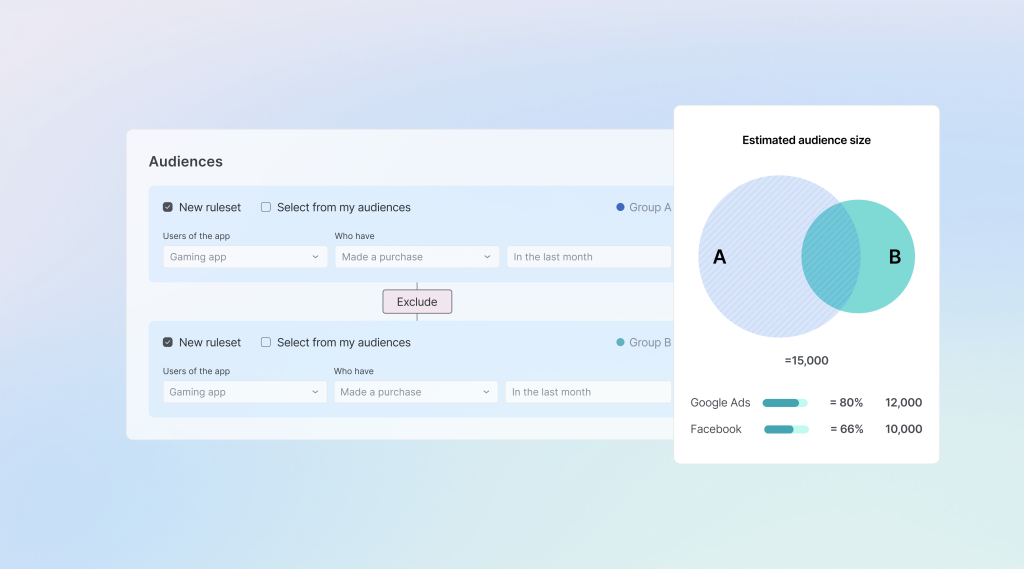
The set-up of any test is both time consuming and resource-draining.
We have seen many experienced BI teams struggling with data preparation; pipelining processes that are required to run such tests; finding users that share similar traits over extended periods of time, randomizing the data into test and control groups; or even building custom API connections with each remarketing network.
With AppsFlyer providing the tools to support the technical side of executing A/B tests, developers are free to invest in creating the organization culture and processes that are required for running effective and scalable testing.

Get the latest marketing news and expert insights delivered to your inbox
Real solutions, real results: AppsFlyer Incrementality success stories
Thousands of brands already make use of AppsFlyer’s Incrementality tool to identify high-performing campaigns and drive ROI. Here we’ll spotlight two use cases and how AppsFlyer is helping them overcome their challenges.
Challenge: High ad spend with minimal return
Without an incrementality solution, marketers run the risk of being unable to differentiate between true remarketing uplift from campaigns, and organic increases. Gaming studio Kabam were seeking to better understand the effects of remarketing ads on the revenue of their hit title Marvel Contest of Champions, and avoid the risks of investing high levels of ad budget with low returns.
Solution: Optimized ad budget allocation via AppsFlyer’s Incrementality tool
Kabam adopted AppsFlyer’s Incrementality solution, and used it to provide incremental measurement of two player groups of Marvel Contest of Champions:
- Paying players who had made a purchase in the last year
- Non-paying players who reached level 15 in the game
Each group was targeted with a remarketing campaign and split into test and control groups automatically. By doing so, Kabam were able to easily identify which campaigns were providing true uplift.
Result: 20% incremental lift in revenue, 4x increase in conversion rate
Kabam learned that their remarketing campaigns were delivering a 20% incremental lift in revenue, with daily reports and aggregated insights showing the incremental lift at every stage. They also learned that non-paying players were four times as likely to make a purchase after seeing a remarketing ad than paying players.
Armed with this knowledge, Kabam were able to apply their campaigns to larger audiences, maximizing revenue from previously non-paying players.
“With the help of AppsFlyer’s Incrementality solution, we were able to uncover critical insights and scale our remarketing efforts with confidence.” – Roz Hajian, Growth Market Product Lead at Kabam
Learn more about how Kabam provide incremental lift with AppsFlyer.
Challenge: Inefficient ad targeting leads to low conversion rates
Food delivery platform Wolt operate in a highly-competitive market, with continuous user engagement being one of the core tenets of their marketing activities. This brought significant challenges in terms of understanding their existing customer base, and what really drives them to action.
Wolt’s marketing team were manually setting up incrementality tests, a process that was inefficient and time-consuming – particularly as they operated in 23 different markets at the time.
Solution: AppsFlyer’s Incrementality tool identifies high-performing segments
Wolt turned to AppsFlyer’s Incrementality tool, enabling them to easily create and analyze incrementality tests in a single dashboard. They halved the time and effort invested in setup and analysis to identify high-performing segments.
Result: 10x growth in remarketing budget
Now able to set accurate benchmarks for existing and future campaigns, Wolt saw significant uplift in remarketing revenue and conversions. The demonstrable effectiveness of these campaigns contributed to a 10x growth in overall remarketing spend across various markets.
“Incrementality is our marketing north-star and AppsFlyer’s solution was key in supporting our growth by enabling incrementality measurement in both existing and new areas of our business.” – Veera Al-Kaila, User Acquisition Lead at Wolt
Find out more about how Wolt are driving incremental growth at scale with AppsFlyer.
Final thoughts
The focus on remarketing has grown dramatically in recent years, across all mobile verticals (shopping being the leader).
With remarketing budgets growing massively, understanding the impact of your remarketing program is necessary for justifying scale.
Additionally, personalization is a key goal for digital marketers today; marketing to specific audiences, controlling how many times users see an ad within that audience, what that message will be, with the notion that those users are constantly moving along the conversion funnel and engaging with different touch-points along the way.
With a people-based attribution approach, the ideal scenario is keeping messaging personalized, coherent, and consistent. Measuring performance in a siloed manner won’t work if we look forward to the future. Naturally, this leads to the importance of understanding the incremental impact across the entirety of your re-engagement program.
Luckily, AppsFlyer is unlocking measurement solutions for incrementality testing in order to help advertisers connect the dots and zero in on what’s truly driving growth.
Check out Part II of Incrementality Testing with AppsFlyer.
Frequently asked questions
Incrementality is a measure of the true value generated by remarketing or re-engagement activity. It identifies any uplift key metrics like installs, purchases or revenue that would not have occurred without your specific remarketing efforts. Through incrementality, marketers can determine which remarketing activity has truly driven results by filtering out organic conversions.
AppsFlyer’s Incrementality tool creates two perfectly matched audience groups: one exposed, and one holdout. The holdout group is automatically excluded from the campaign on the selected media source. The exposed group is included and served ads.
By comparing user activity across these two groups, AppsFlyer’s Incrementality tool reveals any lift that was truly driven by ads, versus what would have happened anyway.
While setting up this kind of A/B test can be time and resource-consuming, AppsFlyer’s Incrementality tool allows marketers to start testing incremental lift right out of the box.
By comparing user activity across these two groups, AppsFlyer’s Incrementality tool reveals any lift that was truly driven by ads, versus what would have happened anyway.
While setting up this kind of A/B test can be time and resource-consuming, AppsFlyer’s Incrementality tool allows marketers to start testing incremental lift right out of the box.
Incrementality tells you whether your campaigns are actually driving acquisitions or conversions.
Without incrementality, you may misattribute conversions like installs or IAPs to campaigns that had no real effect. Incrementality complements attribution, adding a causal lens to the existing picture. It helps marketers move from merely tracking what happened, to understanding what truly made a difference.
Measuring that incremental lift lets you:
– Identify which campaigns truly add value
– Optimize ad spend by cutting non-incremental activities
– Increase overall marketing ROI thanks to data-driven insights
Together, attribution and incrementality give marketers complete visibility. It enables smarter decisions, more efficient investments, and ultimately, stronger growth.
Without incrementality, you may misattribute conversions like installs or IAPs to campaigns that had no real effect. Incrementality complements attribution, adding a causal lens to the existing picture. It helps marketers move from merely tracking what happened, to understanding what truly made a difference.
Measuring that incremental lift lets you:
– Identify which campaigns truly add value
– Optimize ad spend by cutting non-incremental activities
– Increase overall marketing ROI thanks to data-driven insights
Together, attribution and incrementality give marketers complete visibility. It enables smarter decisions, more efficient investments, and ultimately, stronger growth.
AppsFlyer’s Incrementality Tool integrates multiple data layers to produce actionable insight into incremental uplift:
– Audience definitions and control/test splits (from AppsFlyer Audiences)
– Conversion events such as installs, IAPs, or other engagement KPIs
– Impression or reach data from ad networks, when available
– Attribution data for precise lift calculations
Taken together, these data allow AppsFlyer to provide marketers with accurate incremental performance insights.
– Audience definitions and control/test splits (from AppsFlyer Audiences)
– Conversion events such as installs, IAPs, or other engagement KPIs
– Impression or reach data from ad networks, when available
– Attribution data for precise lift calculations
Taken together, these data allow AppsFlyer to provide marketers with accurate incremental performance insights.
Incrementality enables marketers to make better decisions about where and how they invest budget. Using an incrementality tool like AppsFlyer’s helps marketers to:
– Redirect spend from low-impact campaigns to high-lift ones
– Improve targeting accuracy and creative efficiency
– Drive measurable increases in revenue and retention
Brands who work with AppsFlyer have seen up to a 20% incremental lift in revenue as a result of the insights provided through AppsFlyer Incrementality.
– Redirect spend from low-impact campaigns to high-lift ones
– Improve targeting accuracy and creative efficiency
– Drive measurable increases in revenue and retention
Brands who work with AppsFlyer have seen up to a 20% incremental lift in revenue as a result of the insights provided through AppsFlyer Incrementality.
Implementing AppsFlyer’s Incrementality tool requires just a few simple steps, most of which are handled automatically by the tool:
1. Define your hypothesis: what campaign or audience you wish to test for incremental uplift
2. Create audience splits using AppsFlyer Audiences
3. Launch campaigns to the test group while excluding the control group
4. Run the test/control group experiment, with key metrics automatically visible in the tool’s dashboard
5. Analyze, optimize and apply the insights gleaned for future campaigns.
1. Define your hypothesis: what campaign or audience you wish to test for incremental uplift
2. Create audience splits using AppsFlyer Audiences
3. Launch campaigns to the test group while excluding the control group
4. Run the test/control group experiment, with key metrics automatically visible in the tool’s dashboard
5. Analyze, optimize and apply the insights gleaned for future campaigns.
AppsFlyer maintains accuracy and data integrity in its measurement through deterministic attribution and AI-powered predictive modeling. It uses privacy-safe attribution technologies like SKAdNetwork (SKAN) and Google’s Privacy Sandbox to deliver accurate measurement without personal identifiers.
AppsFlyer also includes advanced fraud protection to detect and block ad fraud across every stage of the user journey. By using AI, behavioral modeling and pattern analysis, suspicious activity is flagged in real time as well as post-attribution. This gives marketers clean data and the confidence needed to optimize performance.
AppsFlyer also includes advanced fraud protection to detect and block ad fraud across every stage of the user journey. By using AI, behavioral modeling and pattern analysis, suspicious activity is flagged in real time as well as post-attribution. This gives marketers clean data and the confidence needed to optimize performance.