

The remarketing blind spots you didn’t know you had (and how to fix them)


TL;DR
- Click-only remarketing measurement misses the view-through attributions that increasingly drive re-engagement
- Multiple partners claim credit for the same conversions, with no way to deduplicate
- Fraud blends into legitimate traffic when there’s no independent validation
- The fix is better signals: independent, cross-channel, and fraud-protected
- Without that foundation, remarketing looks like it’s working while efficiency quietly erodes
Most teams assume remarketing measurement is straightforward: measure the click, attribute the conversion, move on. But if you’ve ever looked at your platform-reported numbers and thought “this looks too good,” you’re probably right.
The reality is that remarketing has gotten significantly more complex, and the measurement approach that worked a few years ago now leaves critical gaps. This post walks through what those gaps are, what they cost you, and how to close them.
The gap: clicks tell part of the story. Your budget needs the full one.
Here’s a scenario. A shopping app customer sees a remarketing ad for items left in their cart. They don’t click. Later that evening they visit the brand’s mobile website to browse products, and the next morning they reopen the app and complete the purchase.
Which channel gets credit? In a click-only setup, either nobody does (it looks organic) or the last click from an unrelated touchpoint claims it. The impression and web visit that actually brought the customer back are invisible.
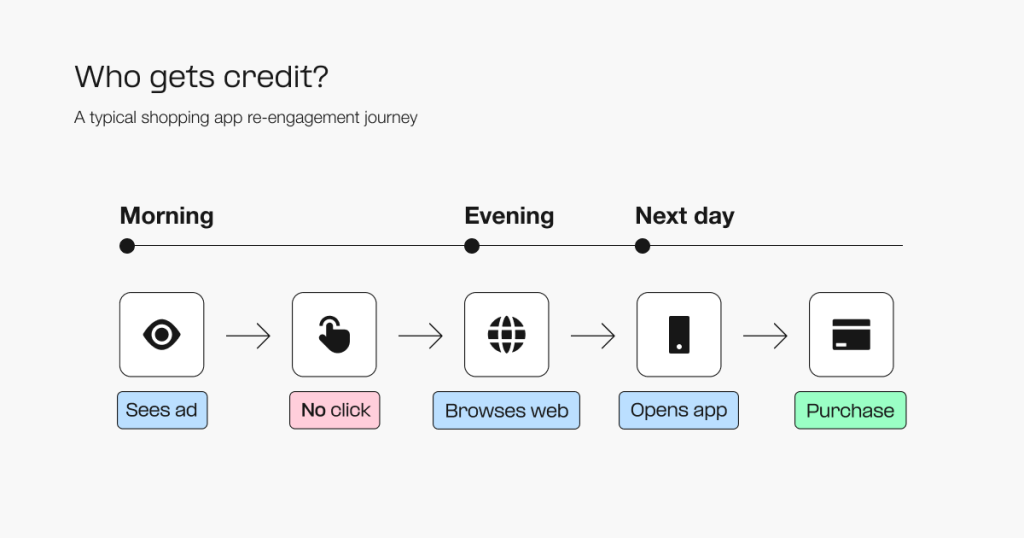
Let’s imagine another scenario: a banking app runs a re-engagement campaign to drive existing customers toward a new credit product. A customer sees the ad on one device, later logs in on another, and eventually applies through the app. Without cross-platform measurement, that entire journey looks like an organic conversion, and the campaign that influenced it gets zero credit.
These aren’t edge cases. In fact, they are becoming the norm for customer journeys that are best characterized by channel hopping. And when your measurement only captures clicks, three things happen:
1) You misallocate the budget. Spend flows to partners that generate clicks, not the ones that generate value. High-CTR, low-impact tactics get rewarded.
2) You overpay. Without deduplication, multiple partners claim credit for the same conversion. You can’t see the overlap, so you can’t fix it.
3) You can’t tell what’s real. Fraud schemes like click flooding, bots, and replayed signals blend right in because every touchpoint looks legitimate when there’s no independent validation.
The tricky part? Your dashboards still look fine. ROAS appears healthy. But the actual efficiency of your spend is eroding underneath. If you take a look from above, you’ll notice that these issues all trace back to the same root problem: fragmented signals. When impressions, clicks, devices, and partners operate in silos, attribution breaks. Fixing remarketing starts with fixing the measurement layer beneath it.
What a complete remarketing measurement foundation looks like
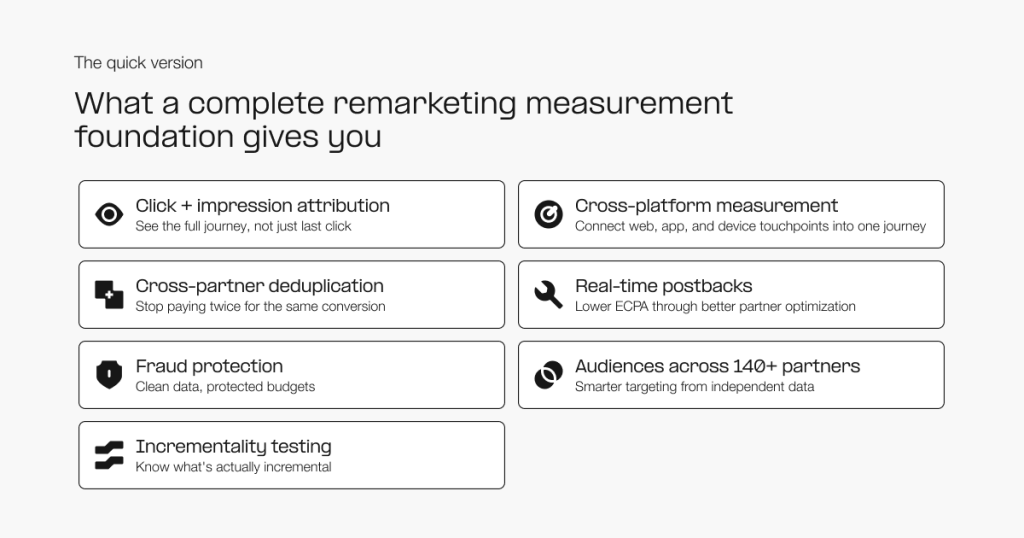
The answer isn’t more dashboards or more data. It’s better signals: independent, cross-channel, fraud-protected, and designed to capture how customers actually behave across web, app, and other devices.
Here’s what this means in practice.
Click and impression attribution, unified
Deep links give you click context, but not the broader impression-led journeys that increasingly shape remarketing outcomes. When a customer sees your ad but doesn’t click, and later converts, that conversion looks organic in a click-only setup. The impression that actually influenced the outcome is invisible, and the campaign that drove it gets no credit. Over time, this means you’re systematically undervaluing the channels and tactics that work through impressions, and overinvesting in the ones that happen to generate clicks.
AppsFlyer fills that gap with unified click-through and view-through attribution: when a conversion follows an impression rather than a click, you can still attribute that influence instead of losing it to “organic.”
For eCommerce, this is especially important. Remarketing accounts for a massive and growing share of marketing-driven conversions in shopping brands (covering paid installs and remarketing conversions). AppsFlyer data shows that shopping apps lead all verticals in remarketing conversion growth, and apps running remarketing campaigns see a 50% higher share of paying users overall. If you’re only measuring clicks, you’re potentially blind to the largest driver of your remarketing performance.
For finance brands, where product consideration spans multiple sessions and devices, view-through attribution captures the influence of ads that a customer saw but didn’t immediately act on, which is often the norm for high-consideration products like loans, credit cards, or investment accounts.
For gaming, the impact is even more measurable. When lapsed players see an ad for a new event or update but don’t click, that impression still influences whether they come back. Without view-through attribution, that influence is invisible, and the campaign looks like it underperformed. Among gaming teams optimizing remarketing with unified click-and-impression signals, AppsFlyer data shows ~20% higher remarketing ROAS, ~60% higher remarketing-driven revenue, and up to 4x ARPU from re-engaged customers.
AppsFlyer also deduplicates claims across partners. When multiple networks report the same conversion, last-touch attribution determines who actually gets credit, giving you one clean picture instead of inflated numbers from every partner.
One source of truth across every partner
When Meta, Google, TikTok, Criteo, and Moloco all report conversions, the numbers won’t add up. They’re each counting from their own perspective, and multiple partners will claim credit for the same outcome. Without a way to resolve these competing claims, you cannot reliably compare partner performance andend up paying for the same conversion more than once.As a result, budget decisions are based on those that report the most impressive numbers, not the ones that actually drove the result.
This is especially painful for teams running across multiple remarketing partners simultaneously, where overlap is the norm, not the exception. AppsFlyer deduplicates these claims and gives you one view: one conversion, one owner.
Real-time postbacks that lower your costs
Your ad partners’ bidding algorithms are only as good as the signals they receive. When those signals are biased, delayed, or incomplete, partners bid inefficiently, and you pay the premium. This is true whether you’re driving repeat purchases in a shopping app, re-engaging dormant banking customers, or reactivating lapsed players. The worse the signal quality, the higher the effective cost per action.
AppsFlyer sends independent, real-time conversion signals (postbacks) back to your ad partners, giving their algorithms cleaner inputs. Better inputs mean better optimization, which translates directly into lower ECPA and less wasted spend.
Fraud protection built for remarketing
Re-engagement campaigns are particularly vulnerable to fraud patterns like click flooding, bot-driven activity, and replayed engagement signals, which distort performance and waste spend.
What this looks like in practice: Say you’re running remarketing campaigns for a shopping app across several partners. One partner’s numbers look great on paper: high click volume, strong attributed conversions. But a closer look reveals that many of those clicks arrived in large bursts, milliseconds apart, with suspiciously uniform patterns.
That scenario describes a click flooding attack: fraudulent clicks are injected at scale to hijack attribution for conversions that would have happened anyway. Without detection, those clicks enter your postbacks, distort your partner optimization signals, and shift budget toward a source that’s generating fake engagement, not real value.
In finance, the stakes can be even higher. Fraudulent re-engagement signals in campaigns promoting high-value products like personal loans or credit cards can inflate performance metrics and lead to budget decisions based on activity that never involved a real customer.
In gaming, where remarketing often runs across multiple ad networks to reactivate lapsed players, click flooding can make one partner appear to drive most of the re-engagements, shifting budget toward a source generating fake clicks rather than genuine player returns.
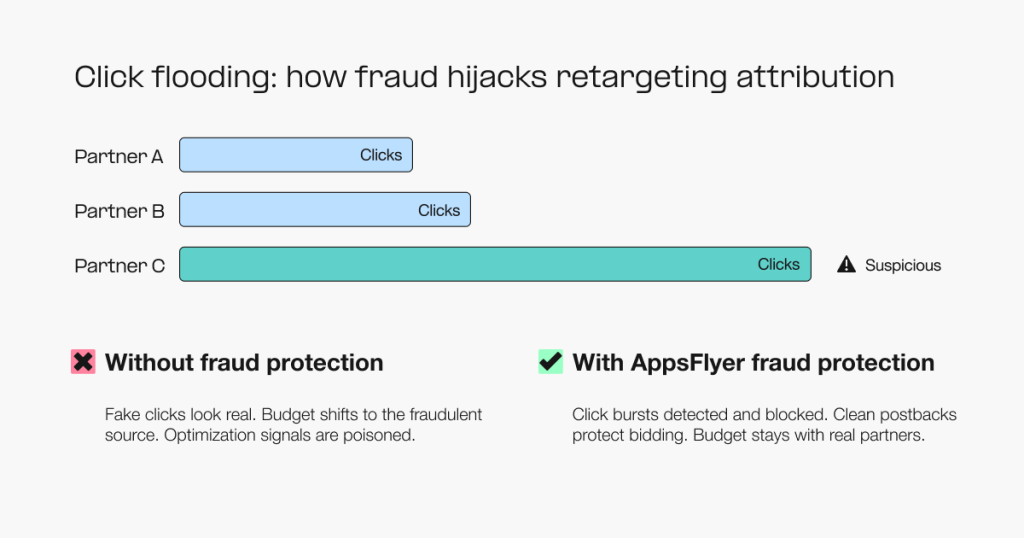
AppsFlyer detects and blocks these patterns using sophisticated AI before they reach attribution or optimization systems, protecting both your budget and the signal quality that everything else depends on.
Audiences built on independent data
Static remarketing lists built on incomplete or single-platform signals waste spend on customers who don’t need to be re-engaged. When your audience segments are based only on what one platform observed, you miss the cross-channel behavior that tells you who’s actually likely to re-engage and who was going to convert anyway.
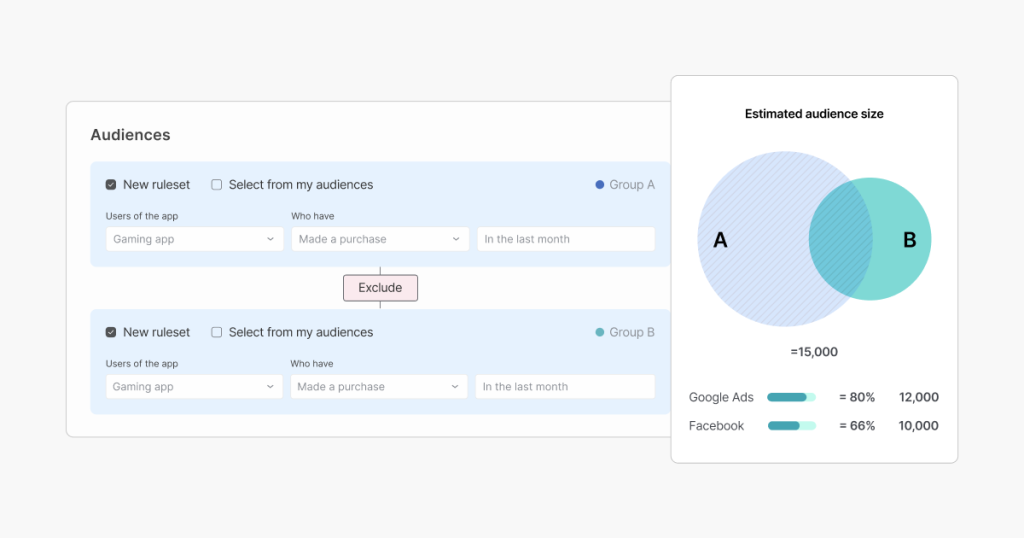
AppsFlyer Audiences lets you build dynamic, behavior-based segments from your measurement data and sync them across 140+ partners (including Meta, Google, TikTok, Criteo, Remerge, and Moloco). This enables targeting based on the real actions customers performed across their full journey, not just what one platform recorded.
For a shopping app, that might mean segmenting customers who browsed on web and added to cart in-app but didn’t purchase, then re-activating that segment across multiple remarketing partners simultaneously. For a banking app, it could mean identifying customers who began a process of loan application but didn’t complete it, and reaching them on the right channel. For a gaming app, it could mean targeting players who haven’t opened the game in 14 days but previously made in-app purchases.
The result is reduced spend on customers who would have converted anyway, and more on the ones who are more likely to engage with a remarketing campaign and convert .
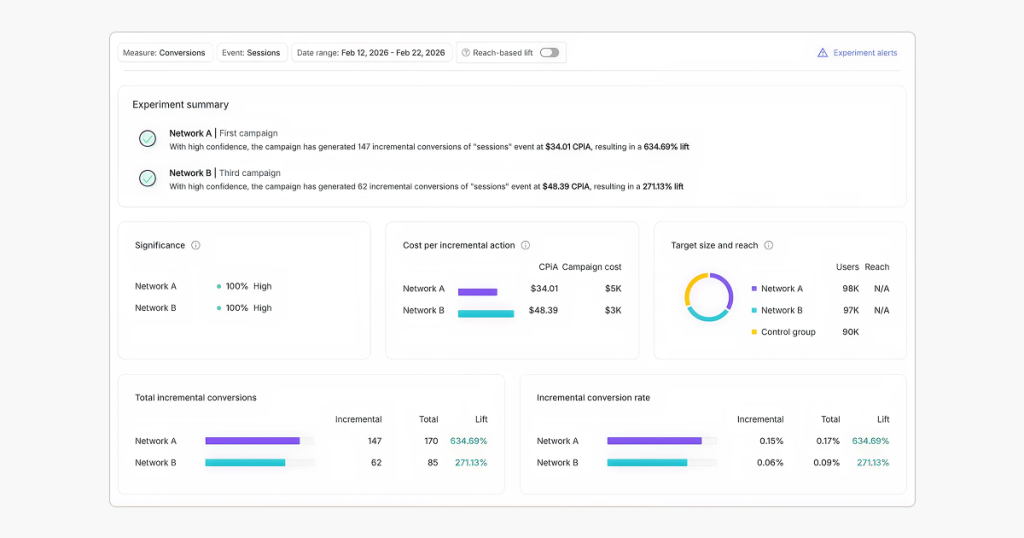
Incrementality: proof, not assumptions
Attribution tells you who converted after seeing an ad. Incrementality tells you whether the ad actually mattered. AppsFlyer’s built-in incrementality measurement isolates true causal lift, distinguishing real contribution from organic actions or inflated last-click claims.
That is the difference between “our remarketing drove 50K conversions” and “our remarketing drove 30K conversions that wouldn’t have happened otherwise.” For eCommerce teams, where remarketing drives a large share of conversions, knowing which of those are truly incremental is the difference between scaling confidently and cannibalizing your own organic traffic.
Coming soon: cross-platform visibility for remarketing journeys
Customers don’t remain in one platform. They constantly move between mobile, web, CTV, and desktop, often within the same day. Without a way to connect those touchpoints, each surface looks like a separate person, and the influence that happens across them is lost. This is one of the biggest remaining blind spots in remarketing measurement, and AppsFlyer is launching cross-platform measurement for remarketing this quarter to close it.
Here’s what this will unlock:
In eCommerce: A customer clicks a remarketing ad on mobile web, browses a few product pages, but doesn’t purchase. Two hours later, they open the app and buy. Today, the web session and the app purchase look like two unrelated events. The remarketing campaign that initiated the journey gets no credit. With cross-platform measurement, both touchpoints are connected and the full path becomes visible.
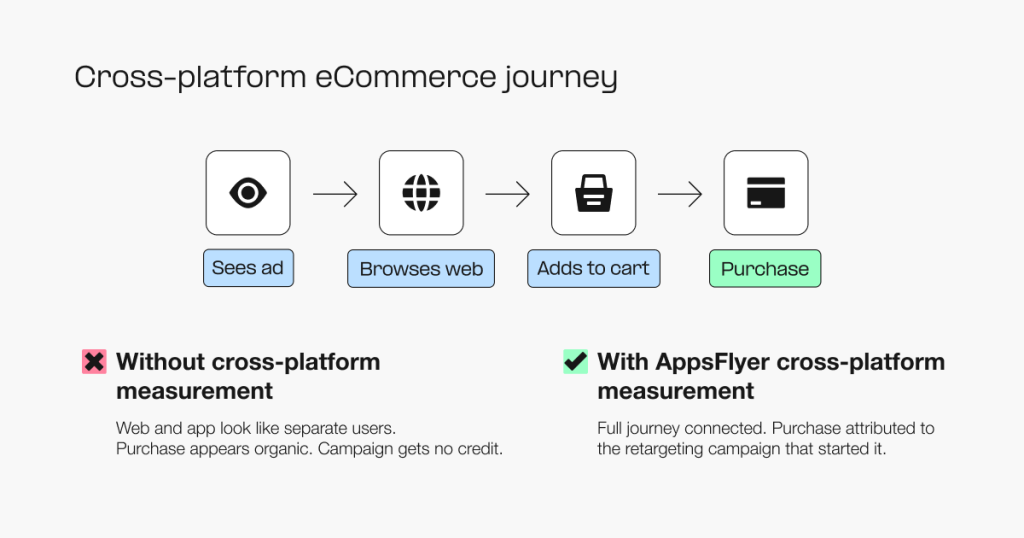
In finance: A customer sees an ad for a new savings account on their phone during their commute. That evening, they log into the banking app on their tablet and open the account. These are the same person on the same journey, but without cross-platform measurement, the campaign looks like it had no impact, and the signup appears unprompted.
In gaming: A lapsed player sees a remarketing ad for a new in-game event on a mobile web page. Later, they reopen the game on their phone or console. Without cross-platform measurement, that ad impression and the return session are disconnected, and the reactivation looks organic.
When these journeys stay invisible, you lose the ability to optimize for what actually works. Cross-platform measurement will turn that blind spot into actionable data.
New ways to see your remarketing value
AppsFlyer is also investing in making remarketing performance easier to see and act on directly in the dashboard.
Two new dashboard templates are now available. The first, Remarketing vs. New Users, enables a side-by-side comparison of remarketing and user acquisition performance KPIs like D1 paying users, conversion rates, and retention. This makes it easy to see and communicate the relative value remarketing delivers compared to acquisition.
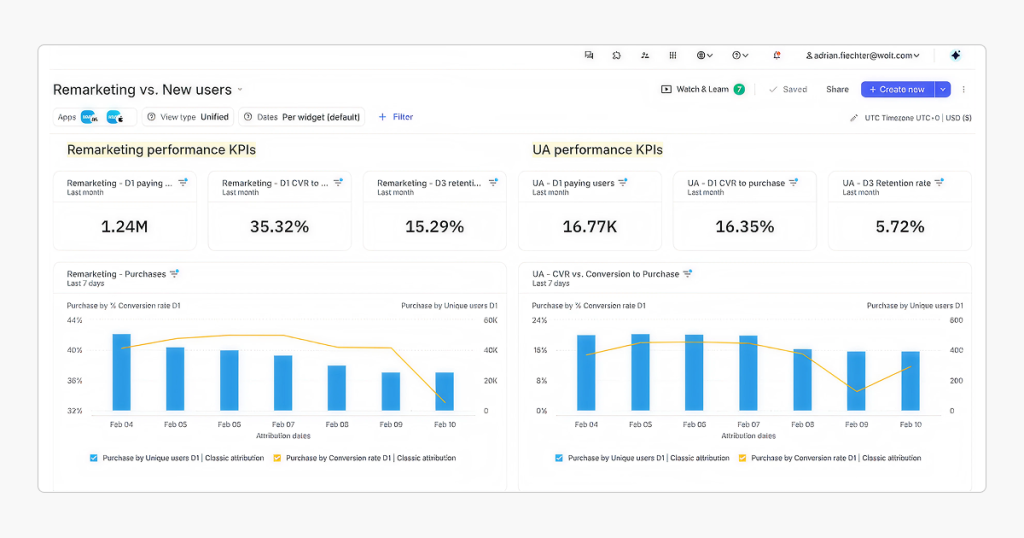
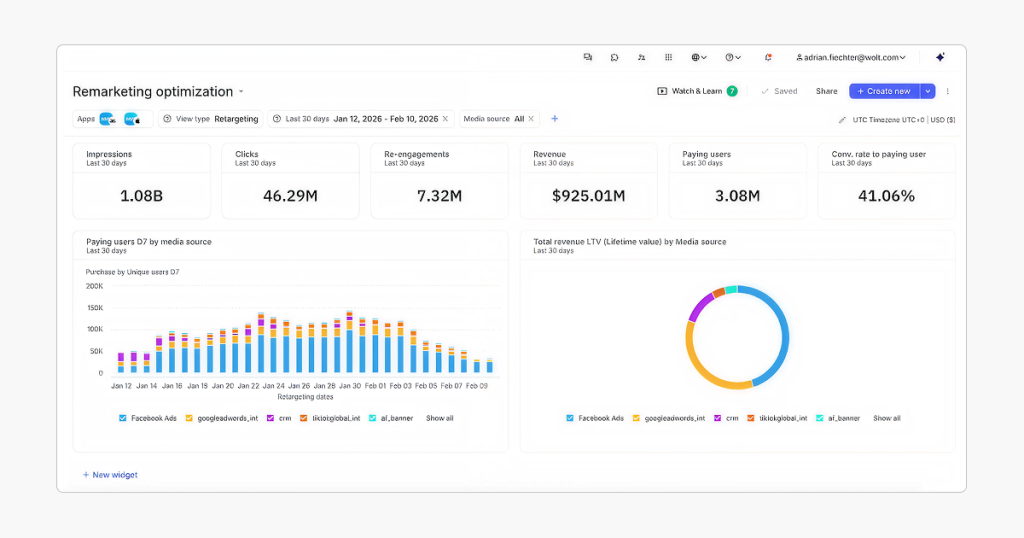
The second, Remarketing Optimization, focuses on the remarketing view with conversion to in-app events and retention metrics broken down by media source, giving you a clear picture of which partners are driving real outcomes.
Looking further ahead, AppsFlyer is building support for cost, impressions, clicks, and activity data within the retargeting view. This will close a gap that has made it harder to calculate true remarketing ROI directly in the platform, and give teams the full picture they need to optimize spend without relying on partner-reported numbers alone.
Key takeaways
Remarketing is one of the most effective growth levers available to eCommerce, finance, and gaming teams. But its effectiveness depends entirely on the quality of the signals behind it. Click-only measurement misses impression-led influence, hides cross-platform journeys, and creates openings for fraud and false credit.
The teams that get the most from their remarketing spend are the ones that invest in an independent, cross-channel measurement foundation, one that shows them what’s really working so they can optimize with confidence and scale without waste.
Elissa Brown, Industry Lead for eCommerce at AppsFlyer, sees this play out with clients regularly: “Remarketing may look like it’s working, but without independent, cross-channel, fraud-protected measurement, you’re crediting clicks instead of real influence and letting efficiency erode without noticing.”
According to Brown,:That’s why proactively educating clients and aligning on remarketing strategy from the start matters so much, including how success will actually be measured. Partnering with the team at AppsFlyer helps make that possible, providing the clarity, validation, and unified measurement foundation needed to drive true performance.”