

5 app entry moments engagement teams in finance can’t afford to break

TL;DR
- In finance, customers enter the app at moments of commitment, not exploration
- Engagement teams own many of the moments that lead customers into the app
- When this transition into the app breaks, customers often don’t retry – and silent failures damage trust long before teams notice
- These failures are often invisible in analytics and misattributed to “low engagement”
- Treating these transitions into the app as intent continuation and a critical part of the user journey – not redirection – changes outcomes
- Teams that ensure their journey into mobile apps is continuous boost engagement , measure granularly for better optimization, and are able to better predict outcomes
App entry is an engagement problem, not a technical one
If you work on CRM, lifecycle, or engagement in a finance or fintech company, you’re responsible for some of the most important moments in the customer journey: account creation and registration, first deposit or first transaction, identity verification and document submission, reviewing statements or required account actions, resuming an application or setup after interruption.
What’s the common denominator? In all of these moments, the customer is trying to continue and complete an action inside the app. They’re not browsing, or experimenting but rather are acting with clear intent.
This continuation is handled by deep linking technology – the infrastructure that ensures that the customer lands in the right place in the app with the right state preserved.
When app entry works, engagement feels effortless. When it doesn’t, customers don’t complain – they disappear.
How can we ensure we deliver effortless engagement? Here are five app entry moments engagement teams in finance can’t afford to break.
1. Account activation and first secure entry
The moment
A customer taps a message to activate their account, complete onboarding, or start using the app for the first time.
Why it matters
This is where intent turns into habit. If activation breaks, many customers never form a relationship with the app at all.
What often goes wrong
- The app opens, but the customer lands on a generic home screen
- Context from the activation message is lost because deep links don’t reliably carry context into the app
- Login interrupts the flow and forces a restart
From the outside, it looks like “customers didn’t activate.” In reality, the journey never continued even if the customer clearly intended to complete the setup.
How to fix it
Treat activation as a continuation of intent. Use deep linking to ensure the app opens directly in the activation or onboarding step the customer was prompted to complete, even if login or verification is required along the way.
2. Secure messages and required account actions
The moment
Customers tap links in emails or SMS messages about statements, alerts, verification steps, or policy updates.
Why it matters
These messages aren’t optional. Customers expect to land on the exact relevant screen, with the right context, so they can immediately take action. .
What often goes wrong
- Messages open the app, but not the specific content referenced
- Authentication breaks the flow
- Measurement shows clicks, but no meaningful in-app action
Engagement teams see high open and click rates, but downstream completion quietly drops.
How to fix it
Deeplink customers from secure messages into the specific in-app screen referenced in the message. Handle authentication as part of the flow so customers can act immediately without re-navigating or searching.
3. Re-engagement after inactivity
The moment
A dormant customer taps a message to check their balance, resume an application, or respond to an offer.
Why it matters
This is often a last chance. Customers who drop here rarely retry.
What often goes wrong
- Customers with the app installed are sent to the app store
- Customers who reinstall or open the app after inactivity aren’t routed correctly because deferred deep linking isn’t handled consistently
- Context from the message isn’t preserved
- The app treats the customer as new instead of returning
Deferred deep linking is what allows customers who don’t yet have the app (or want to reinstall it) to continue where they left off after installation.
While campaign performance may appear to be good, engagement doesn’t recover. In other words, the point of failure sits between the click and the app.
How to fix it
Accurately detect install and user state and prioritize opening the app with preserved context. Returning customers should resume what they were invited to do, not restart from the top.
4. Offline or physical moments to complete actions in the app
The moment
Customers enter the app from the physical world: branch signage, statements, direct mail, ATM screens, or packaging.
Why it matters
These moments represent explicit intent. The customer chose to act, often in a high-trust context.
What often goes wrong
- The app doesn’t open even when installed
- The customer lands in the wrong place
- Links can’t be updated once deployed
These flows rely heavily on deep links that live outside the app and must continue to work long after they’re deployed
Because these campaigns are hard to iterate, teams often stop scaling them altogether after a few bad experiences.
How to fix it
Design offline entry points with the same rigor as digital ones. Ensure links are updateable, governed, and consistently route customers into the correct in-app experience the first time.
5. Login and verification interruptions during sensitive actions
The moment
Customers are interrupted by login or verification and need to resume an action, whether completing an application, initiating a transfer, or going through a setup flow.
Why it matters
Forcing customers to start over after authentication breaks trust and completion.
What often goes wrong
- Context is lost after login
- Customers are dropped at a default screen
- Teams assume “customers abandoned”
In reality, the journey was abandoned for them.
How to fix it
Decouple authentication from intent resolution. After login or verification, return customers to the exact step they were attempting to complete instead of defaulting to a home screen.
The hidden pattern: broken app entry looks like low engagement
Across all five moments, the pattern is the same:
- Engagement teams do everything right
- Messages are timely and relevant
- Customers click with intent
But the transition into the app fails and it often does so silently.
Because these failures happen after the click and before meaningful in-app events, analytics rarely capture them clearly. Teams optimize what they can see, not what’s actually broken.
Questions CRM and lifecycle teams should be asking
If you own lifecycle or engagement performance, these are worth checking:
- When customers enter the app, do they land with the same context they had before?
- How often do customers with the app installed still end up in the app store?
- Can we see what happens between the click and the first in-app action?
- Are resume flows after login preserving intent or forcing restarts?
- Who owns fixing app entry when performance looks fine but engagement drops?
- Do customers who click actually complete the action they were prompted to take?
The real lesson: These are moments of commitment, not “traffic”
Most teams think of app entry as a link, a banner, or a button, but customers don’t.
They’re asking to continue a specific action inside the app, without friction or reset. That requires consistent routing, accurate state detection, and context preservation.
When app entry is handled consistently:
- Engagement increases
- Measurement becomes more trustworthy
- Completion becomes predictable
While AppsFlyer is widely known for user acquisition measurement and attribution, it also offers a dedicated Deep Linking Suite for owned media which does not require a paid media attribution package of any kind.
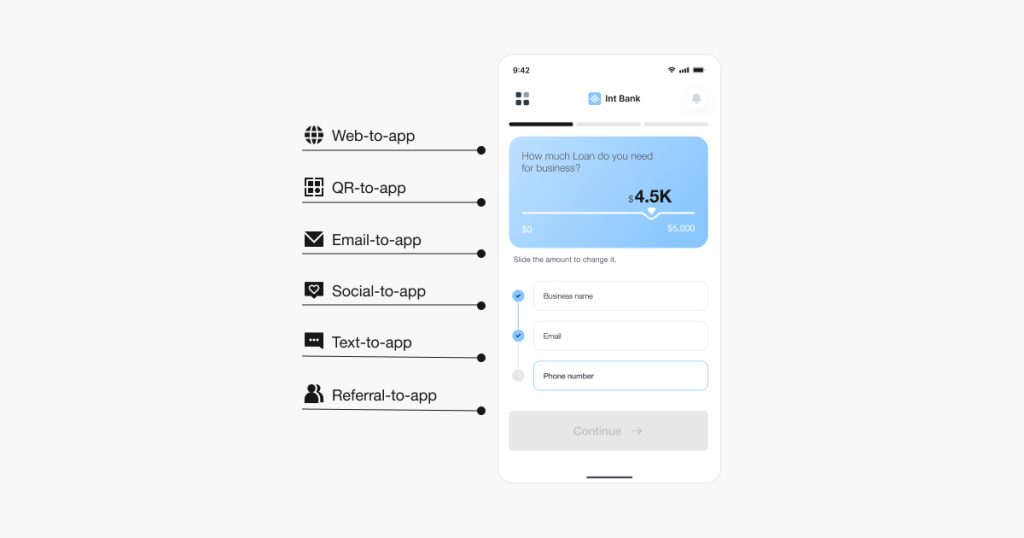
AppsFlyer works with thousands of CRM, lifecycle, growth, and product teams to power reliable X-to-app journeys across web, email, QR, social, SMS, referrals, and deferred install flows, increasing engagement, conversion and overall performance across channels using its OneLink technology.
Key takeaways
- App entry failures often look like low engagement
- Finance customers don’t retry broken entry moments
- Context and state matter more than the channel
- These issues are hard to spot but expensive to ignore
- Treating app entry as intent continuation changes outcomes
- AppsFlyer’s Deep Linking Suite is available for owned media teams.
The teams that get this right don’t just see better engagement numbers – they stop losing customers they already earned, at the moments those customers chose to act. If owned media journeys are a meaningful part of your lifecycle strategy, see how AppsFlyer’s Deep Linking Suite helps teams preserve intent and context across email, SMS, QR, and deferred install flows, without requiring a paid attribution package. Explore the Deep Linking Suite or talk to an expert about your app entry gaps.