

From signals to optimization: how AppsFlyer powers TikTok’s iOS performance


TL;DR
- TikTok iOS campaigns can now be optimized using real-time conversion signals powered by AppsFlyer’s Advanced SRN, rather than relying solely on delayed, limited SKAdNetwork data.
- This gives marketing teams real-time visibility into TikTok performance and enables faster optimization of bids, creatives, and targeting across the funnel.
- Powered by AppsFlyer’s richer data signals beyond SKAN, TikTok gains deeper insight into how users convert, helping brands unlock the full performance potential of their campaigns and optimize results across the funnel.
In performance marketing, every data delay comes at a cost. When insights arrive late or incomplete, opportunities slip away, optimization slows down, and budgets are wasted. For years, Apple’s ATT framework meant that marketers had to rely on delayed, aggregate SKAN data when optimizing iOS campaigns. And while AppsFlyer’s Advanced SRN made manual optimization possible, automated optimization remained out of reach.
That’s no longer the case.
TikTok has introduced iOS Real-Time Conversion Reporting, powered directly by Advanced SRN signals from AppsFlyer. For the first time, TikTok’s iOS optimization engine uses AppsFlyer’s rich, real-time measurement signals to improve bid strategies, guide creative decision-making, and sharpen audience targeting.
How we got here: the evolution of iOS measurement with TikTok
To better understand the impact, let’s explore how far the ecosystem has come.
2021: ATT is introduced
Like the rest of the industry, AppsFlyer and TikTok relied primarily on SKAdNetwork for reporting and optimization. Marketers operated with delayed postbacks and limited visibility.
2023: AppsFlyer pioneers the Advanced SRN solution
For the first time since ATT was introduced, advertisers could see a clearer picture of iOS performance in a privacy-preserving manner through AppsFlyer’s Advanced SRN framework.
However, while AppsFlyer’s probabilistic data improved reporting, optimization remained limited, as it still relied on incomplete and delayed SKAN data and on consented users only, who represent less than half of all installs that can be measured.
2025: TikTok begins optimizing with Advanced SRN signals from AppsFlyer
The real breakthrough came last year when TikTok started using Advanced SRN signals sent by AppsFlyer to power its iOS campaign performance reporting. Covering probabilistic modeling signals for IDFA-less traffic and deterministic signals for consented users meant advertisers could optimize TikTok campaigns based on real-time signals from AppsFlyer — vastly better than relying on delayed SKAN postbacks.
Why this matters: it’s all about the signals
TikTok’s new iOS Real-Time Conversion Reporting surfaces AppsFlyer’s attribution data directly inside TikTok Ads Manager. This includes:
- Probabilistic modeling for ID-less traffic
- Deterministic attribution for dual-consented users
- Enriched engagement metrics (such as engaged views, engaged clicks)
- Granular cross-channel measurement beyond SKAN
These critical signals allow TikTok’s optimization engine to learn, react, and perform far more effectively, directly improving campaign results.
“Better signals drive better outcomes. When advertisers have access to high-quality measurement and privacy-safe signals, they can improve return on ad spend, networks optimize performance, and users benefit from more relevant, meaningful experiences from brands.”
Deep Shah, Global Head of AdTech Partnerships – Measurement, Data, Retail Media, TikTok
How to get started with the new optimization method
To allow TikTok to receive the Advanced SRN signals required for real-time optimization, advertisers must adjust a simple setting in AppsFlyer: The TikTok Advanced Privacy toggle must be turned OFF.
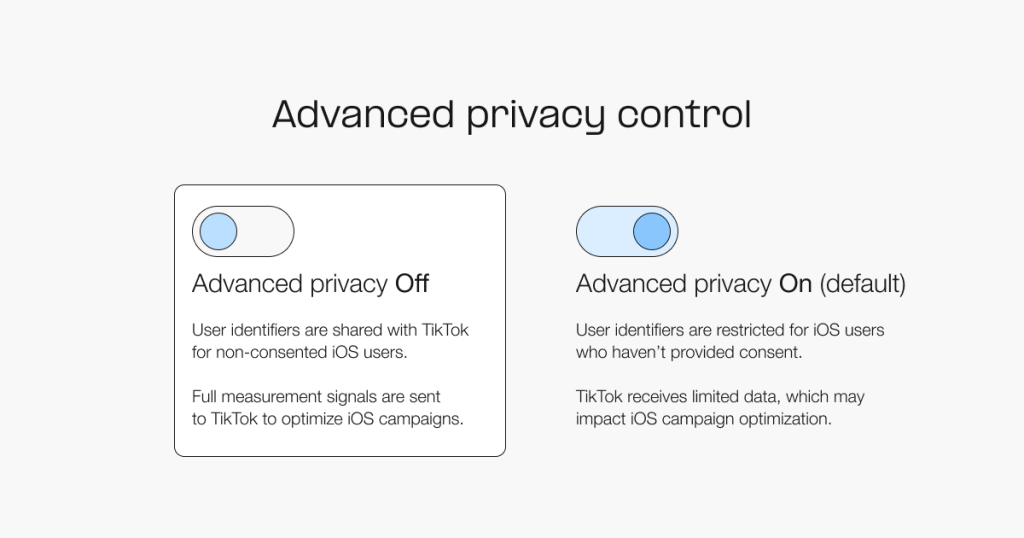
This step ensures the real-time deterministic and probabilistic signals are sent to TikTok, enabling the new optimization method.
Why the numbers don’t match, and why they shouldn’t
In the TikTok Ads Manager dashboard, SKAdNetwork (SKAN) Conversions appear alongside the iOS Real-Time Conversions metric. Discrepancies between the two are expected. There are several reasons for these differences, including reporting delays, limited engagement types, partial measurement scope, and fixed attribution windows.
While both provide valuable insights, they’re built on different attribution methodologies. SKAN provides a solid framework for aggregate app measurement, but falls short in data freshness, campaign-level granularity, and optimization capabilities — areas where the AppsFlyer–TikTok integration delivers deeper, more actionable insights. These two systems aren’t meant to match, but rather, to complement one another.
Unifying signals with Single Source of Truth (SSOT)
Having SKAN and iOS Real-Time Reporting side by side in TikTok Ads Manager is a major advantage, but one challenge remains: the data isn’t deduplicated.
Some conversions are measured by both AppsFlyer and SKAN, and may appear twice across different reporting views — once through real-time iOS AppsFlyer attribution, and again from the delayed, aggregated SKAN postback. This overlap makes it challenging to get a clear and unified view of performance.
AppsFlyer’s Single Source of Truth (SSOT) solves this by deduplicating signals across both attribution methods. With SSOT, advertisers gain a unified and reliable view of performance, enabling them to overcome data fragmentation.
Optimization is the name of the game
Since launching our first-to-market Advanced SRN integration with TikTok, AppsFlyer has been the driving force of privacy-centric iOS measurement. Advanced SRN has become the standard model adopted across the ecosystem, laying the foundation for more accurate and privacy-safe attribution. That groundwork now powers TikTok’s new optimization method.
As Charles Perrot, COO at AI Music MWM, put it: “With AppsFlyer and TikTok’s Advanced SRN integration, we immediately know if a campaign is performing, allowing us to be very responsive.”
This responsiveness is built directly into TikTok’s optimization engine. When AppsFlyer powers the signals, and TikTok optimizes with them, the picture is complete, and advertisers finally gain the real-time, granular optimization they’ve been waiting for on iOS.
Key takeaways
- Enable real-time optimization: To fully benefit from iOS Real-Time Conversion Reporting, your Advanced Privacy (AP) toggle for TikTok in AppsFlyer must be turned off. This allows TikTok to receive real-time signals enabling faster optimization based on live data.
- Expect differences in reporting: AppsFlyer and TikTok attribution data are not meant to match SKAN results, and the two reports aren’t directly comparable. Instead, they’re designed to complement each other.
- Unify performance with SSOT: For a clear, unified view of performance, AppsFlyer’s Single Source of Truth (SSOT) brings SKAN and real-time signals together, deduplicating conversions and unlocking truly actionable insights at scale.