Performance issues identified and resolved before they compound into revenue loss, including KPI drops invisible at the top-level dashboard
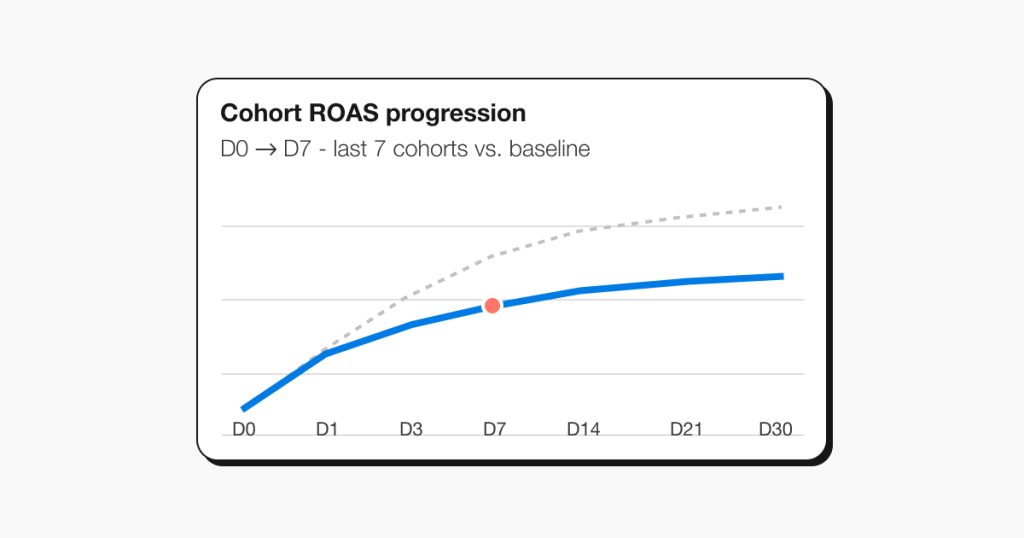
Cohort ROAS progression analysis completed daily across all titles, a task the team could not do consistently by hand at this scale
UA managers focused on decisions, not on manually pulling and interpreting data across platforms
Overview
Supersonic Studios, Unity’s mobile publishing arm, has grown its game portfolio significantly over the past several years. More titles, more campaigns, more data sources, and more daily signals than any team can reasonably measure by hand.
As the portfolio scaled, manual monitoring simply could not keep pace. The volume made complete coverage impossible, and opportunities were missed not because of any lack of skill, but because the data was moving faster than people.
Today, Supersonic’s growth team gets ahead of performance signals faster, runs cohort comparisons with the depth and frequency manual work cannot match, and gets answers from their data in minutes rather than hours. The shift did not come from working harder. It came from connecting AppsFlyer’s data to AI tools and letting those tools handle the work that does not require a human judgment call.
Background
Supersonic’s growth team measures attribution, campaign cost, and in-game revenue across a portfolio that keeps expanding. Core KPIs include installs, cost per install, and ROAS at cohort days D0, D1, D3, D7, D14, and D30, alongside in-game revenue and predictions.
The challenge with these metrics is not knowing what to record or measure. It is keeping up with all of them, across all campaigns, every single day, and still having time to act on what you find.
Product Manager AI and AutomationOfer Regev joined Supersonic five or six years ago, when the portfolio was smaller and the team could handle the data volume with standard BI tools. He has watched the scale change what is and is not possible manually, and has spent the last few years building AI into the growth workflow to close that gap. You can learn more about this use case in the following webinar:
The challenge
As Supersonic’s portfolio grew, the manual monitoring approach hit its limits. UA managers were going campaign by campaign, manually checking KPIs across multiple data sources, and trying to compare against historical benchmarks. The process was thorough in intent but impossible to complete fully at scale.
“Before having an AI assistant or smart AI alerts, our UA manager was going over the campaign data in our dedicated UI, checking the KPIs for each and every data source, from cost, to revenue and predictions. We have had cases where something went wrong in a specific game or campaign, and it took us some time to find out, because going through so many breakdowns on a daily basis is super hard, and we missed a lot of cases.” Ofer Regev, Product Manager AI and Automation, Supersonic Studios
Two specific situations made this especially difficult:
Issues that were not visible at the top line. If a game’s overall revenue was stable, nothing would raise a flag, even if a specific campaign, geo, or KPI was shifting underneath. The signal was in the data, but it required drilling through multiple layers of breakdowns to find it, which no one had time to do across every title, every day.
Cohort progression analysis required more time than was available. Supersonic does not just measure a single ROAS number. They monitor the shape of the cohort curve: how ROAS progresses from D0 to D1 to D3 to D7, and whether that trajectory matches the historical pattern for that title and campaign. A cohort with D1 ROAS of 10% and D3 ROAS of 16%, when the historical norm is 22% at D3, is already signaling a problem even if D0 looked healthy. Spotting that pattern change, across every active title and campaign, manually, every day, was not realistic.
What changed
Getting answers in minutes, not hours
One of the first changes was eliminating the gap between having a question and getting an answer. Using the AI Assistant to ask any question on their data, and then working with additional data sources, connected to AppsFlyer data via MCP. Supersonic’s team can now ask questions about their campaign performance in plain language and get a structured, accurate response, without opening a dashboard or building a report.
A practical example: a UA manager needs a performance summary of top campaigns, including ROAS, ready for a stakeholder update. Before, that meant pulling data from multiple sources, formatting it, and writing the narrative. Now they ask the AI Assistant directly and get a clear, ready-to-use summary in minutes.
“What would have taken maybe a few hours to pull manually, you can just ask the AI and get it in two minutes or less. It just pulls it so you can present it on time.”
That time moves from preparation back into actual analysis and decision-making.
Catching performance issues before they hit revenue
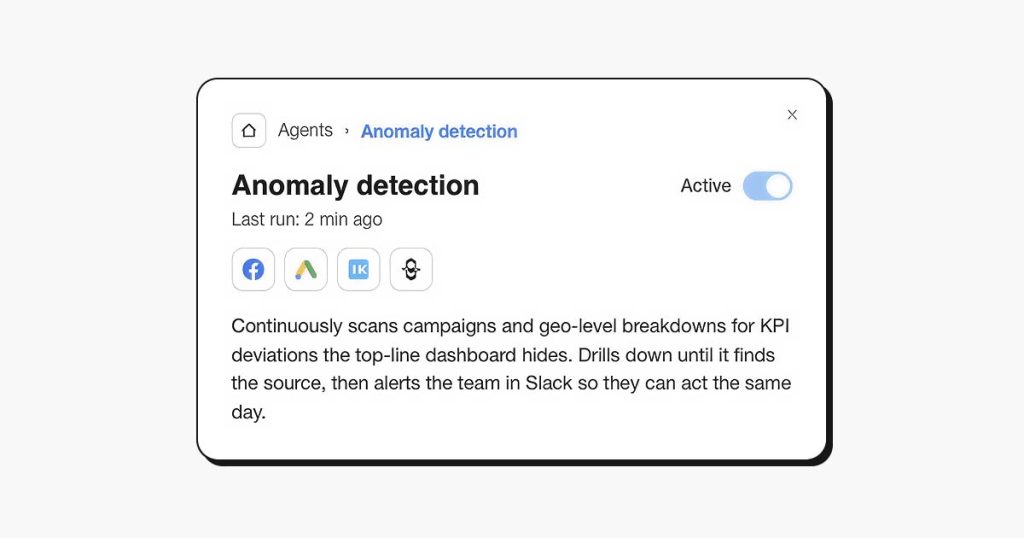
The most significant outcome for Supersonic has been getting ahead of performance problems early. Using Agent Hub, anomaly detection agents run continuously on specific campaigns, checking for deviations from expected patterns across campaigns and geo-level breakdowns, not just top-line KPIs.
A real example: a game experienced a performance drop caused by an in-game change. The overall revenue had not shifted dramatically enough to appear on a dashboard. An anomaly detection agent caught the deviation at a deeper KPI level and sent a Slack alert with the specifics. The team investigated and resolved it the same day. Without the agent drilling through the data automatically, that signal would not have surfaced until the top-line numbers confirmed it, days later.
“We had an agent running on that game. It found the core of the issue and just showed, in a simple alert, that something happened, and now the human can take that and act on it. It was overlooked because it was not the main KPI and was not seen clearly on the dashboard. But the agent drilled down again and again until it found the issue.” Ofer Regev
“Having something do that for us and alert us when something happens is gold. We have the ability to act really fast and avoid revenue loss.” Ofer Regev
Daily cohort analysis at a depth manual work cannot reach
The second major outcome is cohort monitoring at a frequency and depth the team could not previously sustain. Checking whether the ROAS curve from D0 to D7 follows its historical pattern, and flagging when the shape changes, not just when an end number looks low.
A concrete example: if D0 ROAS is stable but the progression to D3 is lagging behind prior cohorts for the same channel, that is an early signal worth acting on before D7 confirms it. An agent identifies that deviation and sends a Slack alert with the context the UA manager needs, which campaign, which game, what changed, and what prior cohorts looked like for comparison.
“Our growth managers today are looking at cohort progress in a 3-dimensional way. Is our D0 ROAS stable compared to previous cohort dates? Is the ROAS progression from Dx to Dy stable? If one or two change, what will that mean for the later cohorts? Doing this on a daily, weekly, or monthly basis is hard and complex, so having an agent running these comparisons every day is gold for us.” Ofer Regev
What made it work: getting the data right first
Before these results were possible, Supersonic had to solve a data problem. Early experiments with raw data fed directly to an AI produced unreliable outputs. Raw data carries inconsistent field names, overlapping revenue dimensions, and ambiguous calculations. When the LLM interprets those incorrectly, it produces numbers the team does not recognize, and trust disappears quickly.
Supersonic’s solution was to pre-aggregate data for each specific use case on the BI side before passing it to the AI. The LLM receives something precise and scoped, with fewer places to go wrong, and the outputs match what the team already sees in their own dashboards.
“We eventually found out that it is much more accurate if you calculate the data on the BI side and provide the LLM with aggregated, consumed data rather than raw data. If you want people to trust AI, they need to see the same numbers they already know, and understand why the LLM recommended something, with actual numbers to support it.” Ofer Regev
What’s next: understanding why creatives win
With monitoring and cohort analysis running reliably, Supersonic is now turning attention to creative intelligence. The question they are exploring is not just which creatives performed well, but why. What was in the scene? What emotion or motivation drove the conversion? Using AI to analyze creative patterns across campaigns, the goal is to produce smarter next iterations faster, using signals from winning ads to inform what gets built next.
The bottom line
Supersonic’s results came from a deliberate approach: identify the workflow that is most painful to repeat at scale, get the data structured correctly for that specific use case, and start with one agent before expanding. Not AI for everything at once.
“Whatever the most common task is that is the most difficult to repeat, I would start there. Use AI to solve the problems you have today.” Ofer Regev, Supersonic Studios
We currently offer demos only to businesses evaluating AppsFlyer for their own apps. However, there’s always tomorrow - and we’d be happy to help you build your AppsFlyer expertise to better support your future clients.
To learn more about our Agencies program or for general inquiries, feel free to reach out to us at [email protected].
Are you already an integrated partner with AppsFlyer?
For any question, please sign in to your existing AppsFlyer account and go to Help → Contact our team
We appreciate your interest in becoming an AppsFlyer partner. In order to begin the integration process, you must be referred by an existing AppsFlyer customer via our platform. If you'd like to start the process, please reach out to your customer and kindly request to receive an invite link. You can find additional resources in our Help Center.
This site is protected by reCAPTCHA and the Google Privacy Policy and Terms of Service apply.
3/3
Meet your AppsFlyer expert
Based on your needs, we've matched you with the right AppsFlyer expert. Book a 15-minute discovery call to discuss your goals and schedule your personalized demo
Thanks for reaching out! 🎉
We can't wait to show you around and learn more about your goals and challenges.
In the meantime, here are two great ways to learn more about AppsFlyer: