How to Measure the Full Impact of eCommerce App Remarketing


Re-engagement is working for most eCommerce teams. The harder problem is proving where the value shows up — in the app, on the web, in repeat purchases, and sometimes in-store.
AppsFlyer’s 2026 eCommerce report found that 92% of iOS ad spend now flows to remarketing, up from 77% a year earlier. That budget is moving because existing customers convert. But most teams are still measuring only a fraction of what that spend actually drives.
TL;DR
- iOS remarketing now accounts for 92% of all eCommerce ad spend — up from 77% in 2025
- Android re-engagement drives a 231% conversion uplift in the US; iOS drives 118%
- Most eCommerce apps capture less than a third of their total app-influenced revenue in reporting
- The fix is measurement scope, not campaign strategy — this article covers what to measure and how
Why are ecommerce marketers spending more on iOS remarketing?
The shift in budget allocation is not a short-term trend. It reflects a broader change in how ecommerce apps are growing.
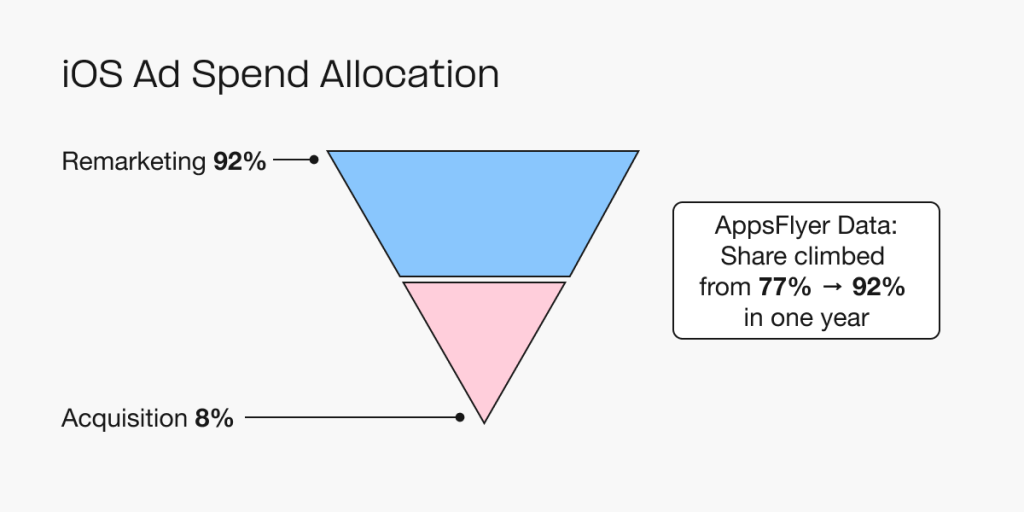
In March 2026, remarketing reached 92% of iOS ecommerce app ad spend in AppsFlyer’s dataset. Paid acquisition has become more expensive and more competitive, pushing ecommerce teams to focus on customers they already know and understand.
In the US, iOS user acquisition spend fell 57% year-over-year in Q4 as China-based advertisers reduced spending activity. The result is a market where remarketing increasingly serves as the primary growth engine.
What we’re seeing is not a replacement of acquisition, but a rebalancing of priorities. Brands still need new customers. However, existing customers often represent the fastest path to incremental revenue when acquisition costs rise.
Our recommendation: Continue investing in acquisition, but make sure your remarketing measurement is sophisticated enough to capture value across channels. The more budget shifts toward retention and re-engagement, the more important complete measurement becomes.
How do you calculate the value of a re-engaged customer?
You cannot measure re-engagement through in-app sales alone.
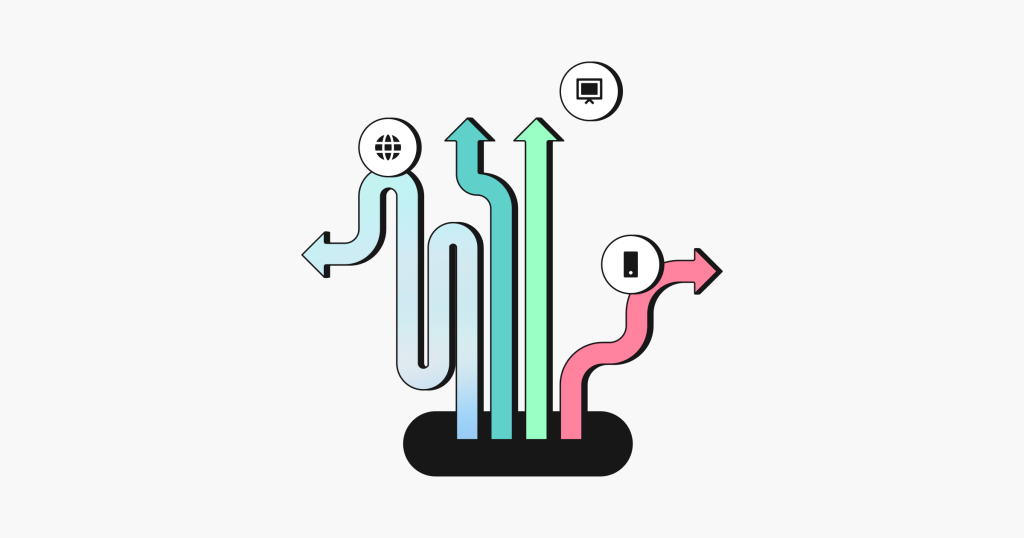
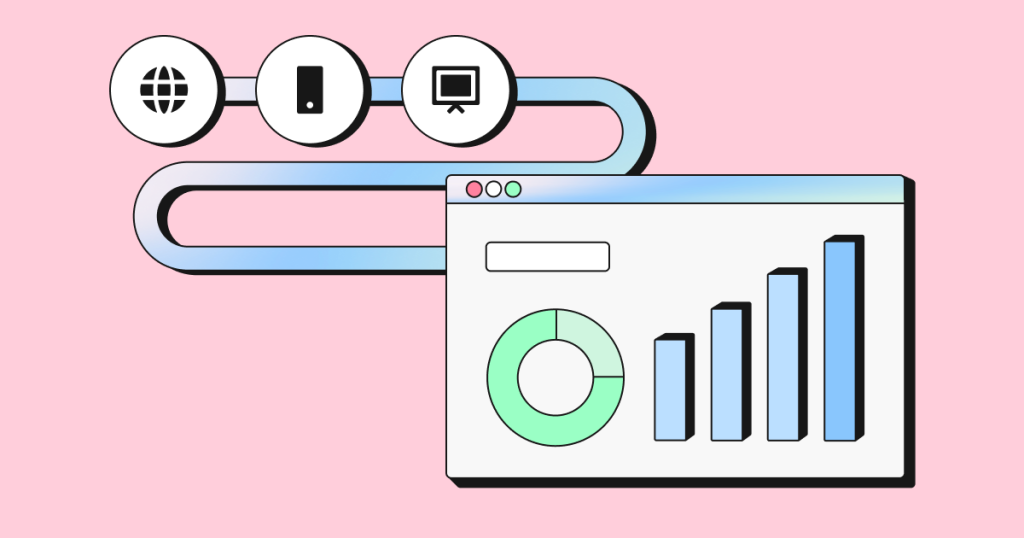
For many ecommerce brands, a significant portion of app-driven value happens outside the app itself. Customers may browse in-app and purchase on the web. They may engage with a push notification and later buy in-store. They may increase purchase frequency over time after a successful re-engagement campaign.
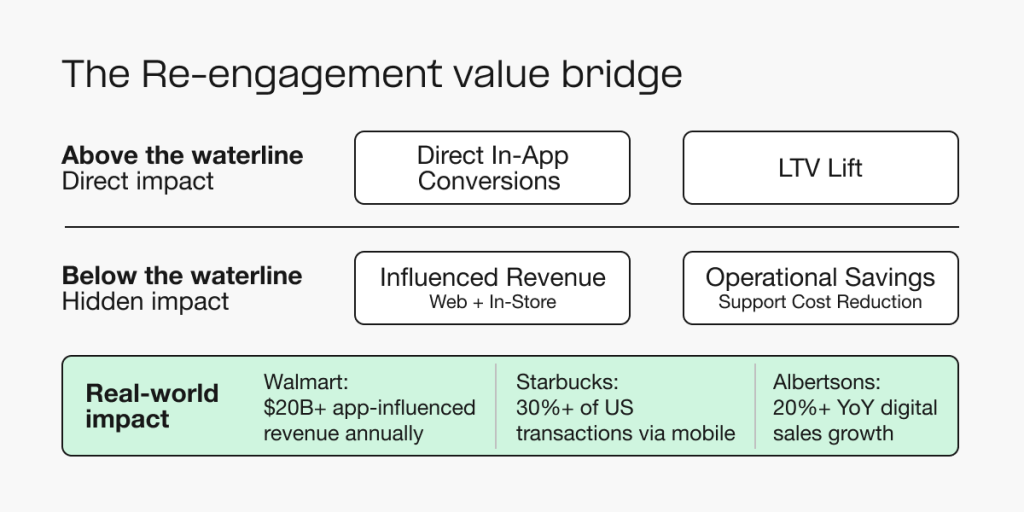
We call this the Re-engagement Value Bridge: a framework for connecting direct app interactions to broader business outcomes.
The Re-engagement Value Bridge consists of four pillars:
- Direct in-app conversions: Purchases made immediately after a re-engagement click.
- Influenced revenue: Web purchases or in-store transactions influenced by app engagement.
- Lifetime value (LTV) lift: Increased spending frequency from re-engaged customers.
- Operational savings: Reduced service costs when customers self-serve through the app.
Re-engagement Impact in Practice
App Re-engagement Success Stories
| Brand | Metric | Business impact |
|---|---|---|
| Walmart | App-influenced revenue | $20B+ annually |
| Starbucks | Mobile order share | 30%+ of US transactions |
| Albertsons | Digital sales growth | 20%+ YoY for 8 quarters |
Walmart attributes more than $20 billion in app-influenced revenue by connecting customer activity across touchpoints. Starbucks uses its app to drive both loyalty and store transactions. In both cases, the app’s impact extends well beyond direct mobile purchases.
Our recommendation: Start by measuring influenced web purchases and loyalty-linked in-store transactions. For many ecommerce teams, those signals reveal significantly more value than in-app revenue alone.
Why should you invest more in Android than iOS for remarketing?
Platform differences can significantly affect remarketing performance.
AppsFlyer’s data shows that remarketing increases Android install-to-purchase conversion rates by 231% in the US. Globally, the uplift reaches 177% on Android compared with 118% on iOS.
One reason is that Android audiences tend to be broader and more varied. Many shoppers require additional engagement before completing a purchase. On iOS, customers often arrive with stronger purchase intent and may convert with fewer touchpoints.
This is also why install growth alone can be misleading. India, for example, saw strong install growth while losing consumer spend share. The takeaway is not that the market is weak. Rather, install volume by itself does not always reflect commercial value.
What matters is understanding which segments respond most effectively to remarketing and where additional engagement creates measurable business outcomes.
Our recommendation: Evaluate remarketing performance by conversion lift and revenue impact—not install volume alone. Markets with strong re-engagement performance may deserve more investment than top-line growth metrics suggest.
How can you protect your remarketing budget from fraud?
As remarketing budgets grow, fraud increasingly follows high-value traffic.
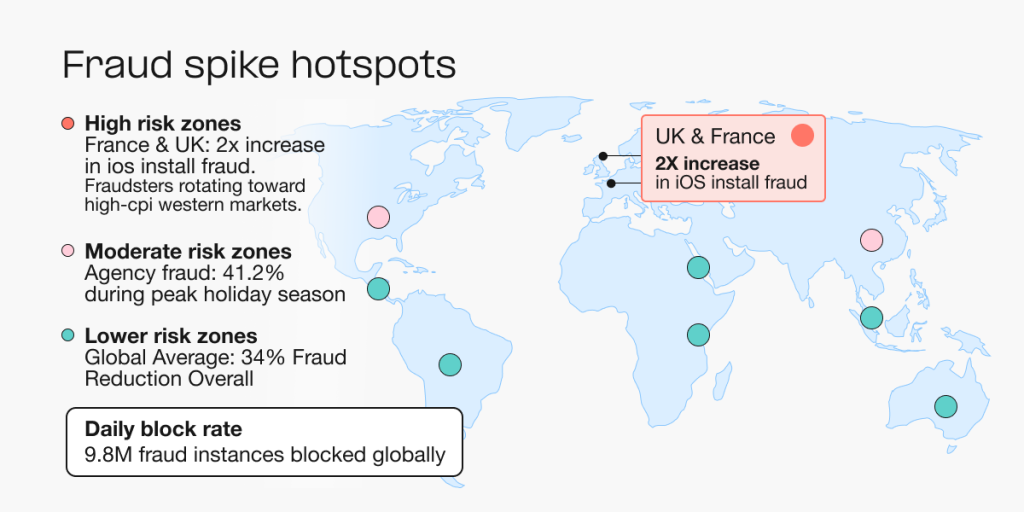
AppsFlyer’s data found that iOS install fraud doubled in France and the UK. At the same time, global fraud rates declined by 34%. This suggests that fraudsters are becoming more selective, concentrating efforts in markets where successful attacks generate larger payouts.
Agency fraud also reached 41.2% during peak holiday periods, highlighting how seasonal demand can create additional risk.
For marketers, the challenge is that fraudulent engagement often appears legitimate. Inflated engagement metrics can create the illusion of strong performance while quietly reducing actual return on investment.
This is where fraud prevention becomes part of the measurement workflow. Before increasing spend, compare traffic quality across sources, markets, and campaigns. Pay particular attention during seasonal peaks when fraud activity is more likely to increase.
AppsFlyer blocks 9.8 million fraudulent events every day, helping marketers identify performance that is real versus performance that only appears successful on paper.
Our recommendation: Treat fraud monitoring as an ongoing optimization process, not a one-time validation step. As remarketing budgets increase, validating traffic quality becomes just as important as measuring conversion performance.
What do ecommerce marketers get wrong when measuring app re-engagement?
One of the most common mistakes is evaluating app performance through direct in-app revenue alone.
AppsFlyer research suggests that apps can influence 35-55% of enterprise revenue, yet many organizations still focus primarily on last-click attribution. As a result, remarketing campaigns often appear less valuable than they actually are.
When influenced purchases are excluded from measurement, teams risk underinvesting in campaigns that are driving revenue across web, loyalty, and physical store channels.
Based on what we’re seeing across ecommerce apps, we would encourage marketers to think about the app as the connective layer across the customer journey rather than as a standalone channel.
Connecting in-store activity, loyalty interactions, and app engagement creates a more complete view of customer behavior and campaign performance.
Our recommendation: Expand measurement beyond direct app revenue and build visibility into influenced purchases wherever possible. The teams that can connect those signals are often the ones making more confident investment decisions.
Key takeaway
The takeaway is not that ecommerce brands should stop acquiring new customers. Acquisition remains essential for long-term growth.
What has changed is the importance of measuring remarketing correctly.
As acquisition becomes more expensive and competitive, ecommerce teams need a more complete view of how remarketing influences purchases across channels—not just inside the app. The brands that can connect those signals will be better positioned to allocate budget, prove ROI, and scale efficiently.
For additional benchmarks and market trends, read the full AppsFlyer 2026 State of eCommerce App Marketing report.
Frequently Asked Questions
You can measure offline impact by connecting digital identifiers to in-store transactions through loyalty programs, QR codes, customer accounts, and attribution tools. This helps reveal influenced revenue that traditional app-only reporting often misses.
Yes, but effectiveness depends on the quality of your first-party data and measurement setup. AppsFlyer’s ecommerce data shows iOS remarketing spend rising sharply, which makes accurate measurement more important.
In AppsFlyer’s ecommerce dataset, Android remarketing was associated with a 177% global lift in install-to-purchase conversion, while iOS saw a 118% lift. Treat these as benchmarks to compare against, not guaranteed outcomes.
The takeaway is not that ecommerce brands should stop acquiring new customers. Acquisition remains essential for long-term growth.
The takeaway is not that ecommerce brands should stop acquiring new customers. Acquisition remains essential for long-term growth.
As acquisition becomes more expensive and competitive, ecommerce teams need a more complete view of how remarketing influences purchases across channels—not just inside the app. The brands that can connect those signals will be better positioned to allocate budget, prove ROI, and scale efficiently.
See how AppsFlyer’s cross-platform measurement platform helps you prove the full impact of your remarketing investment.
See how AppsFlyer’s cross-platform measurement platform helps you prove the full impact of your remarketing investment.