If you’re a marketer, it’s unlikely you’ve managed to avoid a conversation in the past few months where “Data Clean Room“ was not brought up at least once, and usually in an excited yet slightly confused tone.
What is this strange, hygienic chamber of data everyone’s talking about?
Some refer to data clean rooms as “the Switzerland of data”, and rightfully so, because it offers a neutral, safe space for 1st-party user data to be leveraged collaboratively. In a data clean room environment, two parties can securely share and analyze data with full control of how, where, and when that data can be used.
In this way, brands are given access to much-needed data, but in a regulatory compliant space that doesn’t violate consumers’ privacy. While user level data goes into the data clean room, aggregated insights come out in a co-mingled audience group called a cohort.
So, to get you well equipped for 2022, we’re going to take you on a journey through thick forests of unknowns and deep lakes of 1st-party data, in a guide entirely dedicated to the topic of data clean rooms.
By the end of which you’re going to know all about what they are, how they work, why marketers need them, and how they’re going to dramatically affect our ability to measure campaigns in the years to come.
But before we do, let’s begin with the story that actually led us all to this point.

What are data clean rooms?
It’s evolution, baby
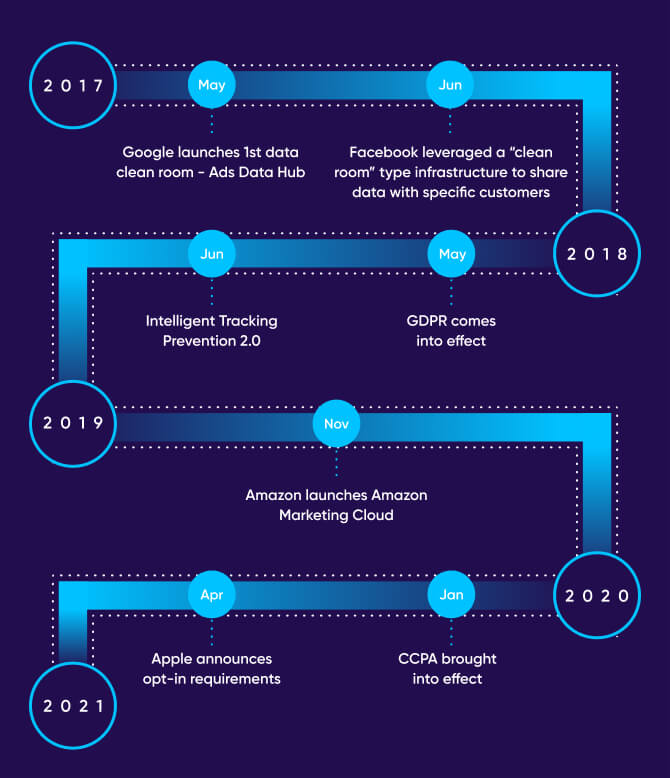
Despite its resurgence in the past year, data clean rooms as an infrastructural concept have actually been around for a few years now.
Google was not the first to coin the term, but it was the first company to commercialize a data clean room solution, launching its Ads Data Hub in 2017. The goal was to create a secure and private environment for enriching their 1st-party data (from CRMs, CDPs, event logs, etc.) with user level data contained within Google’s ecosystem, after which it could be leveraged for Google campaigns.
A mere month later, Facebook announced its own data clean room offering for the purpose of sharing data with its customers. A coincidence? Probably not.
But it was 2018 that truly set off the starter pistol of the user privacy era, with legislation such as the GDPR and Apple’s Intelligent Tracking Prevention 2.0 becoming the new privacy sheriffs in town.
Following suit in 2019, Amazon launched a data clean room platform titled Amazon Marketing Cloud, the CCPA was brought into effect in early 2020, and in April 2020 – the entire mobile app ecosystem gasped as Apple dropped its opt-in mechanism bomb in iOS 14 – aka the ATT.
Amounting user privacy laws and stricter data privacy standards have transformed the way advertisers and brands can collect and share consumer data.
Facebook announced in October of 2021 that it will no longer send user level campaign data to advertisers, but to Mobile Measurement Partners (MMPs) only, with other networks expected to join the party soon.
Between Apple’s game-changing ATT framework, Facebook’s user level data decision, and the upcoming demise of Google’s 3rd-party cookies in 2023, the scale and breadth of data sharing is becoming increasingly limited, making campaign measurement and optimization more challenging than ever before.
So, brands are now scrambling to find new ways to gain meaningful marketing insights in a privacy-compliant way.
Kicking off the data exchange alliance trend in 2019, Disney began collaborating with Target, Unilever joined forces with Facebook, Google and Twitter to create a cross-channel measurement mode, ITV entered a partnership with Infosum in 2020, and in 2021, TransUnion launched its data collaboration with BlockGraph.
The binding element that enabled all these bountiful data collaborations that are only expected to increase? Why, Data Clean Rooms, of course.


