
“We didn’t want Meta grading its own paper. Having a third party like AppsFlyer measure incrementality was extremely important to us.”


Growth for Huckleberry Labs comes from a mix of paid acquisition on Meta and strong organic demand. Heading into 2026, the team had set an ambitious double-digit growth target. Huckleberry Labs already measured performance with AppsFlyer for attribution and Amplitude for product analytics, giving it a clear view of how new users behaved after they installed the app.
In April 2026, Huckleberry Labs’ organic acquisition encountered new headwinds. Google’s AI Overviews were eating into the blog-driven traffic that normally fed the top of the funnel. Erich Detert, Huckleberry Labs’ Director of Performance Marketing, and his team did what most performance marketers would do: they ramped up Meta spend in May to close the gap.
Meta-attributed installs climbed, but the returns started to soften, and that left a question Erich couldn’t shake: how much of that Meta spend was buying customers who would have found Huckleberry Labs anyway, ad or no ad?
“We didn’t want Meta grading its own paper. Having a third party like AppsFlyer measure incrementality was extremely important to us.”
The geo-lift test in AppsFlyer came back at 60% incrementality, meaning 40% of Meta-attributed conversions would have happened without the ad spend. The easy, instinctive move with a number like that is to cut the budget and chase a higher-performing channel.

“If a campaign was only 30% incremental, your immediate reaction would be: I’m going to move the budget to other channels. But what if the campaign is not incremental for different reasons? What if the creative is wrong? What if budgeting is wrong? What if there are targeting issues?”

Erich and team treated the incrementality score as a starting point for diagnosis, not a trigger to pull the plug. Erich connected Claude to AppsFlyer and Amplitude through MCP, the integration layer behind AppsFlyer’s Agentic AI Suite, and threw in a third ingredient: public birth-rate data.
What would normally take a dedicated analyst team weeks took an afternoon, and it surfaced three findings:
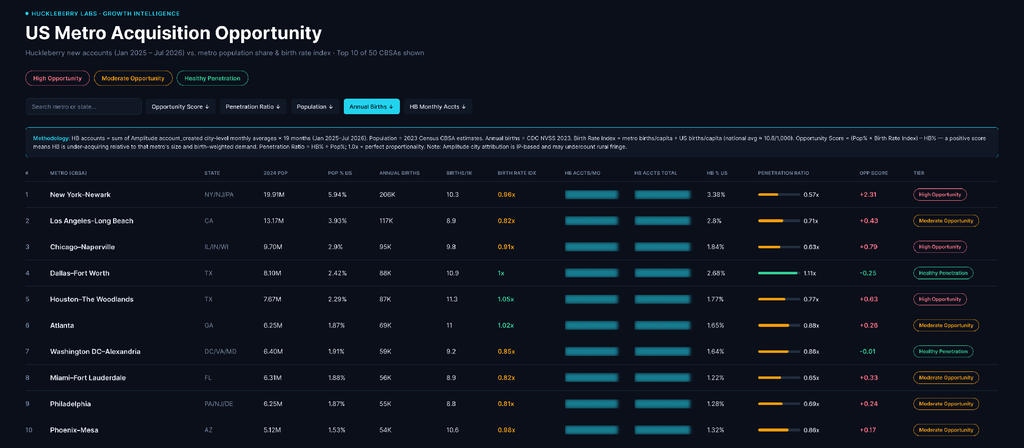
Huckleberry Labs shifted creative and strategy toward expecting parents and parents of infants, swapping generic messaging for language and creatives tailored to each stage. The team also fed the metro opportunity scores into Meta’s bid-optimization tool, Value Rules, to bid higher in the under-indexed markets.
The shift didn’t just retarget the ads; it changed the underlying economics. Parents of infants have immediate, active sleep goals, so they subscribe more quickly. Expecting parents take longer to convert but carry a higher lifetime value at the 24- to 36-month mark. Expanding into less-penetrated markets opened up additional opportunities for incremental growth. And pulling back from the newborn segment meant Huckleberry Labs stopped paying to acquire users who would have subscribed on their own anyway.
Cost per new account improved within the first two weeks and continued to improve over the following month as the audience mix shifted toward expecting parents and parents of infants. Organic acquisition recovered right alongside it, resolving the headwinds Erich had flagged at the outset.
Huckleberry Labs is now reaching profitable incremental ROAS at a point in the customer lifecycle that used to feel out of reach.
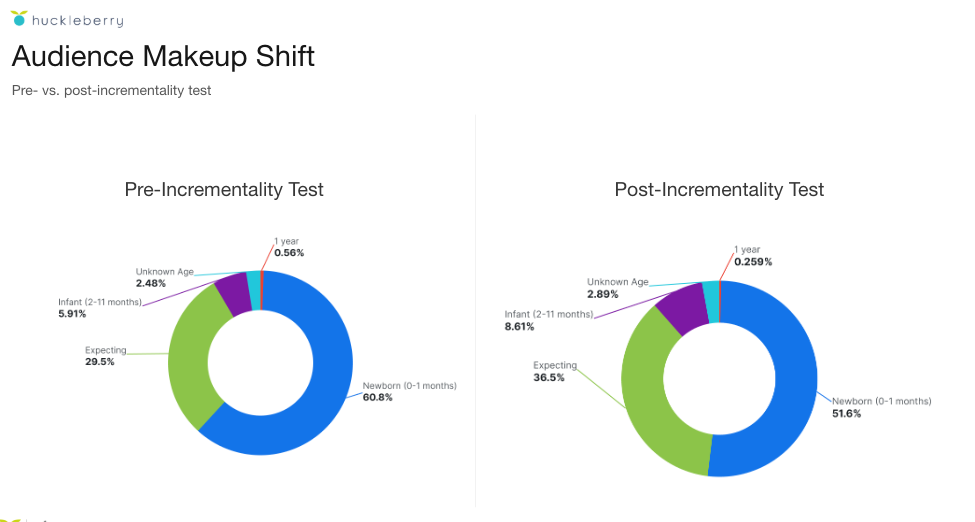
The instinct when an incrementality score comes back low is to cut spend. Huckleberry Labs’ experience demonstrates that the opposite is a better strategy: treat the number as the start of an investigation, not the end of the conversation.
Incrementality isn’t a one-time measurement, either. Huckleberry Labs plans to rerun geo-lift tests on a set schedule as campaigns and markets continue to shift.


