
Why Most Companies Have Lost Their Customer — And How to Win Them Back
Martin Lindstrom
0:00
0:00
Featuring
Martin Lindstrom
Business Transformation Expert & Time 100 Honoree

Episode summary
Martin Lindstrom built his first advertising agency at 13, sold it to BBDO at 18, and has since turned around companies like Maersk, Burger King, and Lego. His core method is simple and uncomfortable: walk in with the mindset of a 12-year-old and ask questions that insiders stopped asking years ago. That naivety, paired with pattern recognition across dozens of industries, is what lets him see what internal teams can’t.
In this conversation, recorded live in Bangkok, Lindstrom breaks down exactly how he identifies a company’s “outer imbalances” — the hidden emotional drivers behind customer behavior — and why most corporate KPIs are actively working against customer focus. He walks through a real case at Maersk where an entire call center was checking “force majeure” on every complaint ticket, not because of disasters, but to avoid filling out extra forms. The KPI rewarded speed. It punished accountability.
He also makes a clear-eyed case against AI dependence: not because AI isn’t powerful, but because it is eroding short-term memory encoding, distorting language, and quietly eliminating the conditions for empathy and creativity. His answer isn’t a tech solution — it’s boredom. The ability to sit still, let the mind wander, and connect dots without a screen. Companies that build around human presence and emotional intelligence, he argues, will be the ones that stand apart.
Key highlights
On how companies lose sight of the customer
“KPIs have become a management tool to tick boxes in theory, or remove yourself from the customer.”
On why AI’s biggest risk is invisible:
“We are begging in a slight deviation from where we stand, an ethical code into our ways of seeing the world.”
Episode Timestamps:
*(01:30): How Martin learned to speak — starting at kids’ parties, not business stages
*(05:00): Building a Lego theme park at 12, getting sued, and landing a job at Lego
*(07:15): Starting an ad agency at 13, selling it at 18, and entering adulthood 15 years early
*(09:00): The two-age model — how a 53-year-old thinks like a 14-year-old to diagnose companies
*(11:00): Why benchmarking against your own industry is a dead end
*(13:00): Maersk’s Shanghai call center: how KPIs killed customer accountability
*(17:00): 90-day interventions — the only time horizon that creates internal belief in change
*(21:00): Why companies are not B2B or B2C — they are human to human
*(23:00): The cost of remote work: 65% of language is body language and we’ve cut it off
*(28:30): AI’s three real threats — memory deletion, language manipulation, and eroding empathy
*(34:00): Engineering Our Dreams — the $22M extended reality ethics project backed by Stanford, Harvard, and MIT
*(38:30): Why Martin doesn’t read business books and doesn’t own a phone
*(39:30): Boredom as the foundation for creativity — and why it’s disappearing
Transcript
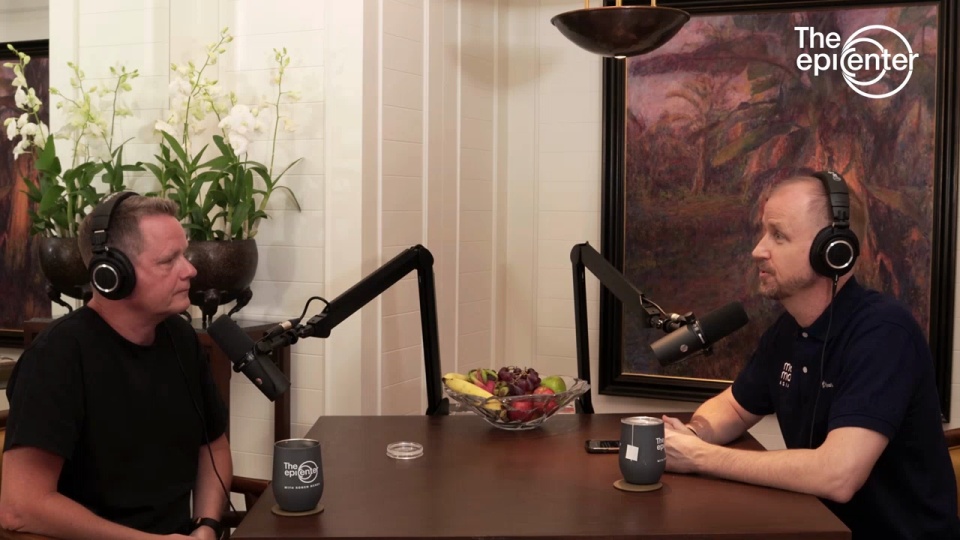
[00:00:00] Ronen Mense: Welcome once again to the Epicenter, an in-depth series [00:00:15] podcast where we feature business leaders who are shaping today’s digital economy. Today in front of me is someone who requires very little introduction, if any at all. Martin Lindstrom. Hi Martin. Thank [00:00:30] you for inviting me. Welcome to Epicenter.
[00:00:32] Thank you. And we’re filming live right here in Bangkok. Fantastic at the beautiful Mandarin Oriental. It couldn’t be more unique where you have just delivered [00:00:45] probably the most thought provoking mind bending keynote session. That I’ve heard.
[00:00:53] Martin Lindstrom: Oh, thank you.
[00:00:54] Ronen Mense: And I’ve heard feedback already from people, and this is actually the second time I’ve heard you speak, [00:01:00] and I find myself just sitting on the edge of my chair trying to grasp everything that you’re saying.
[00:01:10] Martin Lindstrom: You are very kind. Are you sitting on the edge of the chair so you can run out as [00:01:15] fast as possible? I don’t think so. Okay, good. Sure. Yes, yes. I was
[00:01:20] Ronen Mense: nervous there for a second. Where, where did this, where did this come from, this ability to, to be such an engaging and uh, um, [00:01:30] thought stimulating speaker and thought leader?
[00:01:35] Martin Lindstrom: Well,
[00:01:35] Ronen Mense: I
[00:01:36] Martin Lindstrom: think that Winston Churchill once was quoted saying I would’ve written a shorter letter, but I didn’t have the time. [00:01:45] I. I think when you are performing on a stage, you are performing and that contains multiple ingredients. One of the me that you need to have something to say something on your heart, and it can’t just [00:02:00] be a copy paste of what the world is also talking about, but something, hopefully something unique.
[00:02:07] Second, you have to deliberate. In an engaging way where the audience feel that they are part of [00:02:15] it rather than observing it like me. Well, yeah. Thank you. Um, and third, I think you need to establish a narrative, which is it’s [00:02:30] constantly challenging people’s conventional mindset by presenting counterintuitive conclusions.
[00:02:37] And if you’re able to mix those three together, you may tick the the box of being an entertaining speaker. [00:02:45] As I tend to say, my biggest competitor today is a smartphone, and it is because. People are constantly tricked to look at this device. Also, when I’m on stage, so I always say, listen, if you [00:03:00] could video record my preference or my performance on stage and watch it at home, and it’s the same, I failed.
[00:03:10] Hopefully you will say to yourself, I wanted to be in that audience. I wanted to [00:03:15] experience it like a concert. Now, am I there yet? No, but as Malcolm Gladwell once said, uh, it takes 10,000 hours before you are true pro, and I’ve been speaking at least 4,000 times. It peak [00:03:30] has been at least between one and three hours.
[00:03:32] So I’m probably there, and I think that means that you are not. Concerned about how you say it and what you say and all that stuff. You’re dancing. And when you [00:03:45] dance it becomes, um, something more than just a delivery of a message.
[00:03:51] Ronen Mense: And it’s so eloquent the way that you do deliver this message and like, where did this come from?
[00:03:58] This, this, as a [00:04:00] young child or young teenager, did you have a passion for. You know, I mean, because you’ve taken two very unique skills, or maybe there’s more, but one is your ability to, to deliver amazing content, [00:04:15] but you have to first have the amazing content and the mind kind of bending and, and, uh, creating these different growth mindset, uh, uh, principles that you do.
[00:04:24] How, how did this evolve? Uh, over your career? Well,
[00:04:29] Martin Lindstrom: listen, [00:04:30] I’m crazy. When I was a kid, I always had the philosophy that whenever I would get an opportunity to speak, even though I was introvert, I always spoke. So at my parents’ birthday party, [00:04:45] anniversary parties, Christmas. Um, new Year’s, whatever occasion, I would be the first to stand up and speak.
[00:04:52] And, uh, people quite often were kind of laughing about it because why would this kid always speak? Is it something, uh, his parents [00:05:00] have forced him to do? No, it was actually myself doing it, even though I was introvert laid on. What happened was. Was a fun story when I was 12, I was a huge fan of Lego.
[00:05:10] Mm-hmm. And I decided to build up a Lego land in the [00:05:15] backyard of my mom and dad’s garden. Mm-hmm. And it was, um, it was something that took about a year to. Constructs. And then I finally opened the gates to this theme park of mine and all the two people showed up. My mom and my dad. Mm-hmm. Which really was the [00:05:30] lowest point of my career.
[00:05:30] Did they pay to come the to pay $1 each? Yeah. So it was really not a business, commercial business success, I have to say. So I went into panic. I went down to a local print office, persuaded the printer to sponsor [00:05:45] me. And two days later I had an ad in the paper and 131 people passengers showed up. There’s just one problem.
[00:05:53] Visited number 130 and visited number 1 31 with the lawyers from Lego suing me. Uh, they said it was [00:06:00] their brand and I said, what’s the brand? I bought the boxes myself and the um, the owner of Lego heard about this story. Uh, and later on gave me a job at Lego as the youngest kid in history of the Lego company, and then I immediately [00:06:15] thereafter, um, opened up my own advertising agency.
[00:06:18] When I was, think of 13, was I sold to BBDO an advertising agency group later on when I was 18. And the story really is that I began acting as an [00:06:30] adult at a very young age. So when I joined people at the age of 25. I kind of already had 15 years on my back and they were new in the game, and that really [00:06:45] helped me to be, I wouldn’t say a step ahead, but certainly be able to simulate a step ahead all the time, and that I guess, is the same.
[00:06:54] When it comes to speaking that I began very young and we’re exposed to so much stuff [00:07:00] way before most people, that the basics really very quickly was not occupying my mind. That could really concentrate about what matters rather than learning the basics so long when this story to say it probably comes down to the 10,000 hours, [00:07:15]
[00:07:15] Ronen Mense: the 10,000 hours that you’ve spent on delivering content, and, but you’re, you’re, you’re more than.
[00:07:22] I mean, you, you are a business transformation, uh, I guess expert if you will. ’cause you’ve [00:07:30] probably invested 10,000 hours into that as well.
[00:07:33] Martin Lindstrom: Well, if we start to add up all those 10,000 hours, I’m probably 180 years old, so, so I’m careful about giving you somewhat say, because maybe I end up lying here, but Yeah, I do.
[00:07:43] Everything is really [00:07:45] transformational. If you provoke or. If you just disrupt things. Um, so transformation has always been part of my life, whether that has been to help turn around Maersk or Lake or Burger King or whatever company it is, or whether it [00:08:00] is been to transform a celebrity like Tara Banks or a country like Switzerland or Australia.
[00:08:07] So transformation for me has been. No, it has multiple facets. It all comes [00:08:15] down to branding and culture, and it all comes down to seeing it through a different lens and establishing a new reputation. So it’s all one, one of the same, you could say. And under that umbrella, for sure, you can tick the 10,000 hours [00:08:30] box.
[00:08:30] Ronen Mense: And I mean, how, how is it that you can walk into these companies? Well established companies that have been around for tens of years like Lego, like Maersk, and be able to see from a [00:08:45] perspective that they can’t see. Is it because you come in with uh uh, an empty mind per se? That you have no bias or no preconceptions that they’ve all adopt, how, how is it that you [00:09:00] can come and help to identify things that they can’t see right in front of their nose?
[00:09:05] Martin Lindstrom: I think it comes down to the fact that I have two age, like everyone else have. I’m 53 years of age and my twin eight, my [00:09:15] inner age is. Between 12 and 16. Mm-hmm. So when I see the world, when I see a company or an organization, I see it through the kids’ eyes with all these naive questions attached to it. I [00:09:30] don’t understand what they’re saying.
[00:09:31] I don’t understand that website. What do they mean? What does that acronym stand for? And I think a lot of people in our world today are petrified of admitting that there’s a lot of things we don’t understand anymore. We don’t. [00:09:45] Understand those letters and that term and that phrase. So we pretend like there’s a lot of pretending.
[00:09:51] We pretend like we read the whole book. Mm-hmm. We pretend like we read that article. We actually, what’s that thing? Um, but I’m actually just taking on the naive hat [00:10:00] and asking those stupid dumb questions. What’s quite often is representing the average consumer in a situation where he or she’s buying something and it just doesn’t add up or make sense.
[00:10:13] Now if you can maintain [00:10:15] that while also adding a flip to the coin, which is the strategic dimensions to it. Mm-hmm. So say this is how the customer or the consumer sees your world. On the other hand, these are the strategic challenges you have in order to get [00:10:30] there. Let’s navigate around that. Let’s navigate around your immune system, your defense mechanism for change.
[00:10:36] Well then you on one hand, helping to guide the company while also helping to navigate it around these. Obstacles and hoops and loops, which [00:10:45] quite often is paralyzing comedies for evolving and transforming themselves. So I think it’s a naive, naive view of the world. While, of course, an aggregated experience having worked in almost every single category in the world, [00:11:00] um, a lot.
[00:11:02] And then I say the third thing is probably that I steal a lot. I steal from one industry to another because I fundamentally don’t believe that you can get ahead of the leader if you follow his tracks in the snow [00:11:15] or in the sand. You need to follow someone else. Your benchmark has to be out of your industry, not within your industry.
[00:11:22] Um, because industry emerging to the degree it is right now. So. Based on the fact that I [00:11:30] worked in all these crazy industries, um, over the years, I basically just shuffled these cards around. And do you know what quite often, Natalie, that provocative statement from a completely different industry could [00:11:45] actually, and quite often is the answer to a company, uh, struggling to survive with our times.
[00:11:51] Ronen Mense: Mm-hmm. It, it’s interesting how. And, and, and just what you’re saying when I hear you, you speak [00:12:00] about example, for example, with Maersk, right? Put these, Maersk have to put their business into the shoes of being Uber, right? And now all of a sudden they understand the consumer perspective, where [00:12:15] previously they haven’t done that.
[00:12:17] And it, this is so interesting how I see that you, you’ve done this time and time again with companies and I, I, I, it’s how, how do you, how do you kind of [00:12:30] figure out which, which one is the perspective that they need to see and, and how do you overcome the resistance that these companies, because I’m sure like the first thing they say is like.
[00:12:40] Who is this guy? Get him, throw him out of the room.
[00:12:43] Martin Lindstrom: Absolutely. [00:12:45] Um, the first step is to understand the outer balances in the world. That world was happen. To be paying the salaries for those people employed in that company. Mm-hmm. Customers, [00:13:00] passengers, employees, um, guests, whatever industry you operate in.
[00:13:06] And what I’m always looking for is the outer balances. We are all outta balance. Mm-hmm. Um, I’ll tell you a new story. When I was a [00:13:15] younger, I, I bought a Rolex watch. Mm-hmm. Not only a Rolex watch, but a gold Rolex watch. And I had a meeting with a gentleman at Nestle in Vive in Switzerland, and the guy come up, came up to me and he said, is that a gold [00:13:30] Rolex watch?
[00:13:31] And I said, yes. He said, I would never have thought that about you. And I didn’t know if it was kidding or not, but my self-confidence went pretty low. So I went down to Banov Stars in Zurich to a secondhand dealer [00:13:45] handed in my watch and he said to him, to me, you are aware of is a gold Rolex watch. I said, yeah, I know it’s a gold Rolex watch.
[00:13:54] And he said, and only people from Middle East and women are wearing these watches. It’s a woman’s watch you have. [00:14:00] And it was just so ironic that. I later on realized the reason why I bought the WATS was not because it’s always on time because Rolex is never on time. It was because I said to the world, yes, I made it.[00:14:15]
[00:14:15] So obviously I was insecure. I was insecure when I bought that wats. I didn’t know that. I realized that 10 years later got rid of the watch. Mm-hmm. What’s really interesting was that we all have outer balances. It maybe I feel I have no friends. [00:14:30] Maybe I feel, um, I am too weight. Maybe I feel I have a midlife crisis and I’ll buy a Har Davidson.
[00:14:38] I mean, all these different factors of outer balances is defining who we are and who we are not. That [00:14:45] is the, what we call the universal insight. You need to pick up from a customer, consumer. And once you pick that up and put that mirror in front of the employees and ask them, what do you really think your customers are coming [00:15:00] here for?
[00:15:00] Besides just buying something to stop their hunger or their thirst, or whatever it is. And once they realize that outer balance, it’s like you’re having an aha moment. And that aha moment becomes the [00:15:15] foundational, um, starting point to turn around organizations because what happens is that the folks within the organization certainly are not seeing the world from inside out.
[00:15:26] They’re not seeing it with their own personal [00:15:30] agendas of getting higher in their hierarchy or making sure that person will be kicked out or kind knows what of the bureaucracy today ruling the companies. Suddenly they realize. Is the customer would have to be my focus rather than Peter down the [00:15:45] hallway.
[00:15:46] And as that happens, the organization is starting to see the world from outside in. That is then in return, helping the company to be more focused. And then what I do is always to break this [00:16:00] down to small bite-sized steps. Uh, Henry Ford once said that nothing is too difficult if you break it down to smaller steps.
[00:16:08] Right? Well, those smaller steps is what I call 90 day interventions, short [00:16:15] bite-sized proof points, which are solving an outer balance issue in the customer, consumer’s mind. Why 90 days? Because the court announcement. Going on from this distant companies [00:16:30] is 90 days. We don’t have more patients in our world, so if you can prove something in 90 days.
[00:16:37] It creates a movement internally. People start to believe in the fact that change is actually possible. And if you can spread that [00:16:45] word internally and celebrate that change’s mindset, you’ll have more and more people buy into that movement and suddenly it’s a mind shift change. It’s a culture initiative rather than anything else because in the end of the day.[00:17:00]
[00:17:00] The strength of the company is not necessarily the logo on the front elevation, it’s the people.
[00:17:06] Ronen Mense: Mm-hmm.
[00:17:07] Martin Lindstrom: Um, it’s called a cooperation. We cooperate, we work together. We don’t really do that anymore. [00:17:15] Um, but we once did. If we start to cooperate more, that’s where we become a powerhouse. That’s the reason why human, uh, as we are today, we managed to cooperate in the past to build their world.
[00:17:27] Um, so it’s all about movements, [00:17:30] it’s
[00:17:30] Ronen Mense: all about culture. You, you, just, a few moments ago you mentioned about the customer, and do you feel that companies have lost sight of their customer and paid more attention [00:17:45] to the KPI? Of what that they’re trying to achieve.
[00:17:50] Martin Lindstrom: Absolutely. And, but, but not only that, the KPIs.
[00:17:54] Mm-hmm. ’cause there is multiple levels and layers of KPIs [00:18:00] in organizations. Let me go back to Maersk for a second. I was in Shanghai at the call center at Maersk. We had to look into customer experience. And I sat there with an interpreter listening into [00:18:15] all these incoming calls. I was talking with the complaint call syndrome.
[00:18:20] Mm-hmm. 3000 people sitting there lined up, handing complaints. I mean, mostly one of the biggest companies in the world. So of course they have a lot of complaints as well. Sure. So [00:18:30] there I was sitting noting down, and I noticed something really unusual. I noticed that every single complaint was addressed with a little tick in a form.
[00:18:40] Categorizing this as force majeure. Now, just [00:18:45] remind you, force majeure it’s COVID-19. Mm-hmm. It’s earthquake. It’s something dramatic. A tsunami, but not every single complaint out. A thousand of complaints every day, really. So we went back to the drawing board and I started to understand why did [00:19:00] these people in the call center tick that box?
[00:19:03] Very simple. The KPI, the key performance indicator for the customer service. Uh, department was time. The quicker you can answer the call, the better. [00:19:15] Um, and if you tick one box saying force material, you only had to fill out one form. If you didn’t, you had to fill out four forms. Mm-hmm. So the KPIs were in contrast with.
[00:19:27] What actually the objectives were now even [00:19:30] worse than you could go to operations, than you could go to global shared services than you could go to hr, and each of them had different formats of KPIs. None of them were aligned, all of them looking at different aspects of the organization. [00:19:45] How can you create a corporation where people cooperate?
[00:19:49] When what they cooperate around is different types of objectives. You can’t, so what happens with companies is that they have not just [00:20:00] different KPIs, but different departments, which is horrible. Mm-hmm. And not the way to run organizations. They’re also quite often. Do not have the guts or the courage to shave down those KPIs to just a handful With [00:20:15] you.
[00:20:15] And I can remember, I’ve been in organization where they’ve had between 80 and 90. KPIs. One of them was customer set of action, which were allocated 1.5%. 1.5% out [00:20:30] of a year is about four days or five days. We could be customer focused, and then I assume that it links 300 and something days. Mm-hmm. We’re not customer focused, so KPIs has become a.
[00:20:42] Management tool to tick [00:20:45] boxes in theory or remove yourself from the customer.
[00:20:48] Ronen Mense: In reality, remove yourself from the responsibility of the customer. And I think a lot of companies have forgot why they exist, right? We are not like you. [00:21:00] You said I’m stealing it from you. We’re not business to business. We’re customer to customer, or more importantly, human to human.
[00:21:08] Martin Lindstrom: Yeah, we are. And, and the human side now more than ever is [00:21:15] extraordinary. Important. Think about the fact that we do not look each other in the eyes anymore. We look at the lens. Mm-hmm. We don’t see each other’s body language. In fact, if I was to take something in front of [00:21:30] your eyes right now, just try it at home in your living room as you are.
[00:21:33] Mm-hmm. Listening to this, you just look away while you’re talking to a person. The person would within 30 seconds. Seek you somewhere in the room to make sure that you look each other in the eyes or at least [00:21:45] abuse you. But when you’re sitting on a Zoom call or a teams call and your arms are caught off and you are small, gastic relations are caught off.
[00:21:56] Knowing that 65% of our language [00:22:00] is our body language. Mm-hmm. You probably only see 25%. That means that we are communicating with a huge handicap. Of 75%. That human dimension is where we [00:22:15] align our thoughts at an emotional level. That’s the coffee break moment. That’s a water cooler moment. That’s the canteen moment.
[00:22:23] That’s where I come up with a crazy idea, and I know it’s crazy and I’m saying it, [00:22:30] and I’m looking at you in the eyes, and I can feel you okay with that idea. So I continue. Well. I may even pause and think and reflect about things. Now, as soon as you pause on a team’s call, after three [00:22:45] seconds people say, Martin, you’re mute.
[00:22:47] We can’t even think anymore. So the human dimension is disappearing. So those companies, what are doing the opposite? What’s really are taking the human dimension into account? [00:23:00] Remember, we’re all outta balance. Mm-hmm. The more we. I sick and tired of going through a menu of five levels in a phone service call center interaction.
[00:23:13] And you are trying to search [00:23:15] for anything online and you can’t find any information. Mm-hmm. Because they want to award any trick to talk to you. All that stuff. The more you are desperate for human interaction. And when you look at the latest statistics from the United [00:23:30] States, it’s very clear today that the number one thing customer want is.
[00:23:33] A human on the other side. That’s it. It’s super simple, right? So what I’m saying is we need to be human and this is a human to human interaction rather than B2B or [00:23:45] B2C. And if you can wave that into every trust point you operate with, do you know what you’re standing apart today?
[00:23:51] Ronen Mense: What companies do you think are doing that really well?
[00:23:54] Martin Lindstrom: Well, I’ll give you at one example what’s close to my heart. We talked about Lego [00:24:00] previously. Um, so. I’ll give you an example. This is a true case with John. John is a 80-year-old boy. He loves Star Wars or he loved Star Wars and it was his, uh, eight year [00:24:15] birthday. Mm-hmm. And John received the Star Wars, um, kids, the latest and greatest from the movie.
[00:24:22] He was so excited and he started to build this whole set. And then what happened was a disaster, [00:24:30] one brick was missing, so this rocket could just not take off. It was like mom and dad were so excited. They thought, just forget about that brick. No, John did not want to launch the the rocket. The whole party [00:24:45] was a fiasco.
[00:24:47] I wanna pause here for a second. That brick was missing, and this is a question for you. How many complaints do you think Lego receive every year from missing bricks, from parents writing physical [00:25:00] letters, sending it to Lego’s headquarter? Whew,
[00:25:06] Ronen Mense: I, I’m gonna guess thousands ’cause they probably sell millions and millions of boxes of Lego.
[00:25:12] 3 million. 3 [00:25:15] million
[00:25:15] Martin Lindstrom: complaints. Written complaints now. I’ve been to the Lego factory multiple times, and the way the manes is that every box goes on a scale, and if it’s off the scale, it would basically go back into the assembly line. There is literally [00:25:30] not a single box coming out of that assembly line was wrong.
[00:25:33] So there’s 3 million complaints about Lego missing the boat, yet it’s the parents missing the boat. Now here’s my question to you. What will you do if you are ahead of Lego?
[00:25:44] Ronen Mense: Hmm, that’s a good [00:25:45] question. It, it, it’s either you need to give a couple pieces more in order to make sure that you account for any loss or probably change the way that you are [00:26:00] calibrating your skills.
[00:26:01] Martin Lindstrom: Or a third one.
[00:26:02] Ronen Mense: Yeah.
[00:26:03] Martin Lindstrom: Meet
[00:26:03] Ronen Mense: Hannah Quail. Meet Hannah Quail.
[00:26:06] Martin Lindstrom: Hannah Quail is responsible for Lego’s tone of voice. That’s the only rule. Mm-hmm. So Hannah has written [00:26:15] multiple letters. Letters, and I’m going to just paraphrase one letter, which literally was sent to John. Dear John, I hope you’re having a bratallic day.
[00:26:25] I’m so sorry that the Cantina from the [00:26:30] Star Wars warship could not take off on your birthday. Mm-hmm. This is a disaster. Rest assure. I’ve called Han. And Han is right now doing a special investigation to find that brick Now the good news is [00:26:45] they found it. Mm. And I’ve included to you, and I just want to let you know that these disasters sometimes happen for the good one so they can learn how to be better.
[00:26:54] I apologize. Of course. So does Han, but you are ready for a takeoff. Best [00:27:00] regards, Lego. Signed empathy. Signed empathy. This is how 3000 different letters are looking like and sounding like every year, including free bricks from Lego. I’m right now telling you about it. That’s [00:27:15] advertising. Wow. That’s very uh.
[00:27:20] Very empathetic. It is, and it’s a different way of customer service, which I think also was the reason why Sapos took [00:27:30] off later on, acquired by Amazon. Um, there’s certain companies which are doing that stuff, Patagonia, which is going one step further, which may not be conventional business thinking in the moment according to those [00:27:45] KPIs, but in the long run it’s creating a very sustainable brand.
[00:27:51] Ronen Mense: So you talk a lot about human, but let’s talk a lot or a little bit about what may not be [00:28:00] so human ai. What are your thoughts on the good that is gonna come out from AI and what makes you hopeful? And of course the other side of the equation, the bad [00:28:15] or the stuff that makes you stay up at night about what AI.
[00:28:19] Can do to businesses and to, you know, society in general.
[00:28:25] Martin Lindstrom: I think there’s multiple pockets of answers depending on what lens you’re seeing [00:28:30] AI from, from the Martin lens. The Martin lens also have different lenses, but I’ll give you a couple of them. The biggest downfall of us as human species is that we are fundamentally lazy [00:28:45] and laziness was the reason why the wheel was invented. But laziness is also the reason why we don’t remember anymore. Think about it. If you [00:29:00] and I are sitting together now as we are, and now we talk about JF Kennedy, I’m saying to you that F in j. F Kennedy, what does it stand for? Fitzgerald. So on this, you would’ve been as clever as you.
[00:29:13] Most people would’ve grabbed their phone, [00:29:15] scrolled away, and I. It’s al right after 10 seconds looking like a hero. We did a brain scanning session where we scan people’s brains using FMRI. Mm-hmm. And whenever we asked them tricky questions, guess [00:29:30] what? The answer consistently went to an error, which we today is naming the Google spot.
[00:29:35] It’s literally a spot where people have no memory, is basically saying, go and do an action. So we are not doing short-term memory ENC coding anymore. Most people [00:29:45] can’t remember the phone numbers to their loved ones anymore. Now, remember the past? Mm-hmm. Why not today? ChatGPT is infusing itself into the very core of ness.
[00:29:57] Mm-hmm. Which means that we increasingly [00:30:00] will delete short term memory encoding and rely on an external factor on two. ChatGPT is also. [00:30:15] Representing a language which comes across as being extraordinary human. Mm-hmm. Which have two dimensions to it. The first one is that language is the foundation for [00:30:30] society.
[00:30:30] If a remove a language, society collapses. It’s also the foundation of religions. If I remove a language in religions. There is no religion, but if that language is manipulated [00:30:45] through, um. Millions and billions of data point, which is obtained through the voice of the whole planet. Quite often a little bit out of balance.
[00:30:54] In most cases. The language is slowly seducing us to believe what we are [00:31:00] learning is true because it’s so manipulative in the way it comes across that we may be skeptical at first. We test out. Yeah, there was a couple of mistakes and you know what? ’cause we’re lazy. Mm-hmm. Lean up against it. That means we are begging [00:31:15] in, um.
[00:31:17] A slight deviation from where we stand an ethical code into our ways of seeing the world with is issue, uh, number two. And issue number three is that [00:31:30] we increasingly teach ourself through Alexa, AI driven mm-hmm. Through, uh, Siri AI driven and through ChatGPT four and other versions, we are giving instructions, which are demands.
[00:31:44] Um, I’ve [00:31:45] interviewed small kits, which when they give instructions to Alexa, would not say, can you please tell me what the weather is? It is Alexa weather. And then when I took them away from that context and said, for fun in a [00:32:00] group of like-minded kids, can you just ask your friend here what the weather is going to be?
[00:32:05] The person would say, Peter, weather. So the whole empathy dimension is slowly disappearing. So what I’m saying on the oxley [00:32:15] side here is it is an extraordinary addictive tool with a deleting our short term memory. Destroying our language and manipulating our minds. On the good side, we [00:32:30] all know the stories.
[00:32:31] Mm-hmm. It’s extremely powerful to, uh, if, depending on what AI format it is you’re using and, and the one with generative AI is less likely to do that, but another version is more likely to do this. For example, aggregates huge amount of [00:32:45] data from an FMRI scan and find issues way ahead of experts. It’s able to do things from a medical and human point of view, which is extraordinary.
[00:32:56] This is a hammer, which you can either [00:33:00] use to put a nail in the wall and hang up a beautiful painting, or you can hammer people in the heads, but it’s probably the most powerful hammer we ever had, which when I talk to experts around the world, including the, the founders and co-founders of various AI [00:33:15] technologies, they all are in agreement today that this is much bigger than the nuclear bomb.
[00:33:21] So that’s what we are sitting with right now. It is so seductive. It is so admirable. It is so easy to use and we are playing with [00:33:30] our future and next generation. So I am extraordinary concerned about the future and what it will bring to the table. ’cause I don’t think people have really thought about how this now is estimated within the next [00:33:45] few years to generate 60.
[00:33:47] 60% of all content on the internet, 60% will three years from now be generated by ai, which basically means that we’ve lost control of a narrative which we want created. Right. [00:34:00]
[00:34:01] Ronen Mense: Martin, you’re in a great position to to, to do something about this. Are you leading some type of forum or. [00:34:15] Um, console that helps to address the, the good and the bad that is gonna come from this.
[00:34:23] Martin Lindstrom: Well, about a year ago I founded something called Engineering Our Dreams. It’s the largest extended [00:34:30] reality experiment in the world. It’s a $22 million project. Um, it’s, uh, supported by Stanford, uh, Howard, and MIT. Uh, we have 22 of the most prominent experts in the world. Everything from the [00:34:45] founder of augmented reality, virtual reality, uh, various of the Siri Alexa services.
[00:34:53] Um, and then we have, uh, more than 20 of the leading brands in the world, uh, involved in the project. Um, the [00:35:00] design around this project is really to experiment about the future. It’s basically to say, if we were really taking the most creative minds in the world and developing applications, Asians, uh, which could take this to the extreme, how [00:35:15] would the future then look like?
[00:35:17] And then we are saying. This is how brands are going to evolve. What is the picket fence going to be of ethical code, which means that we are not going to stumble, brands are not going to be self-destructive, and consumers are [00:35:30] not going to be destroyed. So this project is up and running. We are using, uh, vision Pro Apple’s, new glasses.
[00:35:37] Um, by February 1st, 2024. Uh, we have more than a thousand people moving into this extended [00:35:45] reality for half a year. Uh, so it’s super interesting and, and the outcome of this is really to set a new global standard of ethical codes. Um, I hope someone else will do it before us. Mm-hmm. Um, I have my doubts to be honest, because it’s very [00:36:00] clear right now that very few people actually are doing anything.
[00:36:02] A lot of people are talking about it, but very little ness associated with it. So I hope this can contribute to getting things on the right track. Who knows? But at least we’re trying. [00:36:15]
[00:36:16] Ronen Mense: This is fascinating. Um, there’s so much that you’ve covered here that is, is just so again, my mind is, is, [00:36:30] is running around in circles trying to, to grasp this all and I’m sure the audience, uh, out there is, uh, going to appreciate this, uh, immensely.
[00:36:38] Um, but before we end. I’d love to do a rapid fire question around with you. Okay, cool. [00:36:45] So if Martin were a brand, what brand would you be? I would definitely be a Lego. Wow. And if you could meet three people for dinner, living or otherwise, who would they be [00:37:00] and why?
[00:37:01] Martin Lindstrom: I would like to meet Obama. I never met him.
[00:37:06] I would like to spend some more time with Steve Jobs. I have met him. I sat in meetings with him once and I’ve seen him speak once [00:37:15] and I probably would like to meet Winston Churchill because he’s probably one of the most articulated speakers and poets of all of our time. Oh, there’s so many people I would like to meet, but these are three people I thought [00:37:30] would be interesting to meet.
[00:37:31] Is there
[00:37:31] Ronen Mense: a book that, uh, has helped. You, you know, shape, uh, some of your thoughts or, or a book that you wanna recommend to the audience out there that is a must read on Martin’s list? [00:37:45] Um, besides, of course, the ministry of Common Sense, which I’m going to recommend here. I’m just so gone. Um,
[00:37:53] Martin Lindstrom: no, and the reason why is I haven’t written, I haven’t read a book, a business book ever in [00:38:00] my life.
[00:38:00] Um. And the reason why is because I’m so afraid of stealing. Mm-hmm. Ideas and thoughts or even words. Read that and say, oh gee, I did not come up with that idea. So I actually do not read books, um, [00:38:15] at all. I only write them kids don’t listen to that. No, I know. It’s horrible. Yeah. My views are a bit screwed when it comes to these type of topics.
[00:38:25] Ronen Mense: Why don’t you have a mobile phone?
[00:38:27] Martin Lindstrom: Well, it’s one of those topics. Um. [00:38:30] There’s three reasons why I come to realize why I don’t have a phone, because it was not as articulated as it is today when I’m saying it. Um, I skipped my phone six years ago. Mm-hmm. And by phone, I mean. [00:38:45] Any phone, anything. Yeah. Um, the first thing I realized is when you are standing in a bar and you’re meeting someone and the person is late, the first thing you do is to grab your phone and do anything with a phone, so you don’t look like a complete loser.
[00:38:58] Right? Right. The second [00:39:00] thing is you don’t see things anymore. Everything you see is through a lens. The first step of your baby, that amazing meal, that memory, all of it is through a lens. [00:39:15] But the third thing is the worst thing. We never get bored anymore. And boredom is the foundation for creativity, is that pause in life.
[00:39:23] Mm-hmm. Where we are able to connect dots in a new way and be creative [00:39:30] and we never creative anymore. So when I skipped the phone, I did not know. I thought it was kind of for a year as a test to myself, and I became kind of addicted not to have a phone, which sounds unusual for [00:39:45] most I could imagine. I would never get a phone again.
[00:39:47] Mm-hmm. If I can, because the world is getting tough and tougher to live in and survive in without a phone. But I have to say for anyone who is listening and are intrigued by that. [00:40:00] Go for it. Don’t do what I’m doing though. Um, but go for it for half a day on Sundays. Yeah. Or a whole weekend. And do it with your children.
[00:40:09] Make sure that you stimulate your mind and your brain. We only have one of it, [00:40:15] one brain. Um, and if we are going to compete against the GDPs of the world that generate ai, I think the only thing we can compete with is two factors. One is empathy. by the way, is a reason why [00:40:30] we as a species are around today.
[00:40:31] Remember, no other species have empathy. Mm-hmm. That’s the reason why we thousands and thousands years ago, were able to predict what a polar bear would do when it would attack us. That’s the reason why our brain evolved the way we do. We [00:40:45] literally have an area where empathy is created. And that area literally is disappearing now through brain scans.
[00:40:51] We can see this and recent studies showing, uh, two universities in the United States monitoring this over about two decades, [00:41:00] seeing a drop of 61% of empathy you can build and maintain empathy by not having a phone around you all the time. Mm-hmm. Because you’re forced to interact with your surroundings.
[00:41:11] And the second thing is. That you’ll get [00:41:15] bored. And that means you’ll have to get used to yourself in your own company, which is really, really difficult. Sounds easy. It’s not. Mm, which will make you become creative. And that’s the other factor, which ChatGPT may be [00:41:30] creative but not in an empathic way. And that’s the point of differentiation between humans and ai.
[00:41:38] For now,
[00:41:40] Ronen Mense: I can’t think of a better. Closing than that one. [00:41:45] Thank you so much, Martin. Thank you. What an amazing guest here today. Um, truly humbled and, uh, I, I feel that empathy and, uh, it’s just been such a pleasure. Thank you, Martin. You’re very kind. Thank you so much. Thank [00:42:00] you.
Meet our host

Ronen Mense
President & Managing Director, APAC @AppsFlyer
Ronen Mense is a growth strategist and host known for thoughtful conversations at the intersection of technology, business, and human potential.
Explore more resources
Uncover AppFlyer’s wealth of expertise and in-depth resources, to empower your growth and success in today’s dynamic market.


