


Why fraud data is your secret growth engine (Not just a filter)


TL;DR
- Ad fraud doesn’t just waste budget—it corrupts your ML models, skews KPIs, and rewards fraudulent partners
- Evaluating fraud detection data reveals patterns you can use to sharpen strategy and reclaim wasted spend
- The real power: confidently optimize future spend by turning fraud intelligence into a growth enabler
What most marketers miss about fraud
We all know ad fraud burns money. That’s not news.
But what catches even sophisticated marketers off guard is this: you’re making million-dollar decisions based on distorted data, and that’s what really destroys performance.
Think of fraud prevention like having a water filtration system. Sure, it’s great that you’re blocking contaminants. But what if you could analyze what’s in the filter (the weird chemicals, the unexpected particles) and use that intel to optimize your entire water supply chain? That’s the difference between blocking fraud and learning from it.
In this blog, we’ll show you how evaluating fraud data transforms it from a cost center into a growth engine. You’ll learn how to decode fraud patterns to sharpen your targeting, recalibrate your KPIs to reality, and turn prevention into a competitive advantage. Because once you stop just blocking fraud and start learning from it, you unlock insights that make every dollar you spend work harder.
The hidden damage: when your “winners” are actually losers
Ad fraud continues to drain roughly 12% of digital ad spend globally, with losses projected to hit $172 billion by 2028.
But the most threatening part isn’t actually the money that’s lost. It’s what happens to the money you keep spending.
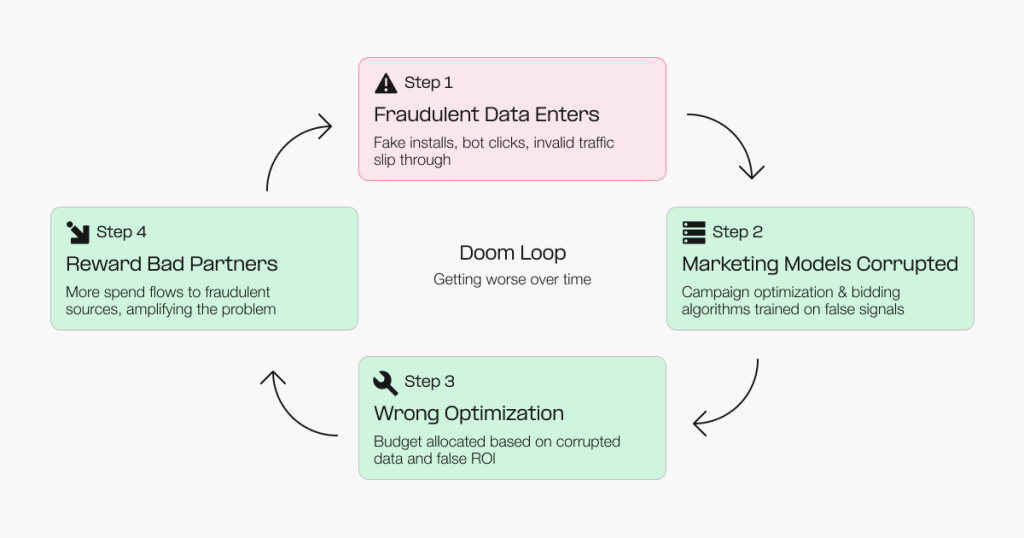
When fraudulent installs or clicks slip into your dataset, they don’t just inflate your numbers. They corrupt your entire feedback loop. Your machine learning algorithms? They’re learning from false data. Your budget pacing? Optimizing toward fiction. Your “best-performing” channel? Might be your biggest fraud risk.
Here’s a real case that makes this painfully clear:
A gaming advertiser discovered a quarter of their traffic was invalid. No big surprise there. But here’s the real problem: 80% of installs were misattributed. Their optimization engine was literally rewarding the partners inflating fake conversions. It took months to rebuild trust in their data and recalibrate their bidding logic.
This isn’t just a marketing leak. It’s a data integrity breach that infects every decision downstream.
But wait… having fraud protection isn’t enough?
Many advertisers treat fraud detection like setting up antivirus software. Install it, enable the filters, maybe check the dashboard once a quarter, and call it done.
The problem: detection without evaluation is like having a security camera that never gets reviewed. You’re blocking threats, but you’re missing the intelligence goldmine sitting right in front of you.
Every fraudulent install, click, or impression leaves a fingerprint. Timestamps, device clusters, velocity patterns, behavioral mismatches. These aren’t just anomalies to filter out. They’re signals telling you exactly where your defenses are weak.
When you evaluate fraud data, you start asking better questions:
- Detection speed: How fast did we catch this? Pre-attribution or after we’d already paid for it?
- Pattern recognition: Are the same fraud signatures showing up from specific sub-publishers or geos?
- Attribution hijacking: Are legitimate sources getting credit stolen by injected traffic?
Most marketers never look this deep. But this is where the real competitive advantage lives.
Turning fraud evaluation into your growth engine
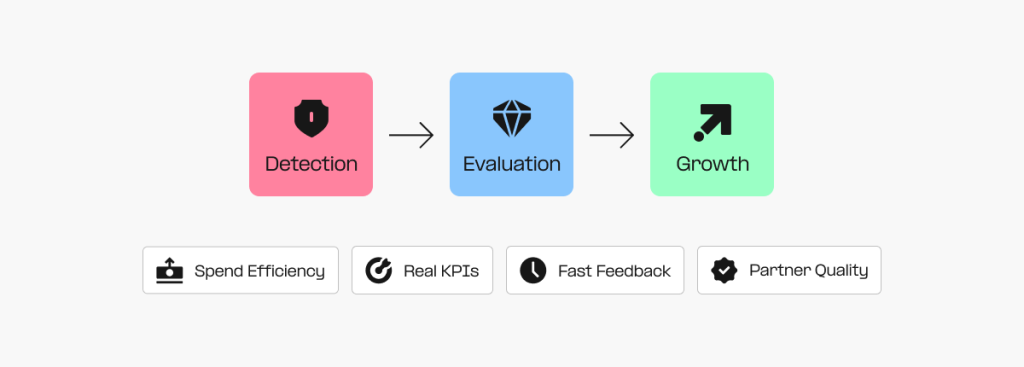
Let’s flip the script. Instead of thinking about fraud data as a defensive necessity, treat it like performance intelligence. What does that look like in practice?
Optimize spend efficiency, not just spend hygiene
Fraud data doesn’t just show you where budgets get burned. It reveals where your real incremental lift comes from.
Before, you might have thought “cut the bad sources and move on.” Now you’re thinking in terms of budget recapture rate: how much of that reclaimed spend can you redirect into proven, fraud-light channels? Advertisers who continuously reallocate reclaimed spend into fraud-light channels can recover significant portions of their budget and redirect it toward real incremental growth
Recalibrate your KPIs to reality
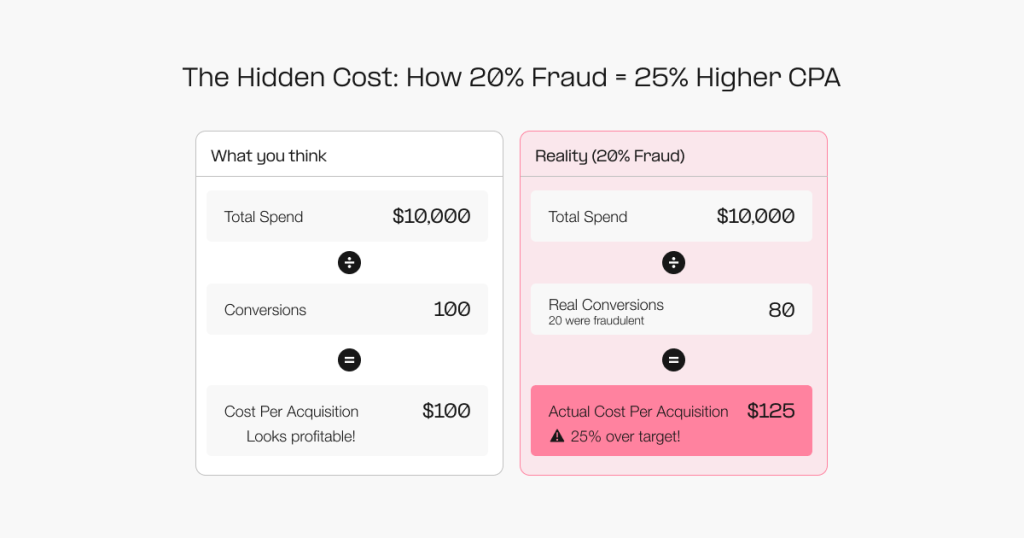
Your ROI, ROAS, and CPA metrics only mean something if they reflect authentic user behavior. When you strip out fraud, you’re not just improving accuracy. You’re recalibrating every performance model that depends on those numbers.
Here’s the math: if 20% of your conversions are fraudulent, you’re paying 25% more per real customer than you think. Say you spend $10,000 for 100 conversions at $100 CPA. But 20 are fake, so you actually paid for 80 customers at $125 each. Evaluating fraud data early reveals the true cost and keeps your bidding aligned with reality.
Shorten your feedback loop
Fraud insights have a shelf life. The longer they sit unreviewed, the less value they provide.
By integrating real-time fraud evaluation into your analytics pipeline (through APIs or direct data access), you can act before optimization drifts off course. This continuous feedback loop means your marketing teams adapt in days instead of quarters.
Build accountability into partnerships
Fraud data shouldn’t live in a silo. When you share fraud evaluation metrics with networks, DSPs, and affiliates, you create alignment around quality standards. It also signals that you’re measuring performance at a granular level. That’s a subtle but powerful deterrent.
Over time, this shifts partner behavior toward transparency and sustained quality. Think of it as raising the bar for everyone in your ecosystem.
The detection paradox (this one trips people up)
Here’s something that may sound counterintuitive: when your fraud detection improves, your fraud metrics often spike first.
It’s easy to panic and think “oh no, fraud is getting worse!” But actually, you’re just seeing what was always there. You’ve upgraded from a flashlight to floodlights.
The goal isn’t zero detected fraud. That’s impossible. The real goal is increasing detection coverage and reducing detection latency. Catching more fraud, faster, before it contaminates your optimization.
By evaluating your fraud data over time (comparing detection timelines, false-positive rates, and attack vector evolution), you can actually quantify how well your protection stack is learning. This is what transforms fraud prevention from a checkbox into a competitive differentiator.
Making fraud evaluation part of your routine
Building a culture around fraud evaluation means weaving it into your operational rhythm:
Weekly: Review emerging fraud patterns. New publisher IDs, device farm signatures, click velocity spikes.
Monthly: Cross-reference fraud trends against campaign performance to validate your KPIs.
Quarterly: Audit detection efficacy. Latency, false-positive ratios, rule overlap. Refine your thresholds. This is also when you align with partners. If fraud rates are climbing from a specific source, it’s time to renegotiate agreed-upon performance standards. Fraud metrics give you leverage to enforce quality and hold partners accountable.
The critical move? Tie these reviews directly to optimization decisions. If a source shows rising fraud rates despite volume growth, it’s not “performing.” It’s stealing.
And if your team is still treating fraud as an external vendor problem instead of a data problem, that’s the mindset shift to tackle first.
Key takeaways
When you make fraud evaluation a core part of your analytics workflow, things change:
- Fraud evaluation is a data integrity function: It protects the accuracy of your KPIs, ML models, and strategic decisions, not just your budget.
- Continuous pattern review shortens your feedback loop and prevents the slow drift that kills optimization performance.
- Fraud insights create leverage with partners, enforcing transparency and aligning incentives around real, quality performance.
- The goal isn’t eliminating detected fraud. It’s increasing detection coverage and slashing detection latency so you get earlier, more actionable intelligence.
- Fraud optimization enables growth: Confident fraud evaluation lets you take calculated risks, test aggressively, and scale faster because you know how to manage risk intelligently.
Teams who regularly evaluate fraud data outperform those who only block it, because they treat fraud as strategic intelligence, not just a defensive safety net.