

Cross-platform measurement: the complete guide for 2026


Meta’s dashboard shows 600 installs last month. Your BI team’s deduplicated number says 400. Your web analytics shows 200. All three are wrong, and your budget decisions are based on whichever number someone chose to believe that week.
That is not a data quality problem. Web has never been held to the same measurement standard as mobile, and that gap is exactly what shows up in meetings like this: three systems, three numbers, no single truth. Cross-platform measurement is how you close it.
TL;DR
- Siloed measurement makes the same customer look like three different people across three dashboards
- Cross-platform measurement fixes this by following the actual person, not the device
- A Customer User ID (CUID) is the identity layer that makes journey stitching possible
- AppsFlyer’s Product Line groups all your apps and assets under one umbrella for unified LTV, ROAS, and attribution
- You can only automate what you can measure consistently
What is cross-platform measurement?
Cross-platform measurement is the practice of connecting customer behavior across every surface a brand operates, mobile apps on iOS and Android, desktop and web, tablet, PC and console games, Connected TV, retail media networks, and emerging AI-driven environments, into a single attributed view that shows what each channel actually contributed to revenue.
That shift from device-level reporting to customer-level measurement is what the industry increasingly calls cross media measurement.
Traditional attribution answers one question: what drove the first conversion? Cross-platform measurement answers the bigger one: which channels are actually building long-term customer value?
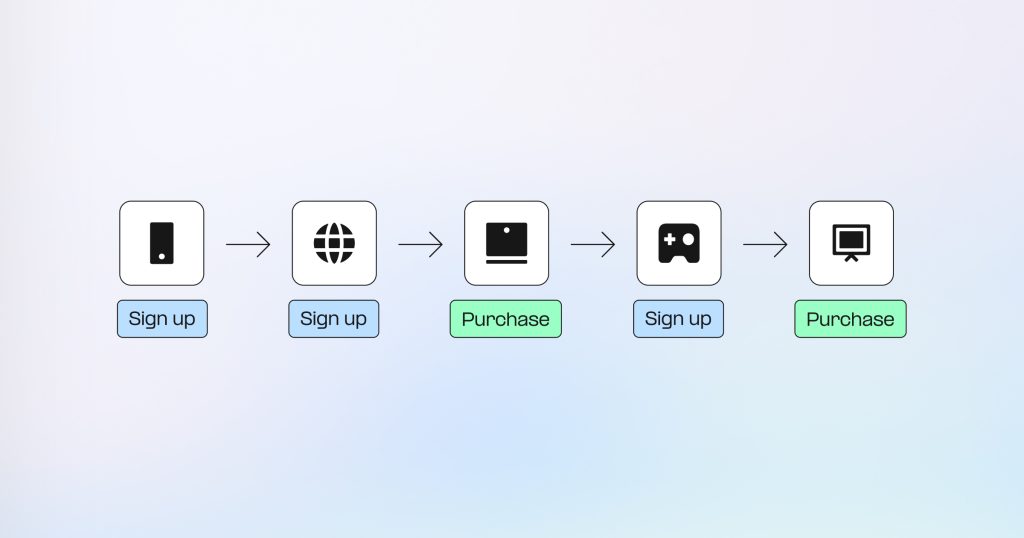
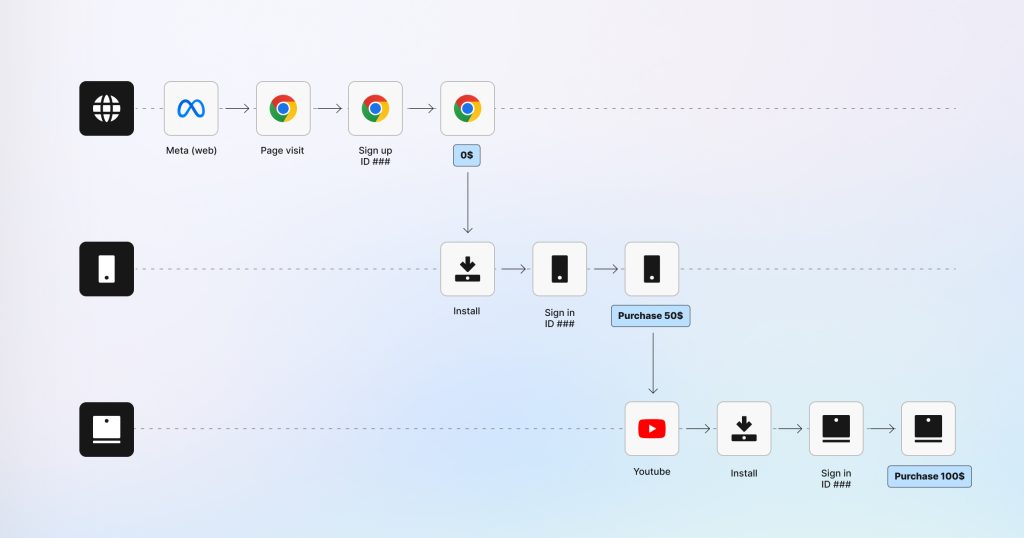
A customer who signs up on web, purchases on the app, and buys again on PC appears as three separate users in siloed reporting. In practice this means the paid campaign that drove the original web signup gets zero credit, the app purchase looks organic, and the PC revenue is attributed to whatever last-touch channel happened to be in the path. Your team scales the wrong campaigns, underinvests in the channels actually driving revenue, and your blended CPA looks better than it is. With cross-platform measurement, that same customer is one attributed journey with one LTV figure, and the campaign that earned it gets full credit.
Why is cross-platform measurement so hard?
Most teams already know their reporting is fragmented. The harder question is where the fragmentation actually comes from.
Three problems usually create it.
Data is siloed by platform
Web, mobile, CTV, console, and other digital channels often operate as disconnected data silos, producing conflicting reports and incomplete LTV calculations because each platform only sees part of the customer journey.
No neutral referee.
Meta, Google, retail media networks, and other platforms frequently claim full credit for the same conversion. That is duplicate attribution, and it inflates reported ROAS while hiding which campaigns are actually driving high-LTV customers. This is not a technical glitch. It is structural. GA4 is Google measuring Google’s channels. Platform pixels self-report. Without an independent layer applying your business logic, every network’s number is biased toward itself.
Stitching is manual
Most teams rely on BI tools and custom pipelines that break as platforms and APIs change, leaving marketers dependent on delayed reporting, fragile datasets. Any time there is a platform update or API change, teams have to manually rework the entire process, cutting heavily into resources and time. The cost compounds for AI: modern optimization systems and agentic budget reallocation all require clean, normalized, cross-surface data to function reliably. Fragmented inputs do not just produce wrong reports, they produce wrong autonomous decisions at scale.
What does unified cross-platform measurement look like?
When we enable CUID stitching for brands, the first thing most teams notice is that their reported LTV jumps, not because revenue grew, but because cross-surface purchases that were previously invisible get attributed correctly. A customer who has three disconnected events becomes one journey, and the campaigns that drove them start getting the credit they earned.
With unified measurement, what the industry also calls cross channel measurement, the same three-platform journey resolves into one number. One customer, one attributed LTV, visible immediately, no BI merging required.
Cross channel performance becomes measurable because every touchpoint across web, iOS, Android, PC, and CTV connects under one customer identity. Revenue connects back to the original acquisition source, with the option to attribute it to a re-engagement touchpoint as well. And instead of waiting days for BI teams to reconcile reports across platforms that cannot be compared apples to apples, your team accesses stitched journeys in real time.
Cross platform performance becomes measurable because customer journeys across web, mobile, PC, and CTV connect under one identity. Revenue connects back to the original acquisition source, giving marketers one consistent cross-platform attribution view across every channel.
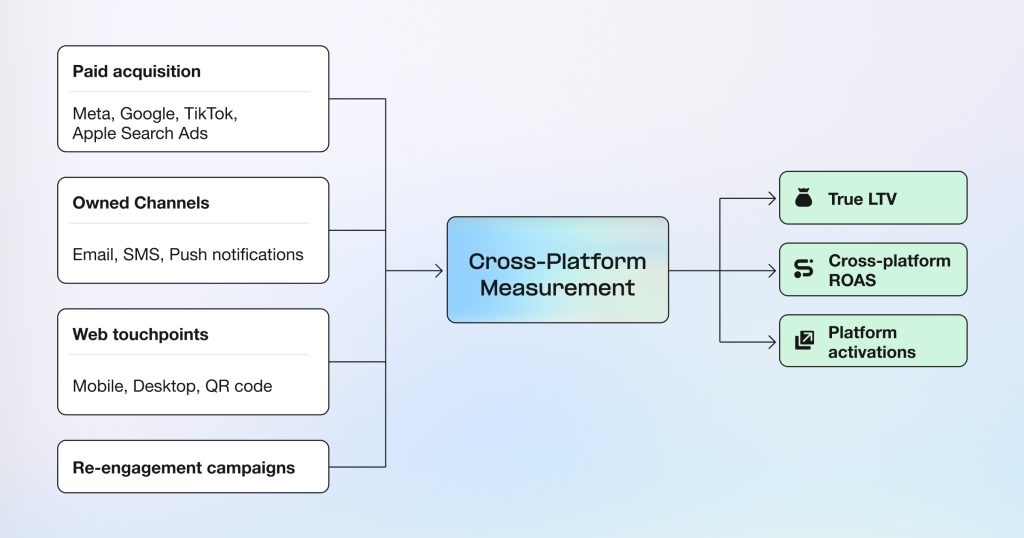
Instead of waiting for BI teams to manually merge reports, you can access stitched customer journeys in real time through dashboards, exports, and AI-assisted querying.
What are the key components of a cross-platform measurement framework?
A complete framework has four components:
- Customer Unique ID (CUID): A persistent identifier, usually a hashed email or login ID, that stitches customer activity across surfaces
- Product Line grouping: Groups multiple apps and digital assets under one reporting umbrella, so you see the complete customer funnel regardless of which device or surface your customer engaged with
- Unified attribution logic: Applies consistent attribution windows and event definitions across all channels
- Real-time data access: Makes stitched data available in dashboards, BI systems, and AI tools
The full surface map for a complete framework covers mobile on iOS and Android, desktop and web, tablet, Connected TV, and AI surfaces including chat-driven discovery.
What are the options for cross-platform measurement?
Most teams approach cross-platform measurement in one of two ways.
- Unified measurement platforms
Third-party measurement providers apply a consistent attribution layer across surfaces, handling identity stitching, deduplication, media measurement, and reporting in one system.
Of these, only AppsFlyer connects mobile, web, CTV, and retail media attribution in a single stack without requiring a separate identity partner. That is the gap this article is built around. Singular and Airbridge cover mobile-first use cases with partial cross-platform capability. Adjust operates at device level without cross-platform attribution, no customer identity stitching, no cross-surface LTV. GA4 covers web and, via Firebase, mobile app events, but it has no native CTV measurement, no cross-network deduplication, and stitching identity across surfaces requires a manual User-ID implementation rather than coming built in.
In practice, that means AppsFlyer can apply a defined rule, such as first-touch, last-touch, or a custom weighted model, whenever two networks log the same conversion, and apply that rule consistently across Meta, Google, TikTok, and every other source. The result is one deduplicated attribution record per conversion, not several competing claims that each look correct in their own dashboard.
AppsFlyer also captures web conversions via server-side (S2S) postbacks without a Web SDK required. This bypasses ad blockers and browser restrictions, and typically captures around 20 percent more conversions than client-side implementation alone.
- DIY infrastructure
Some organizations build their own measurement layer using a data warehouse and identity graph.
This approach gives full ownership over identity and attribution logic, but it requires a mature data engineering function and ongoing maintenance as platforms and APIs evolve.
For teams running marketing campaigns across multiple media channels, a unified platform is usually the more practical option.
| Capability | DIY | Basic MMP | GA4 | AppsFlyer cross-platform |
| Customer-level attribution | Possible, complex | Device-level | Web + app (Firebase); cross-surface needs manual User-ID setup | Yes, all surfaces |
| True cross-platform LTV | Manual build | No | No (LTV limited to web+app property, not CTV/retail media) | Yes |
| Retail media support | Manual | No | No | Yes |
| CTV coverage | Manual | Limited | No | Yes |
| Custom key acquisition events | Yes, complex | Limited | Yes, web + app (up to 25 params per event) | Yes, per surface |
| Funnel reporting across surfaces | Manual build | No | Web + app only, no CTV/retail media | Yes |
| Independent of ad networks | Yes | Partial | No (Google-owned) | Yes |
| Server-side (S2S) postbacks | Custom build | No | Limited (Measurement Protocol supplements client-side tracking, requires existing tag) | Yes |
| AI-powered optimization loop | No | No | Limited (predictive metrics, Google Ads integration) | Yes |
| Setup complexity | High | Low | Low for web, higher once cross-surface stitching is added | Low |
| Privacy-ready | Depends | Yes | Partial | Yes |
How can you measure across platforms with AppsFlyer?
We have seen what happens when the same customer is measured in silos. The short version is that every channel looks better than it is, and every budget decision is wrong by a predictable amount. The Meta campaign that actually drove the customer in gets zero credit. Whatever channel happened to be active at the moment of conversion gets full credit instead. The team scales the wrong thing.
AppsFlyer solves that problem by giving marketers one unified measurement layer across every surface. Instead of treating web, mobile, and CTV as separate reporting environments, AppsFlyer connects every touchpoint under one customer identity using Product Line grouping and CUID stitching.
The result is one consistent view of cross-platform LTV, ROAS, attribution, campaign performance, and media performance across the entire customer journey.
One unified view instead of disconnected reports
Without unified measurement, the same customer often appears as separate users across web, app, PC, and CTV dashboards. That leads to duplicate attribution, inflated ROAS, and incomplete LTV reporting.
AppsFlyer connects those fragmented touchpoints into one attributed customer journey, so you can finally measure cross channel performance from one consistent source of truth instead of stitching reports together manually.
Cross-platform ROAS that reflects the full customer journey
Most attribution platforms only measure what happens on a single device or app. AppsFlyer connects revenue generated later across web, PC, CTV, and other digital channels back to the original acquisition source.
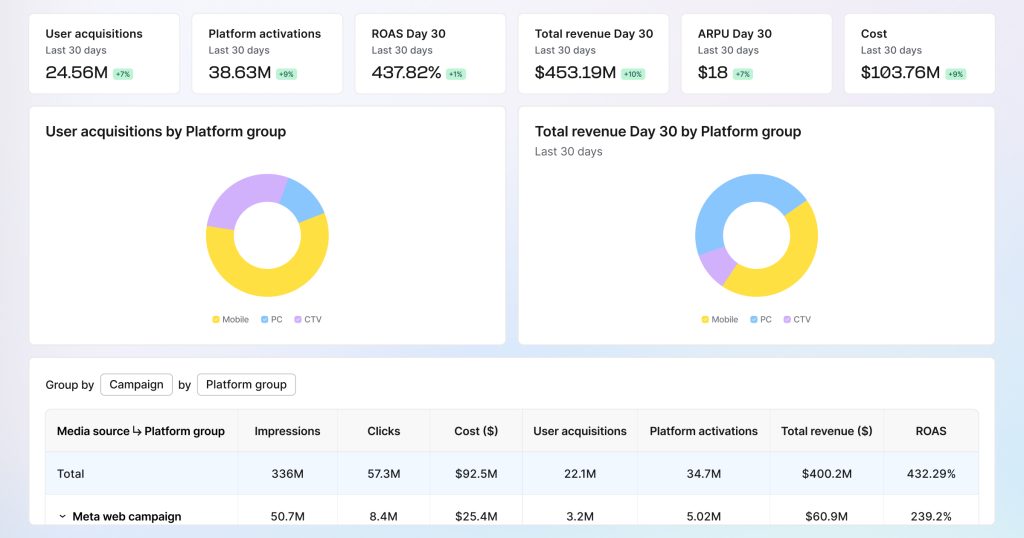
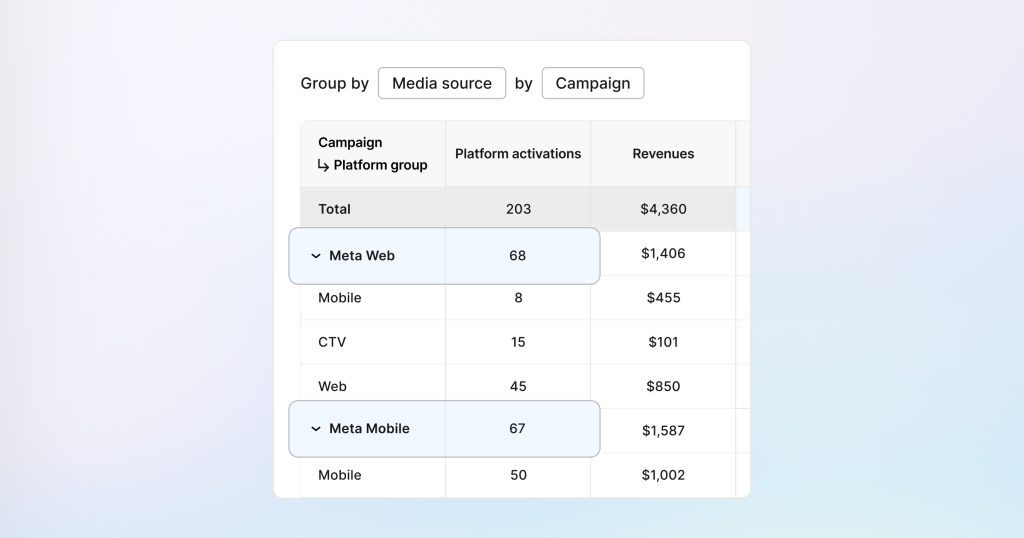
A Meta mobile marketing campaign showing 60 customer acquisitions, 67 platform activations, and $1,587 total revenue appears as one row, not three separate reports. That gives marketers a much clearer view of which campaigns are actually driving long-term customer value.
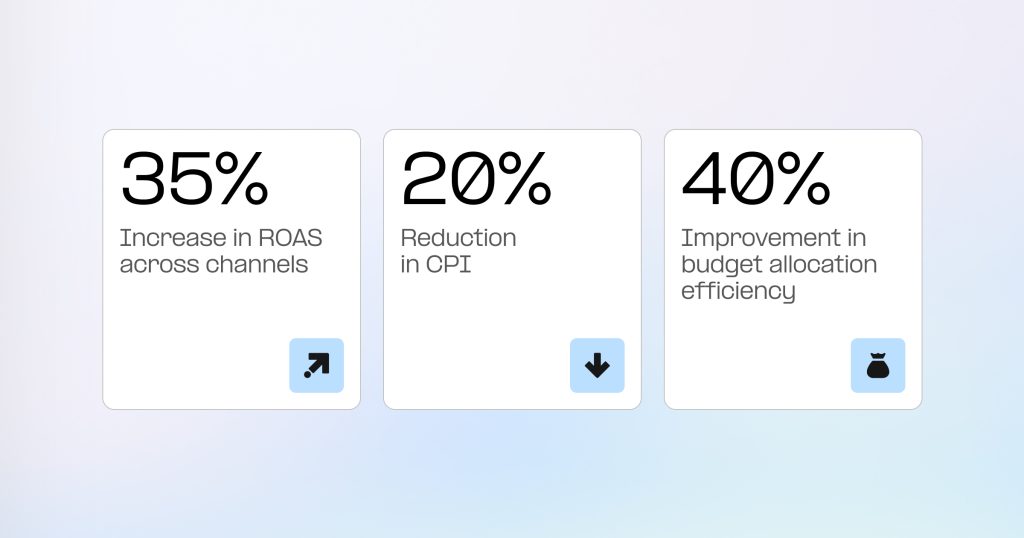
FuboTV had exactly this problem. Customers would see a mobile ad, sign up on the web, and the mobile campaign got zero credit for the subscription. Once AppsFlyer unified their mobile, web, and connected TV data under one customer identity, the team could see which mobile campaigns were actually driving web subscriptions. Budgets were reallocated accordingly. The result was a 15% reduction in CPI and a 20% increase in budget allocation efficiency, both traceable directly to having one attribution view across devices instead of three separate reports.
“There’s no other tool that aggregates and measures the data the way AppsFlyer does. Consolidating, comparing and being creative with the data helped our marketing teams come together to learn and rethink our marketing strategy across all channels and devices.” Vincent Eterlet, Head of Mobile Growth Marketing at fuboTV:
Faster decisions with real-time unified data
Unified measurement only matters if marketers can actually use the data. AppsFlyer makes stitched datasets available in real time through dashboards, BI integrations, Data Locker, and AI-assisted querying.
Teams can analyze cross-platform LTV, platform activations, campaign performance, and media performance from one consistent dataset instead of manually merging reports across systems.
The same dataset can be viewed in dashboards, streamed into BI environments through Data Locker, or queried in natural language through the AI assistant and Marketing Control Panel. A marketer can ask, “What is the total customer LTV for my Meta mobile campaign, and how many platforms have been activated?” and get an accurate answer instantly.
Built for AI-driven optimization
Because AppsFlyer unifies customer-level measurement across mobile, web, CTV, and emerging AI surfaces, the same dataset can power automated budget allocation, re-engagement, and cross-surface optimization using consistent customer-level signals.
Unified measurement is what makes AI-driven optimization reliable. Without clean cross-platform data, automation systems optimize against fragmented signals and incomplete attribution.
One measurement layer across the full media mix
AppsFlyer also acts as an independent measurement layer across the full media mix. It ingests cost data from 10,000+ integrated partners and deduplicates conversions based on your business logic instead of platform self-reporting.
When Meta and Google both claim the same conversion, AppsFlyer determines which source actually drove it. The result is one consistent view of media performance, attribution, and customer value across every channel.
AppsFlyer now supports over 100,000 active mobile and CTV apps and more than 15,000 customers globally, including Walmart, HBO, TikTok, Etsy, and Visa.
How does siloed measurement compare to cross-platform measurement?
| Feature | Siloed (per-device) | Cross-platform (AppsFlyer) |
| Customer identity | Device-level only | Customer-level (CUID) |
| LTV measurement | Per platform, incomplete | True cross-platform LTV |
| Attribution | Last-touch per device | Original acquisition source with the ability to give credit to re-engagement sources as well |
| Platform coverage | Mobile or web, not both | Mobile, web, PC, CTV, console |
| Data stitching | Manual, BI hours | Automated, real time |
| Cross-platform ROAS | Not available | Yes |
| Campaign grouping | Per channel silo | Cross-platform campaign view |
| BI integration | Manual export and merge | Hourly unified dataset |
| Tablet measurement | Undercounted | Unified mobile measurement |
| AI-powered optimization loop | No | Yes, via agentic suite |
How do you choose the right cross-platform measurement approach?
For most teams running marketing campaigns across multiple media channels, including mobile, web, CTV, and console, a unified measurement platform is the practical choice. Building your own identity graph and stitching layer internally is possible, but it requires a mature data engineering function and ongoing maintenance as platforms and APIs change.
A platform like AppsFlyer handles the stitching, attribution, deduplication, and reporting in one system, making cross-platform LTV and ROAS visible without relying on manual BI work.
A DIY approach makes more sense for organizations that already operate a large internal data infrastructure and need full ownership over how identity and attribution are managed.
Make cross-platform measurement your baseline for 2026
Cross-platform data fragmentation is a solvable problem, not a permanent constraint. Seeing true customer LTV across web, app, and CTV does not require rebuilding your data stack. It requires a consistent identity layer, a unified attribution schema, and a measurement platform that applies both across every surface your customers touch.
For the first time, the same attribution logic and identity layer that powers your mobile measurement now covers every surface your customers actually use. As AI agents begin making autonomous budget decisions across surfaces, brands with unified measurement will have cleaner signals and faster optimization than those still reconciling dashboards manually in 2027.
Your measurement should reflect that.
Start with the Omnichannel Advantage report to see how leading brands are unifying measurement across web, app, and CTV.
Ready to see it for your own stack? Talk to our team.
FAQ
Cross-platform measurement connects customer activity across web, mobile, CTV, console, and other digital channels into one unified view. Instead of treating the same person as separate users on different platforms, it stitches every interaction into one customer journey with one attributed LTV and ROAS figure.
Cross-device measurement monitors the same customer across multiple devices, like a phone and laptop. Cross-platform measurement goes further by connecting activity across completely different environments, including web, mobile apps, CTV, and console.
Unified marketing measurement applies one consistent attribution model across every channel, platform, and customer touchpoint. Instead of relying on disconnected reports from different systems, marketers get one consistent view of campaign performance, LTV, and media performance.
Cross-platform attribution works by assigning a persistent customer identifier, usually a Customer User ID (CUID), across every platform. When a customer converts on web, app, PC, or CTV, the revenue connects back to the original acquisition source instead of being split across separate reports.
A CUID, or Customer User ID, is a persistent identifier such as a hashed email or login ID. It connects customer activity across platforms, making it possible to stitch web, app, and CTV interactions into one customer journey.
Group your apps and digital assets under a Product Line in AppsFlyer, implement the CUID using a consistent login-based identifier across every surface, and toggle on cross-platform measurement in the Product Line settings. Note that CUID implementation is the most engineering-intensive part of the setup. The effort depends on how your event data is currently structured. Once the CUID is in place, dashboard configuration requires no additional code.
Once CUID stitching is active, every purchase across web, app, PC, and CTV connects back to one customer identity and one acquisition source. This creates one unified LTV figure instead of separate platform-level revenue reports.