
Cross-channel marketing analytics: how it works in 2026


If you’re comparing Meta’s numbers to Google’s numbers in two separate dashboards and calling that cross-channel analytics, you’re not there yet. You’re watching two platforms take credit for the same customer, and paying for it twice without realizing it.
We’ve all heard the “connect your channels” pitch by now, usually followed by a demo of a better-looking dashboard. Here’s what those pitches tend to skip: a nicer dashboard doesn’t fix an identity problem. Until you can resolve the same customer across every channel that touched them, whatever attribution model you’re running is measuring channel credit, not customer value. This guide walks through what actually fixes that, so you can stand behind your numbers instead of quietly hoping they hold up.
TL;DR
- Cross-channel marketing analytics means no channel gets credit for a conversion another channel already earned
- The core problem is a fragmented identity. The same customer looks like multiple people in siloed systems, so the same revenue gets counted several times across several channels
- You likely have multi-channel analytics, not cross-channel analytics. The difference is a single identity layer connecting the data before attribution runs
- A Customer User ID (CUID) is the technical foundation that makes everything else work
- Clean attribution is also the prerequisite for AI-driven optimization. Automated systems can only optimize toward what they can measure
What is cross-channel marketing analytics?
Cross-channel marketing analytics is about measuring how your different marketing channels, including paid social, search, owned media, and retail media, actually work together to drive a conversion, using one consistent attribution model instead of letting each channel report its own numbers and hoping they add up.
A dashboard showing Meta’s numbers next to Google’s numbers next to TikTok’s numbers feels like progress. It isn’t. It’s channel aggregation, not cross-channel analytics. Cross-channel analytics means that when Meta, Google, and an email campaign all touch the same customer journey, credit for the resulting sale gets split once, consistently, across the channels that actually contributed, instead of claimed in full by each of them at the same time. In AppsFlyer’s data, brands that unify channel-level attribution typically see a 30%+ uplift in attributed revenue and average revenue per user, with documented cases of up to a 60% increase in revenue and a 20% lift in ROAS once deduplicated measurement is in place.
That distinction changes everything about how you calculate ROAS and allocate budget across networks. And it changes how your AI optimization tools behave, too: automated bidding systems can only optimize toward the credit they’re shown, so if every channel is overclaiming, your AI ends up optimizing toward whichever channel shouts the loudest, not the one actually doing the work.
Why is cross-channel analytics harder in 2026?
Three things have made this structurally harder since 2022, and none of them are going away on their own, so you might as well get ahead of them.
- Signal loss from privacy framework: Apple’s App Tracking Transparency (ATT) removed the IDFA (Identifier for Advertisers), the identifier that used to power deterministic cross-device measurement, for non-consenting iOS users. Third-party cookie restrictions on Safari and Firefox are doing something similar on web. The identity bridges you used to rely on to connect customers across sessions simply don’t exist by default anymore. The only fix that actually holds up is a first-party identifier set at login, one that doesn’t depend on whatever a browser or OS decides to allow this year.
- Walled gardens and fragmentation: Every major ad platform, including Meta, Google, TikTok, Amazon, and retail media networks, measures its own contribution using its own logic. A sale Amazon claims in its dashboard is often the exact same sale your mobile measurement partner (MMP) already attributed to a mobile campaign.
- Identity breaks across surfaces: Your customer on mobile web, iOS, and desktop are three different people in siloed systems. IDFA on mobile, cookie on web, CTV device ID, retailer login ID. None of these map to each other natively. A customer journey that touches all four looks like four separate customers in four separate dashboards.
AI-driven marketing is multiplying campaigns and channels faster than measurement can keep up. Every new surface you activate without a unified identity layer is just one more blind spot in your attribution model.
What’s the difference between cross-channel and omnichannel analytics?
Cross-channel analytics unifies attribution across marketing channels (Meta, Google, TikTok, owned media) so the same conversion isn’t claimed multiple times. Omnichannel analytics is the broader layer built on top of that: it connects the full customer journey across every surface a customer touches, including offline and in-store activity, into one continuous path rather than a set of channel totals.
| Dimension | Cross-channel analytics | Omnichannel analytics |
| What it unifies | Marketing channels (Meta, Google, TikTok, owned media) | Full customer journey, including offline and in-store touchpoints |
| Core problem it solves | Multiple channels claiming credit for the same conversion | Disconnected touchpoints that look like separate customers |
| Output | One deduplicated conversion, one accurate CAC/ROAS per channel | One continuous journey across every surface, online and offline |
| Typical question answered | “Which channels actually drove this sale?” | “What was the full path this customer took, start to finish?” |
What are the key components of a cross-channel analytics system?
Four components have to work together, and most setups are missing at least one without realizing it.
Unified data collection
Every surface needs to send event data through a consistent schema. For mobile, that means an SDK. For web, a server-to-server (S2S) integration is more reliable than a pixel. S2S bypasses ad blockers and captures conversions that client-side tags miss. Without this, web revenue is undercounted and the identity layer downstream cannot connect what it cannot see.
Identity resolution
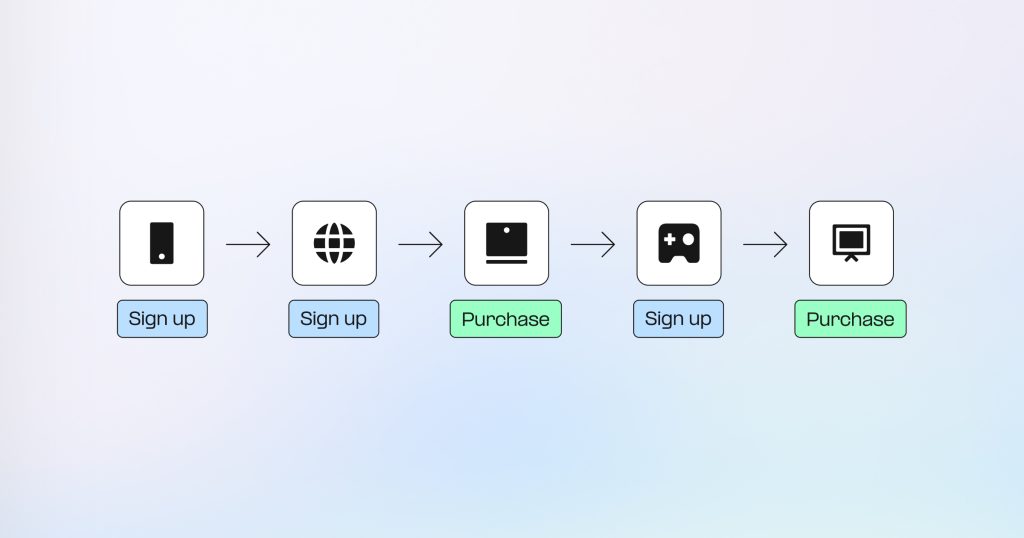
The hardest component and the most underinvested. Post-ATT and post-cookie, platform-provided identifiers no longer connect the same customer across sessions and surfaces. A first-party Customer User ID, a login-based identifier your brand controls, is what makes this possible. Without a CUID, attribution runs on fragmented data. With it, every session, install, and purchase across mobile, web, PC, and CTV connects into one journey.
Attribution modeling
The modeling layer assigns credit to channels that influenced each conversion. But if every channel is still self-reporting and overclaiming, a fancier model won’t fix that. It just applies more sophisticated math to numbers that were already inflated before the model ever saw them.
Unified reporting and AI readiness
A reporting layer that shows Meta’s self-reported revenue next to Google’s self-reported revenue has not solved the overclaim problem, it’s just put it on better display. A properly unified layer deduplicates before the numbers ever surface. And that same deduplicated dataset is what feeds agentic AI: automated bidding, budget reallocation, re-engagement flows, all of it is only as good as the data going in.
Which attribution model should you use?
No model is correct in all situations. Here is what each one actually does and where it breaks.
Traditional fractional models assign credit based on rules:
- First-touch gives 100 percent credit to the first interaction. Good for measuring awareness channel contribution. Ignores everything that followed.
- Last-touch gives all credit to the final interaction before conversion. The default in most ad platforms and the most likely to mislead: the channel that shows up last is usually retargeting or branded search, not the one that drove the customer.
- Linear gives equal credit to every touchpoint. More complete than single-touch, but treats a CTV impression and a bottom-funnel click as equivalent.
- Time-decay weights recent touchpoints more heavily. Makes sense for short purchase cycles. Systematically undervalues channels that built intent weeks earlier.
- Position-based (U-shaped) gives the most credit to first and last touch, and distributes the rest across the middle. A practical starting point if you run paid acquisition.
- Data-driven attribution uses statistical modeling to assign credit based on actual conversion patterns in your data. The most accurate model, but it requires significant conversion volume (typically 50,000+ monthly conversions) and a platform that can run it across all surfaces.
- Incrementality testing asks a different question: not which channel got credit, but whether the conversion would have happened without the campaign. Hold out a control group, compare conversion rates, and the difference is true incremental lift. The only approach that produces causal rather than correlational answers.
- Media Mix Modeling (MMM) uses aggregate data to measure channel contribution over time, including offline, TV, and surfaces where user-level attribution cannot reach. A complement to user-level attribution, not a replacement.
| Model | Best for | Key limitation | Requires unified data | Cross-surface compatible |
| First-touch | Brand and awareness measurement | Ignores the full journey | No | Partial |
| Last-touch | Simple funnels and fast cycles | Overstates retargeting and branded search | No | Partial |
| Linear | Understanding full journey contribution | Assumes equal impact across touchpoints | Yes | Partial |
| Time-decay | Short purchase cycles | Penalizes early-stage channels | Yes | Partial |
| Position-based | Balanced acquisition and conversion view | Still rules-based, not data-driven | Yes | Partial |
| Data-driven attribution | High-volume multi-channel funnels | Requires conversion volume and capable platform | Yes | Yes, with CUID |
| MMM | Offline and unmeasurable channels | Aggregate only, no user-level detail | No | Yes, complementary |
| Incrementality | Proving true causal lift | Requires holdout setup and time | Yes | Yes |
Most single-touch and basic multi-touch models break when a customer crosses from CTV to web to app. Data-driven attribution and incrementality testing are the only models that handle cross-surface revenue correctly.
How do you choose the right cross-channel analytics tool?
Start with your actual use case, not the demo that impressed you most.
Mobile-first?
Choose an MMP-led stack. iOS ATT, SKAdNetwork reconciliation, and cross-surface stitching are all MMP-native problems. Google Analytics (GA4) has no mobile attribution, no CTV coverage, and a structural conflict of interest for brands running Google Ads. It is Google measuring Google’s channels.
Web-first?
GA4 and CDPs are the usual starting point. GA4 works for web-only measurement. As soon as mobile or CTV enters the channel mix, it recreates the silo problem in a different form.
Running omnichannel?
You need an independent MMP, one that does not sell ads. Any measurement tool that also buys media has a financial incentive to report that media favorably.
Key things to evaluate
Does the platform cover mobile, web, and CTV natively? Is it independent of every ad network it integrates with? Does it push deduplicated data to your data warehouse in real time?
Tool categories at a glance
MMPs (AppsFlyer, Adjust, Singular) for independent attribution across paid channels. CDPs (Segment, mParticle) for data routing. They do not deduplicate conversion claims. BI layers (Looker, Tableau) for visualization, only as good as the deduplication upstream. Ad platform native analytics for directional input only, never as a source of truth.
What the alternatives miss
Most cross-channel marketing analytics software falls short in a specific way. Improvado aggregates self-reported data from platforms. It does not deduplicate before reporting. Cometly covers paid web ROAS but not mobile attribution or CTV. Amplitude starts post-install. It measures in-product behavior, not campaign attribution. Braze executes campaigns but does not measure what drove the conversion. Salesforce attribution is tied to its own ecosystem with no mobile app attribution depth. None of them can act as an independent attribution layer across mobile, web, and CTV simultaneously.
If you build your own measurement infrastructure, you own every API change, every new surface integration, and every privacy framework update. If you’re running campaigns across four or more channels, a unified platform is the faster path.
How can you measure across channels with AppsFlyer?
Measurement starts with a persistent CUID that connects every surface your customer touches into one journey. Everything else, cross-platform dashboards, web-to-app measurement, incrementality testing, follows from that.
Cross-platform measurement
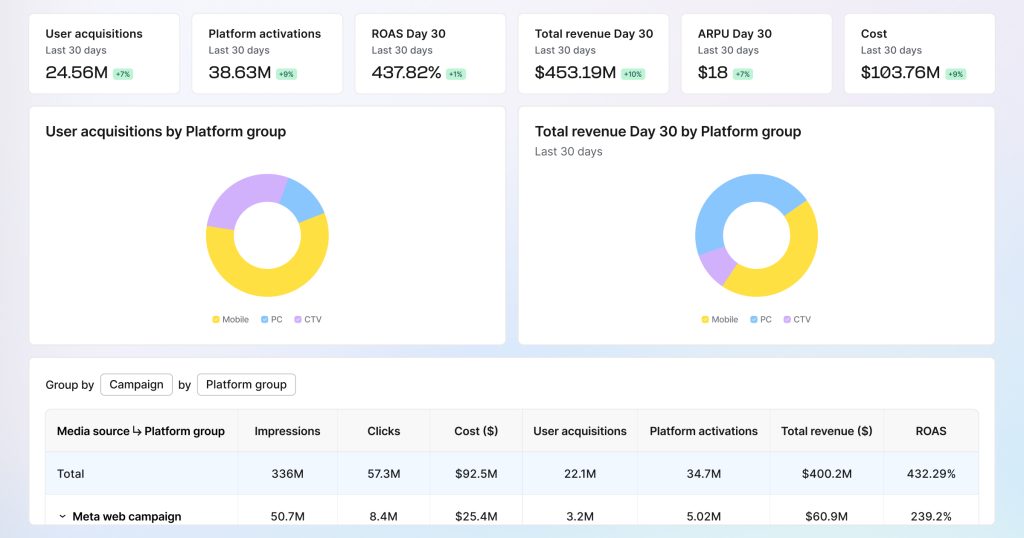
Group your apps and assets under a Product Line in AppsFlyer and enable cross-platform measurement with CUID-based stitching. A customer who sees a Meta ad, signs up on web, installs on iOS, and purchases on PC is one customer with one revenue figure, not four events across four reports. A Meta mobile campaign showing 60 acquisitions, 67 platform activations, and $1,587 total revenue (mobile $1,002, CTV $132, web $453) appears as one row. Because AppsFlyer is independent of all 12,000+ ad networks it measures, that number reflects your business rules, not the platform’s preferred attribution window.
Web-to-app continuity

Without proper instrumentation, a customer who clicks a paid web ad and downloads your app through a Smart Banner looks like an organic install. AppsFlyer’s Smart Script captures the original campaign parameters and passes them through the install process, so every downstream purchase traces back to the campaign that drove the web visit. Smart Banners that implement this typically drive a 67 percent lift in web-to-app conversions.
Incrementality testing
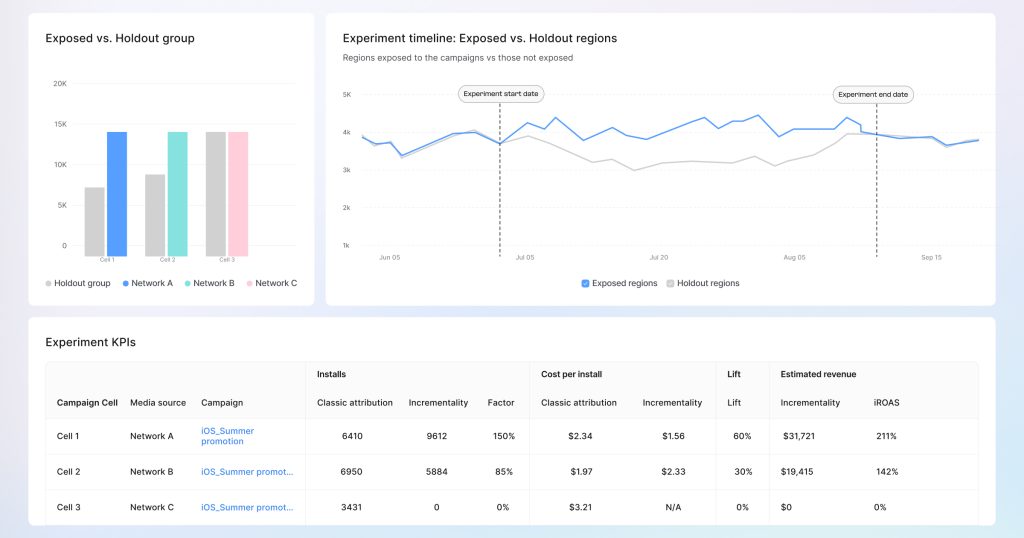
Attribution tells you which channel got credit. AppsFlyer’s Incrementality measurement tool tells you whether the credit was earned, using a holdout group the ad platforms cannot influence. That is the only way to know whether your retargeting spend is driving real incremental revenue or claiming credit for customers who would have converted anyway.
Data Locker
If your BI team runs internal models or MMM analysis, AppsFlyer pushes attribution-ready raw data directly to your cloud storage (AWS, Google Cloud, Snowflake, BigQuery, Azure) on an hourly basis. Web and mobile data share the same schema, so no custom joins are required.
Agentic AI Suite
Clean, deduplicated attribution data feeds directly into automated optimization: budget reallocation, AI-triggered re-engagement, real-time ROAS adjustment, without manual intervention. The measurement layer is the foundation. The AI suite is what acts on it.
Sweetgreen is a good example of this in practice. Sweetgreen’s web and app purchases were tracked by separate systems that double-counted some conversions and undercounted others, so the team could not tell which channels were actually working. Unifying measurement with AppsFlyer corrected the picture and drove a 17 percent increase in overall marketing ROI.
“AppsFlyer’s holistic web and app attribution brought the missing data pieces to our revenue and LTV measurement. This allowed us to take better control of our overall marketing strategy and budget.” – Jeff Lin, Director of Media & Growth, Sweetgreen
“Thanks to AppsFlyer, we were able to measure campaign performance accurately and optimize our media mix in real time, resulting in significant improvements in ROI.”
– Jinnal Gori, Digital Marketing Manager, Wellness Forever
How do you build a reliable cross-channel measurement foundation?
Cross-channel marketing analytics isn’t a reporting upgrade you bolt on at the end. It’s what every budget decision in your business ends up running on, whether you’ve noticed that yet or not.
Deduplication has to come first. Attribution models, dashboards, and AI optimization are all downstream of whether channels are still claiming credit for conversions that don’t belong to them.
As AI agents start making autonomous budget decisions across channels, fixing the overclaiming problem now is what separates teams that optimize faster and waste less from the ones still reconciling platform-reported numbers by hand in 2027.
Explore AppsFlyer’s cross-platform measurement or request a demo to discuss your setup.
Frequently asked questions
Cross-channel analytics unifies measurement across digital surfaces, including mobile, web, and CTV, under a single identity layer. Omnichannel analytics extends that same approach to physical retail and other offline touchpoints. Cross-channel is the foundation. Omnichannel is what you build on top of it once that identity layer is in place.
Assign each customer a Customer User ID and pass it consistently across web, app, and CTV. Once that identifier follows the customer across every surface, your measurement platform can stitch their events into one journey.
For web-only measurement, yes. Once mobile or CTV enter the picture, no. GA4 has no native mobile attribution or CTV coverage, and because it is Google measuring Google’s own channels, it carries a structural conflict of interest. Brands running campaigns across more than one surface need an independent MMP.
Signal loss is the reduction in measurement visibility caused by iOS App Tracking Transparency (ATT), third-party cookie restrictions on Safari and Firefox, and walled gardens restricting what data they share. It means a growing share of customer journeys can no longer be reliably connected using platform identifiers alone.
The reporting layer, including dashboards, integrations, and attribution models, typically comes together in days. Getting deduplication actually right takes longer, since it means agreeing on lookback windows and business rules for which channel gets credit when multiple platforms claim the same conversion, and that depends on how clean your existing conversion data already is. The reporting setup is rarely the bottleneck. Getting the dedup logic right is.