Strong open rates, weak app revenue: your email campaign isn’t broken. Your links are.

TL;DR
- Email, SMS, and push are your highest-intent owned channels. When a customer clicks, they are not browsing. They are returning to complete something.
- Most brands see CTRs between 30–40% from owned-media campaigns. In-app conversion from those same sends? Often 1–3%.
- The gap is not your subject line, your creative, or your segmentation. It is the handoff between the click and the app, and your ESP is a key reason it breaks.
- Every major ESP wraps your links for click tracking. That wrapping is where deep link context gets stripped, routing breaks, and in-app attribution disappears
- When context is preserved at the handoff, purchase rates can be up to twice as high. When it is not, most users simply abandon.
- This failure is almost never visible in your dashboards. CRM sees a win. Product sees a miss. No one owns the gap between them.
You did everything right.
The campaign looked perfect on paper.
The abandoned cart email landed at the right time. Segmentation was tight. The incentive was personalized. The product block was dynamic. Open rates were healthy, click-through hit 35%, and the CRM dashboard showed a satisfying spike in engagement.
Then the revenue report came in.
App purchases barely moved. Re-engagement was flat. The loyalty campaign did not lift in-app behavior in any way that showed up where it counted.
Nothing was obviously broken. And yet something clearly was.
The problem did not start in the inbox. It started after the click.
What your customer expects when they tap
Email, SMS, and push are not discovery channels. They are continuation channels. When someone clicks an abandoned cart reminder, they are not browsing. They have already decided. They are returning to complete something they started. That click carries real ready-to-convert intent.
This is why brands invest heavily in routing owned-media traffic into the app. The app converts better than mobile web. App users spend more and retain longer. Sending your highest-intent traffic to your highest-performing surface is the obvious move.
The numbers no one puts next to each other
Brands running owned-media campaigns typically see solid click-through rates between 30 and 40 percent. The kind of numbers that get highlighted in campaign reports and shared in leadership updates.
In-app conversion from those same campaigns? Often sitting between a mere 1 and 3 percent.
The drop between click and meaningful in-app action is not a rounding error. It is a structural gap.
When cart or product context is preserved correctly at the handoff between email and app, purchase rates can be up to twice as high. When context is lost, most users abandon rather than rebuild the journey themselves.
Something is happening between the click and the app, and it is not your creative.
Why you are not seeing it
This is where the problem becomes severe: it hides in plain sight.
Your CRM team sees a 35% CTR and calls it a strong campaign. The slides look good, and the stakeholders are satisfied.
Your product team looks at in-app conversion and sees underperformance. They start asking about UX issues, onboarding flows, app speed.
Your growth team tries to attribute what happened between click and purchase and cannot get a clean answer.
The handoff between email and app is rarely measured as its own moment. There is no standard dashboard metric for “did intent survive this transition.” There is no alert that fires when a customer clicks your email and lands on the wrong screen.
So the gap becomes a blind spot shared by every team and owned by none of them.
Confidence in routing traffic to the app quietly erodes. Lifecycle teams start defaulting back to mobile web as the destination, not because web converts better, but because at least they can see where the funnel breaks. The app gets harder to justify as a primary destination, even though it is clearly the better environment.
Because if you cannot see the handoff, you cannot fix it.
What is actually breaking, and why your ESP is at the center of it
There is a specific layer in every email-to-app journey that most lifecycle teams never think about, because it is invisible by design.
Every major email service provider wraps your links before sending. Whether you are running campaigns through Braze, Klaviyo, Customer.io, Emarsys, Sailthru, or any of the other platforms your team relies on, the same thing happens: your original deep link gets replaced by a tracking URL that redirects through the ESP’s servers before reaching its destination. They do this for click measurement. It is a standard, expected part of how email analytics work.
That redirect is where context breaks.
The wrapping breaks the app-domain association that iOS Universal Links and Android App Links depend on to route users directly into the correct in-app experience. Instead of opening the app to the right screen, the link falls back to a less reliable method, routes the user to mobile web, or opens the app to a generic state with no context intact.
The result is predictable. The app opens. But it opens empty.
And the measurement problem compounds it. Once the click routes through the ESP’s tracking layer, the attribution chain breaks. The ESP records a click. What happens inside the app after that becomes invisible to your CRM dashboard. Marketing sees engagement while product sees drop-off. Neither team has a complete picture because the handoff lives in a gap between their tools.
The specific failure modes vary, but the pattern is consistent:
- The app opens to the homepage instead of the screen that was promised
- Customers who already have the app get routed to the App Store anyway
- Cart content disappears because session context was not passed through the link
- The right screen loads but requires the customer to log in again before seeing the offer
- Behavior differs between iOS and Android in ways that controlled QA tests never catch
- Attribution is split or lost entirely between the ESP click record and what the app sees
None of these show up as errors. They show up as drop-off. And drop-off is easy to misattribute to creative, timing, or segment quality, because no one is looking at the handoff itself.
The business impact compounds quietly
Owned-media campaigns are among the highest-intent touchpoints in your entire marketing stack. When they cannot translate that intent into in-app action, the consequences build.
Retention programs miss targets. Re-engagement investments underperform. App growth stalls even when email engagement looks healthy. Lifecycle teams start questioning whether the app is the right destination at all, which means future campaigns get routed to lower-value surfaces.
Meanwhile, the underlying economics have not changed. App users still convert better. They still spend more and generate stronger long-term value than web-only users.
The opportunity is real. The link between your campaigns and that outcome just is not holding up.
AirAsia resolved their email-to-app routing and saw email become a key re-engagement and acquisition channel, contributing to over 15% of total installs. The campaigns did not change. The context handoff did.
What the fix actually looks like
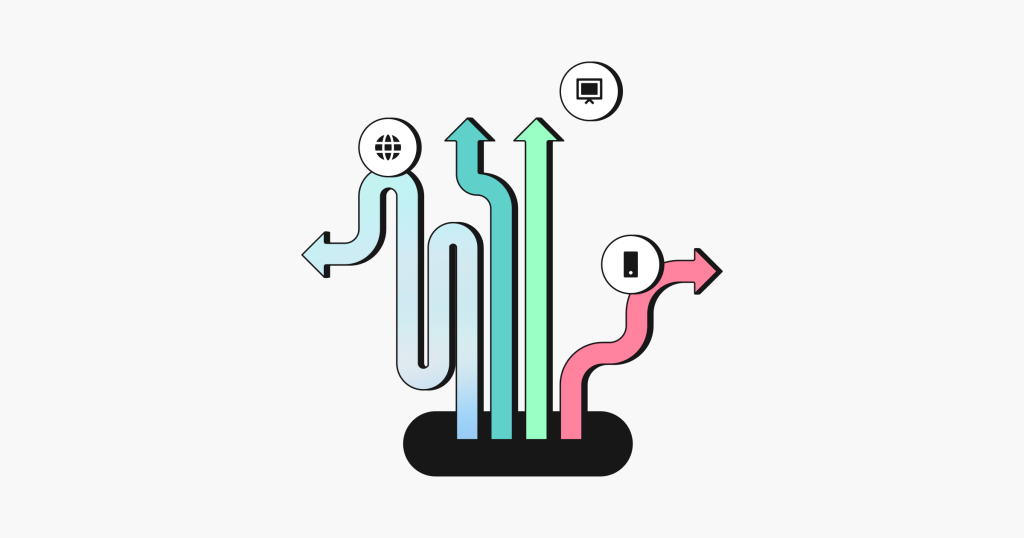
The fix is not a new campaign strategy. It is a different way of treating the link itself – as a continuation layer, not a redirect
That means every click from a CRM campaign carries context through the transition. The product the customer was viewing. Their cart state. The offer that was shown. Whether they are installed or not, logged in or not, on iOS or Android, using a third-party email client that adds its own wrapping on top of the ESP’s.
AppsFlyer’s Deep Linking Suite solves this by acting as a proxy between the ESP and your domain. Instead of the ESP’s tracking redirect breaking the app-domain association, AppsFlyer serves the technical association files that iOS and Android require to route users directly into the correct in-app experience. Deep linking works, context survives, and measurement stays intact.
This is supported natively for 19 of the ESPs your team is most likely already running, including Braze, Klaviyo, Customer.io, Emarsys, and Sailthru. See the full supported list.
AppsFlyer’s Deep Linking Suite helps teams preserve intent and context across email, SMS, QR, and deferred install flows, without requiring a paid attribution package. Explore the Deep Linking Suite or talk to an expert about your app entry gaps.
In practice, that means:
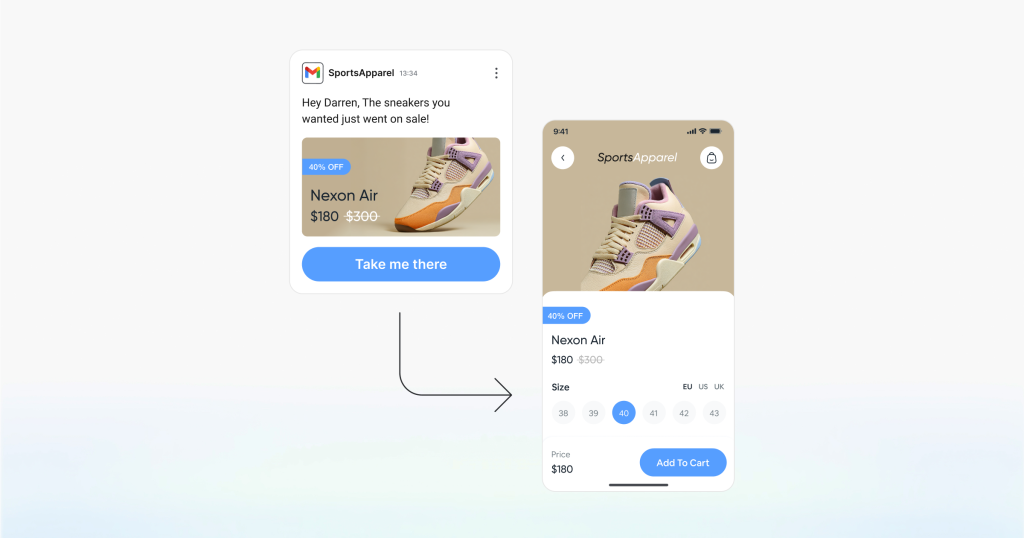
- Abandoned cart emails that open the actual cart, not the homepage
- Loyalty campaigns that land on the correct rewards screen, every time
- Re-engagement messages that continue the experience rather than restart it
- Consistent behavior across devices, browsers, app versions, and install states
- Measurement you can trust, because the handoff is finally visible and attributable
This is not a campaign optimization. It is the infrastructure layer that makes every campaign perform closer to its actual potential.
Key takeaways
- A strong CTR with weak in-app conversion is not a campaign problem. It is a handoff problem.
- Your ESP wraps links for click tracking. That wrapping breaks the app-domain association that deep linking depends on, stripping context and breaking measurement before the user ever reaches the app.
- When context is lost between click and app, the customer arrives cold, regardless of how warm the message was.
- This failure is invisible in standard dashboards because no team owns the moment between click and in-app action, and the ESP tracking layer sits between those two worlds.
- The fix lives in the infrastructure layer, not the campaign layer. And it works with the ESP stack your team already uses
- When the handoff holds, campaigns deliver closer to the intent they earned, consistently, and at every scale.