
Paid AI traffic is measurable. Now your organic traffic is too.


TL;DR
- AppsFlyer now measures ChatGPT Ads, so paid AI traffic has a clear line in your report.
- Organic AI traffic, meaning the answers that recommend your brand for free, has been a black box. Answer Engine Optimization (AEO) attribution opens it.
- It credits the AI engine that sent the customer, across web conversions, app installs, and re-engagement.
- Paid and organic AI traffic can now sit side by side in one report.
Someone asks an AI chatbot for a recommendation, and your brand comes up. They click the link, land on your site, and buy.
In your report, that sale says “direct.”
The sale is real, but nobody knows where it came from.
Sounds familiar? The AI did the work, but “direct” got the credit.
The customer journey now starts with an AI chatbot
Customers now increasingly turn to AI to decide what to buy, where to go, and who to trust. Their journeys start with a question to an AI chatbot, before they ever reach your site, your app, or your store.
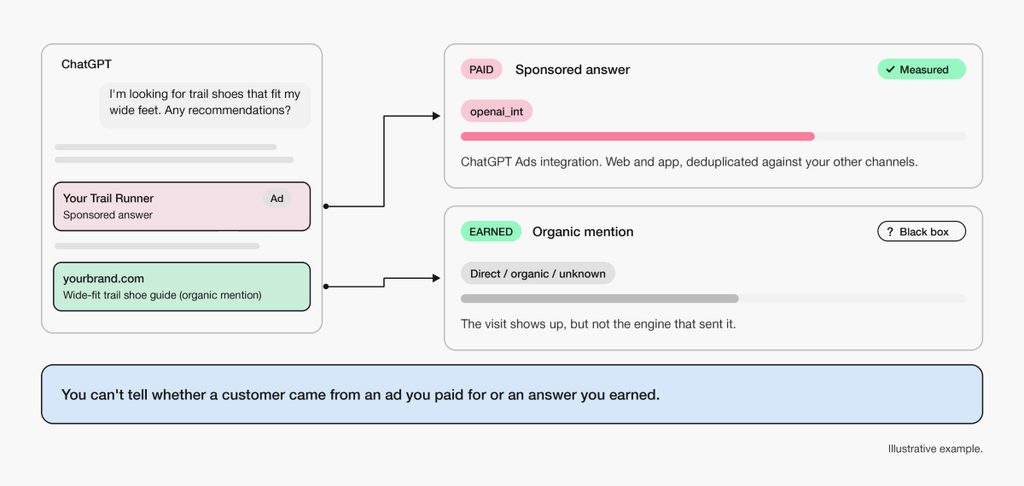
This is no longer a niche habit: ChatGPT alone has more than a billion weekly active users sending over 2.5 billion prompts a day. Every one of the questions asked in those prompts can send someone to your brand in two ways: through a sponsored ad you paid for, or through an organic mention you earned. It’s the same tool and the same intent, but the two paths are very different, and both are growing every week.
Paid is measurable. Organic is a black box.
Take ChatGPT Ads as an example. OpenAI now offers ads inside ChatGPT, and brands can measure web and app events from those campaigns, deduplicated against their other channels. That gives the paid half an independent read on what the ads delivered.
The organic half is a different story. Think of a shop that only counts the customers who walk in with a coupon. Everyone else just walks in. Some found you through search, some through a friend, and some because an AI chatbot recommended you. At the door, they all look the same.
In your reports, that traffic lands in direct, organic, or unknown, mixed in with everything else. You can’t tell how much of it came from AI, or compare one engine to another, and that quickly becomes an optimization problem. If you can’t tell whether someone came from an ad you paid for or an organic answer, you may end up paying to win back customers who would have found you anyway. Either way, you can’t defend the spend.
The fix: AEO attribution
AEO stands for Answer Engine Optimization, and AEO attribution is how you measure what it earns for your brand.
When someone clicks a link in an AI answer, their browser passes along where they came from (the web referrer). AppsFlyer reads it and credits the engine.
Eight AI engines are covered: ChatGPT, Claude, Perplexity, Manus, Copilot, Gemini, Grok, and DeepSeek. It also covers 13 search engines, including Google, Bing, and Yahoo, so SEO sits in the same view. That way you can see how AI engines stack up against search, instead of guessing which one sent the customer.
AEO attribution works across three customer journeys, and each one answers a different business question.
1. Prove which AI engines drive your online sales
For the sake of this example, let’s picture a shoe brand called Solemate that sells running shoes online. A shopper asks ChatGPT, “I’m looking for trail shoes that fit my wide feet. Any recommendations?” The answer links to a Solemate buying guide. They read it, head to checkout, and buy.
Here’s what happens behind the scenes: When the shopper lands on the page, the AppsFlyer web attribution SDK reads the web referrer. It says ChatGPT, so AppsFlyer credits the visit to that engine. When the shopper buys, the purchase is credited to the same engine. If you’d rather not add the SDK, your server can send the events to AppsFlyer instead.
| WHAT YOU WANT | To know which AI engines drive purchases on your site, so you can compare them by conversions instead of visits. |
|---|---|
| HOW YOU GET IT | Use the AppsFlyer web attribution SDK or send events server-to-server. AppsFlyer reads the referrer on arrival and ties the purchase back to it. |
| WHAT YOU GET | Purchases credited to the AI engine that sent the customer, next to your other channels. |
2. Find the AI engines that bring you new app customers
Now let’s take a Finance brand called Pocketwise, a budgeting app for freelancers. A freelancer asks Perplexity, “I’m looking for a way to manage my freelance income. Any app suggestions?” The answer links to the Pocketwise website. They tap “Get the app,” install it, and open it.
This journey has an extra step, because they leave your website to install. That’s where Smart Script comes in. It’s a small snippet of code on your website, part of the AppsFlyer Deep Linking Suite, that sits behind your “Get the app” button.
When they tap it, Smart Script checks where they came from and builds an AppsFlyer link based on that. Think of it as a note passed from your website to your app: “this person came from Perplexity.” Once they install and open the app, AppsFlyer credits the install to Perplexity. For that last step, your app needs the AppsFlyer mobile SDK.
| WHAT YOU WANT | To know which AI engines send new app customers, so acquisition teams can evaluate them like any other source. |
|---|---|
| HOW YOU GET IT | Add the AppsFlyer mobile SDK to your app and the Smart Script to your website. The script collects the web referrer and passes it to the install. |
| WHAT YOU GET | New app customers credited to the AI engine that sent them. |
3. See which AI answers bring customers back to your app
Lastly, let’s look at a travel brand called Daytripper, a trip-planning app. A customer who already has the Daytripper app asks Gemini, “I’m planning 3 days in Lisbon and love food and history. What should I do?” The answer links to a Daytripper Lisbon guide. One tap opens the app on the Lisbon guide.
Here, the customer already has your app, so there’s no install and no browser stop. This works when your web pages are mapped to the matching screens in your app, using Android App Links and iOS Universal Links (the standard way to make a link open an app instead of a browser). When the customer taps the link, the app opens on that specific screen, and the web referrer goes to AppsFlyer. AppsFlyer credits the app open to Gemini as a re-engagement. As before, your app needs the AppsFlyer mobile SDK.
| WHAT YOU WANT | To know whether AI answers bring existing customers back, and which engines do it best. |
|---|---|
| HOW YOU GET IT | Use the AppsFlyer mobile SDK, map your web pages to your app, and set up Android App Links and iOS Universal Links. The link opens the app and the referrer goes to AppsFlyer. |
| WHAT YOU GET | App opens credited to the AI engine as re-engagements, so retention teams can judge AI answers like any other re-engagement channel. |
Put paid and organic in one report
Now both halves sit together. AppsFlyer’s ChatGPT Ads integration brings in the paid events server-side, and AEO attribution adds the organic side from ChatGPT, Perplexity, and the other engines. Web conversions, installs, and re-engagements show up in the same view.
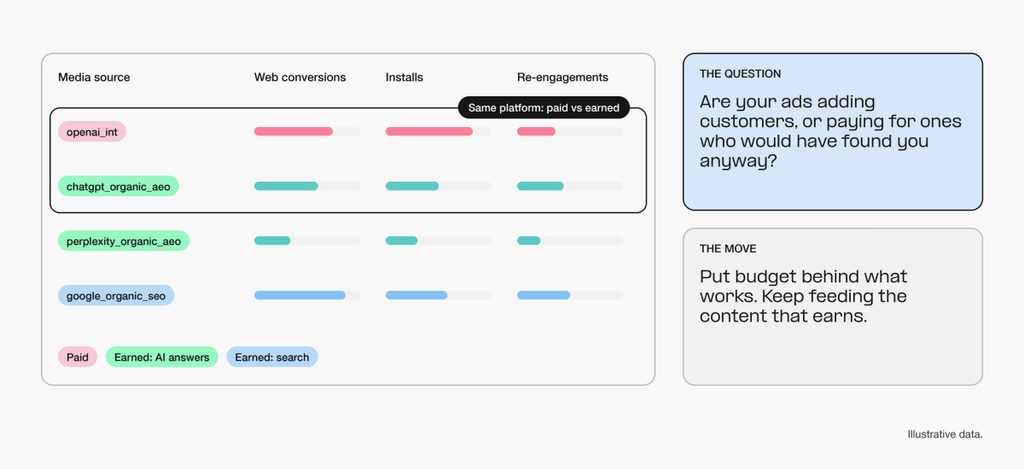
This answers a question you couldn’t answer before: is ChatGPT worth more to you as an ad channel, an answer channel, or both? With one report, you can move budget and content effort with a number behind the decision.
Optimize for the engines that deliver
If organic AI traffic turns out to bring real sales, installs, or app opens, that’s your cue to optimize your content for AI answers, so the engines are more likely to recommend you. Then check your report to see if the numbers move. If an engine sends very little, you’ll know that too.
Give organic AI traffic a line in your report
Paid AI traffic already had a line in your report. Now the organic side has one too. You can see which AI engines bring people to your site and your app, and what they do when they get there. No more guessing which engine sent them, or how much your content is really earning.
Want to try it? Start with the journey that matters most to you. This knowledge base article shows you how. Your AppsFlyer customer success manager can help too.