Cracking the 2026 Holiday Season: A Data-Backed Playbook for Marketing Leaders

TL;DR
- Black Friday behaves like one compressed day, not a week. Purchase lift runs two to three times sharper than install lift across every market we pulled.
- Singles Day is a real second peak only in Brazil, the UAE, and Spain. The US and France barely react to it.
- Cost per install spikes hardest where it looks safest: Spain had the cheapest CPI in the dataset, then saw the sharpest jump of all, up nearly 50%.
- Remarketing already drives 65% to 92% of non-organic spend across every market, and that share climbs even higher during peak week.
- None of it converts without a connected journey. Deep-linked users are twice as likely to purchase and spend nearly 3x more than those landing on a generic screen.
The data behind the 2026 blueprint
Most Q4 planning starts with last year’s calendar and a bigger budget line. The more useful starting point is what the last holiday season actually taught us. That question carries more weight now: three years of iOS privacy changes and rising CPMs have pushed acquisition costs up structurally, not just seasonally. As a result, outspending competitors to acquire new users during peak week is a costlier bet than it used to be. The advantage in 2026 goes to marketers who know what has changed, what still works, and what’s simply inherited habit.
We analyzed 165 million installs and 210 million in-app purchases across eight markets—the US, UK, Germany, France, Spain, Brazil, Mexico, and the United Arab Emirates (UAE)—during the five weeks spanning Singles Day, Black Friday (branded White Friday in the UAE), and Cyber Monday 2025.
Every lift below compares a key date with that market’s own average day (baseline) within the same five-week window, rather than with the previous year. This captures how sharply demand concentrates within the season itself.
It’s a focused view of the shift AppsFlyer’s State of eCommerce report explored across the wider market this year. What emerged is a blueprint for 2026: peak demand is real, remarketing is what captures it, and neither works without deep linking connecting every touchpoint, offline, online, and owned media, into one journey.
Black Friday is a moment, not a week
The sharpest number in the dataset is Brazil’s Black Friday day purchase spike: +146% above baseline. Not the week. The day. Brazil isn’t the outlier in kind, only in size. In the US, installs rose 55% on Black Friday day while purchases climbed by 61%. In the UK, installs increased 33% while purchases jumped 83%. Germany saw a 30% install lift and a 71% purchase lift.
That gap, purchase lift consistently running two to three times wider than install lift, means the buying moment is far more compressed than a “Black Friday/Cyber Monday week” plan assumes. When a deal is time-boxed and heavily promoted, the pattern suggests shoppers decide before they even open the app. The app visit carries out a decision, it doesn’t start one, which is a different job for marketing than building consideration.
AppsFlyer found the same pattern at a completely different scale during this year’s football tournament, where engagement and purchases also arrived in predictable bursts instead of spreading evenly across the event. Going into 2026, plan around the day, even the hour, not the week, and build creatives for someone who’s most likely already decided, not someone you’re still trying to persuade.
Singles Day is not a global habit
Singles Day started in China as Alibaba’s 11/11 shopping event. Last year’s data shows exactly how far it’s traveled. Brazil saw the number of purchases rise 60%. The UAE recorded a 58% rise in purchases. Meanwhile, Spain had the biggest Singles Day install lift, up 34%. None of these markets has a local tradition behind it. France, on the other hand, saw installs rise (+19%) without a corresponding increase in purchases (-5%): people browsed but didn’t buy that day. The US barely noticed, with purchases down 12%.
Singles Day is spreading not through established local shopping habits, but through the apps promoting it. Large-scale APAC-based platforms have a reason to push 11/11 into new markets, and Brazil, the UAE, and Spain are showing the clearest response.
Treating Singles Day as one global campaign in 2026 risks putting too much budget into markets where the event has little impact, while missing the markets where it is gaining traction. Focus on where the event is actually driving purchases and installs, rather than assuming 11/11 works the same way everywhere.
The UAE is a good example of why a market-specific approach can work better. Its Singles Day response stands out even without a local 11/11 tradition. The same logic applies to other regional moments, such as Ramadan planning in the Gulf, where local calendar events can have a much bigger impact than imported ones.
Peak pricing hits hardest where it looks safest
Cost per install, UA and remarketing spend combined against non-organic installs, rises everywhere during Black Friday/Cyber Monday week, but not by the same amount, and the pattern doesn’t follow the logic most media plans assume. The UK’s CPI climbed roughly 14%, the smallest jump of the three despite being the most competitive market already. Mexico’s rose closer to 24%. Spain, despite having the cheapest CPI in the dataset by far, saw the sharpest jump of all, up nearly 50%.
That’s the part worth sitting with: a low CPI usually signals room to spend more before competition bites, but a thin market has fewer advertisers absorbing the demand spike, so the same wave of Black Friday budgets moves the price further and faster than it would in a deeper market like the UK.
Competitive pressure during peak hits hardest precisely where it looks safest on paper. Build the CPI spike into 2026 ROAS targets now, checking your own trajectory against AppsFlyer’s App Marketing Benchmarks, so “we got outbid” isn’t a surprise in November.
Remarketing is already doing the heavy lifting
Remarketing isn’t a fallback channel in Q4, it’s the main event. As privacy changes have made new users harder to target, and the cost of acquiring them has climbed, the economics have tilted toward re-engaging consumers a brand can already reach directly.
Across every market in the dataset, remarketing already carries most of non-organic spend before peak even starts, and climbs higher during the peak: US remarketing share rose from 64.5% to 68.3% during Black Friday/Cyber Monday week. The wider category backs this up too: remarketing budgets in iOS now claim 92% of eCommerce ad spend industry-wide, up from 77% a year earlier. Measuring remarketing’s impact properly means looking past in-app revenue alone, to what it influences on web and in-store too.
Brazil and Mexico, markets often framed as “still growing,” post the highest remarketing shares of all (86% and roughly 90%, respectively), which means their peak-season growth engine is overwhelmingly about re-engaging consumers who already know the brand, not chasing net-new users at an inflated CPI. Going into 2026, that’s the lever to double down on. But a remarketing dollar only pays off if the person it re-engages lands exactly where the ad promised.
Deep linking is what holds the journey together
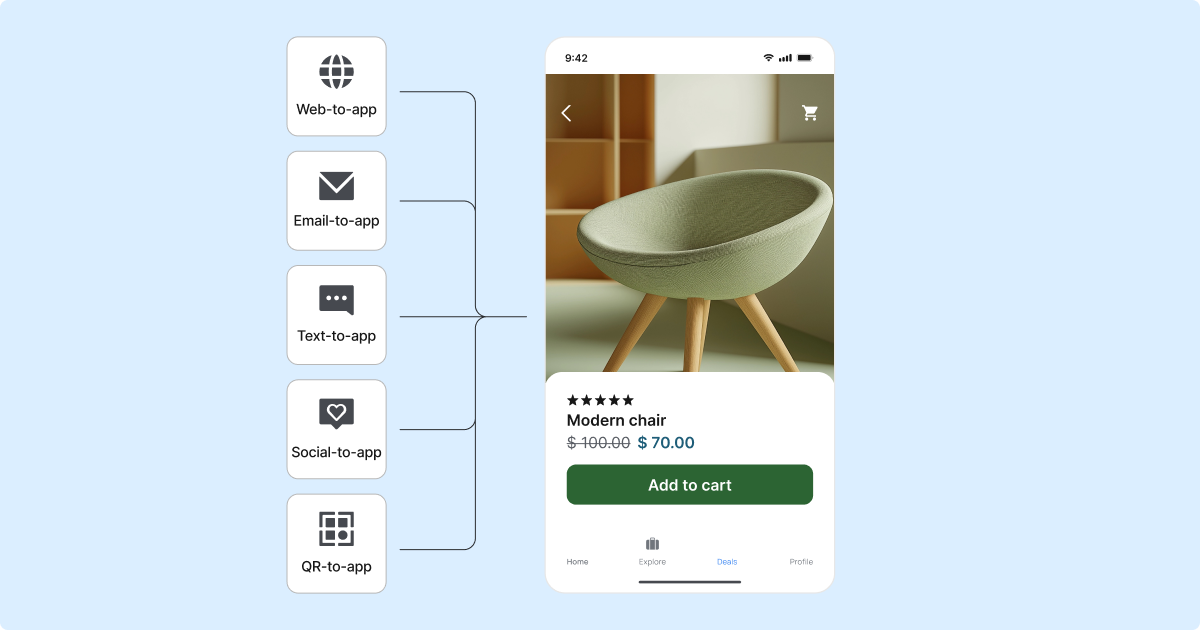
A returning customer during peak season rarely takes one path back to your app. They might scan a QR code on packaging or in-store signage, tap a CRM email about a saved item, click a remarketing ad on social, or return through a browser tab they left open days earlier.
Owned and organic channels visibly pick up during peak too: in Germany, owned media’s share of non-organic installs jumped from 20% to 30% specifically on Singles Day, and in the US it rose from about 20% to 22% during Black Friday/Cyber Monday week. Brands are earning more of their own return traffic exactly when that traffic is most valuable, and least forgiving of a bad landing experience.
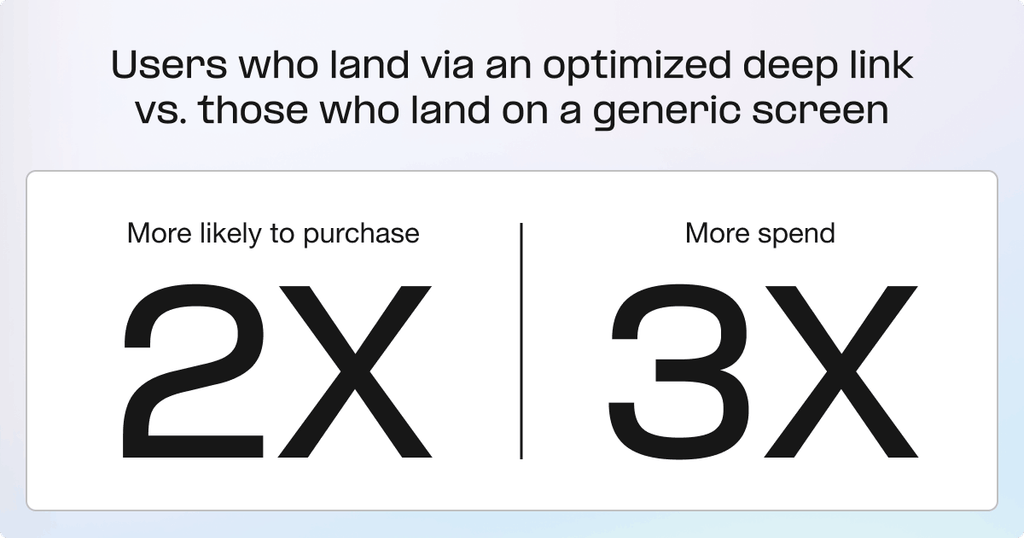
Every one of those entry points needs to land the customer on the thing they actually clicked on, not a generic home screen. When it doesn’t, the journey breaks in the handoff, quietly, with no error message, and the spend that earned that click gets wasted. AppsFlyer data shows users arriving through optimized deep links are roughly twice as likely to purchase, and spend almost three times more, than those who land on a generic screen.
It also shows 40% of remarketing conversions happen on day one, and over 75% happen within the first week of being served. AppsFlyer has documented the same pattern in finance, where app entry happens at moments of commitment, not casual browsing, and a broken handoff there gets misread as low engagement rather than a routing failure.
In a week where Brazil and Mexico run 86% to 92% of budget through this exact motion, that failure turns into a real business risk sitting inside the highest-stakes days of the year, and it’s one you likely won’t spot in a standard dashboard, since a lost handoff just looks like a slightly soft conversion rate, not a broken link.
Deep linking is what makes an offline QR scan, a CRM email, and a paid social ad all resolve into the same connected journey. It’s the infrastructure the remarketing strategy runs on, not an extra layer on top of it.
The real return lands after the spike
A purchase spike that doesn’t turn into a lasting relationship is a worse outcome than a smaller spike that does. That’s the idea behind customer lifetime value: the total revenue a customer generates over their whole relationship with the app, not just the one transaction measured on Black Friday.
It’s also why cross-platform measurement matters here: a purchase that starts with a Black Friday ad and finishes on web or CTV days later needs to count as one journey, not get written off as a loss on one channel and a mystery win on another. That gap only gets bigger as brands add more owned and offline touchpoints to their remarketing mix.
A Q4 strategy that’s 90% remarketing, as Mexico and Brazil now run, only pays off long-term if that re-engagement is building value in an existing customer base, not just squeezing the same shrinking group at a rising cost. One thing is worth a closer look before that playbook runs again unchanged in 2026: Mexico’s Black Friday day actually underperformed (installs down roughly 10%), while Cyber Monday absorbed the real lift, a pattern that lines up with El Buen Fin, Mexico’s own major shopping event, which usually falls earlier in November and may be pulling demand forward.
Key takeaways
- Measure Black Friday by the hour, not the week. The spike is sharper and shorter than most peak-season plans assume.
- Check market-level adoption before setting a global budget for an imported event. Installs and purchases will tell you where it’s real.
- Track remarketing across every channel it touches, not just the last click. It’s already outperforming fresh acquisition almost everywhere.
- Connect every entry point, QR, CRM, social, owned media, through deep linking. One broken link wastes the spend that earned the click.
- Benchmark this year’s CPI spike against real market data before setting next year’s ROAS targets. A cheap market isn’t necessarily a safe one.
Every one of these only works if the systems behind it are connected, from the signal that tells you where to spend, to the link that decides whether that spend actually lands.
AppsFlyer’s Deep Linking Suite brings all of this together, cross-market timing, remarketing sequencing, offline and online entry points, into one connected routing layer. And with AppsFlyer’s agentic AI suite, that same data can automatically re-engage the right customers and shift budget to where it’s working, as 2026’s peak season approaches.