
Introducing AEO Attribution & ChatGPT Ads: Measure Every Customer AI Is Sending You

TL;DR
- Every customer who is directed to your app from an AI conversation got there one of two ways: you paid for it, or you earned it. Until now, most marketers could only measure one side of the equation.
- AppsFlyer now attributes both: organic search attribution, expanded to cover AEO (Answer Engine Optimization), covers the earned side across 8 AI engines and 13 search engines, and ChatGPT Ads integration that covers the paid side.
- On the earned side, it supports both re-engagement for customers who already have your app, and install attribution for those who don’t (via OneLink and Smart Script).
- On the paid side, AppsFlyer’s ChatGPT Ads integration attributes campaigns through OpenAI’s Conversions API, now live and rolling out globally as OpenAI expands its Ads Manager into new markets.
- Broad coverage from day one is included in your existing package, and built on the deep linking foundation (OneLink, App Links/Universal Links, Smart Script) most advertisers already have in place.
Intro
Every customer who found your brand through an AI conversation discovered it one of two ways.
They ask ChatGPT which running shoe to buy, and a sponsored link takes them to your app. Others ask a question, get an organic answer with your brand mentioned, and click through on their own. Same tool, same intent, two completely different paths in.
Most marketing stacks can only see one of those paths. Paid clicks might show up as a vague “web referral.” Organic clicks from an AI answer usually don’t show up as anything at all, they just get filed under “direct” or “organic”, or “unknown,” a rounding error in a channel that’s growing every day.
That’s not a measurement footnote. If you can’t tell whether a customer came from an ad you paid for or an answer mention you earned, you can’t tell which one is actually working and might be paying to acquire customers who’d have found you anyway, cannibalizing the organic traffic you already had. Not to mention that you definitely can’t defend the budget for this activity. And that same organic signal is what tells your content and SEO teams whether their work is actually landing with AI answer engines, the same optimization discipline that has been applied to search for years now applies here too.
A billion people are asking ChatGPT questions about brands like yours every single week. Some marketers are already watching their ChatGPT Ads spend against their AEO numbers side by side, moving budget toward whichever one’s actually pulling weight. Others are still guessing, or paying twice for the same customer without knowing it. Which one are you?
What changed
AppsFlyer is now at the forefront of this shift, right where your customers already are, with two solutions that cover the traffic you’re buying with ad spend and the traffic your content and product earn without it.
The traffic you’ve already earned: measuring organic search and AI answer engines
The organic side of the equation doesn’t involve a direct media budget. It’s the customer who asked an AI tool a question, got an answer that mentioned or linked to your website or app, and clicked through on their own. AppsFlyer has measured this kind of organic search value for years covering Google, Bing, and other traditional search engines. Now that same measurement covers AEO (Answer Engine Optimization): ChatGPT, Claude, Perplexity, Gemini, and the rest of the answer-engine field.
It follows the customer’s actual journey, which is really two different mechanics wearing the same name:
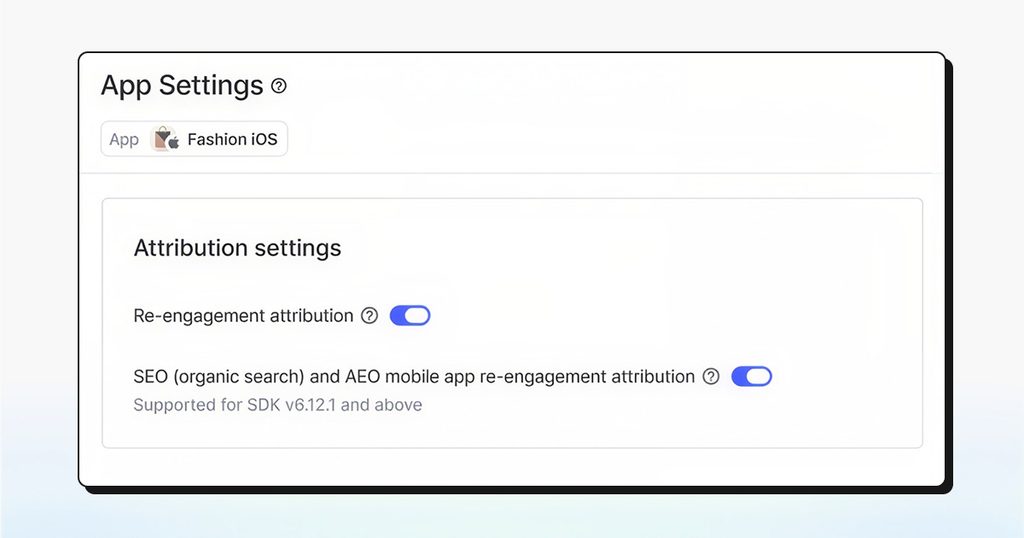
If someone already has your app installed, a click on a search result or an AI answer opens it directly, through Android App Links or iOS Universal Links, and AppsFlyer attributes that session as a re-engagement based on the referrer, not the link itself. It’s not only first-time research either, someone who already has your app might ask an LLM to double-check a choice they made months ago. If the answer still favors you, that click lands them right back in the app they already have, measured the same way, so you get full context on the source for future campaigns. As an AppsFlyer customer, you can easily turn it on with one toggle in App Settings.
If the end-user doesn’t have your app installed, they land on your website first, and Smart Script (a code snippet, part of our Deep Linking Suite, that personalizes each visitor’s path to the app store based on where they came from) picks up the handoff, so the eventual install gets attributed too. For example, a customer asks Perplexity for a restaurant recommendation, clicks through to your site, and that same context carries all the way to the eventual install. This functionality is already active in new and existing Smart Scripts, with no separate toggle to hunt for.
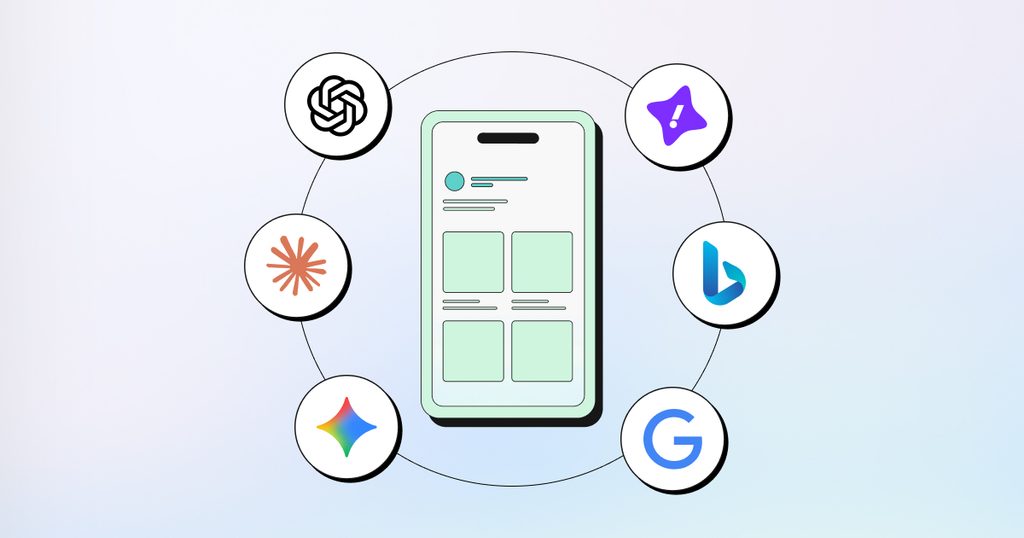
Coverage is broad from the start and includes 8 AI engines: ChatGPT, Claude, Perplexity, Manus, Copilot, Gemini, Grok, and DeepSeek, alongside 13 traditional search engines, from Google and Bing to Naver, Baidu, and Yandex.
Your reporting splits the two apart cleanly, so you can see SEO and AEO performance side by side and on platforms that carry both, like ChatGPT, paid versus organic as well.This allows you to assess the true incremental lift of running ads in that placement instead of relying on organic alone. It’s included in your existing package: no extra fee, no separate ceiling on conversions.
Learn more and set up re-engagement attribution now
Learn more and set up install attribution via Smart Script now
The traffic you paid for: introducing ChatGPT Ads integration with AppsFlyer

ChatGPT now has over 1 billion weekly active users sending more than 2.5 billion prompts a day, on a platform people already trust with their real questions and decisions. Whether someone is searching, asking for a recommendation, or just continuing a conversation ChatGPT has context on, every message carries both intent and identity, what they’re looking for and who they are, in a way search and social never quite captured.
AppsFlyer’s integration measures that signal across both web and mobile app conversions in one connected setup, on the same server-side infrastructure already powering Meta, Snapchat, TikTok, and Google. It’s an independent, deduplicated read on performance rather than a self-reported one. You can go live in minutes: no engineering work is needed to activate the connection.
Learn more and set up the ChatGPT Ads integration
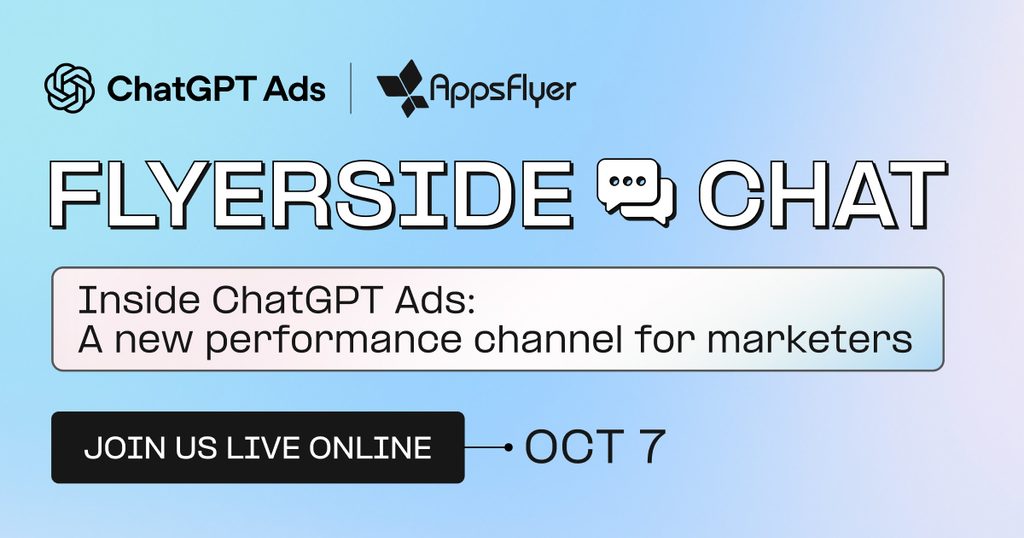
Want to hear more? Join our online webinar with OpenAI on October 7, 2026 for “Inside ChatGPT Ads: What performance marketers need to do ahead of the holiday season,” a live conversation on how the channel works today and how to measure and optimize app and web outcomes. Register for the webinar now
Why this matters now
AI conversations have become a major if not leading discovery surface, but for most teams, measurement hasn’t caught up yet. It has now, on both sides, at no added cost, and largely on top of the deep linking setup you already have.
Performance marketers are already testing ChatGPT as a paid channel, often with only partial visibility into how those clicks actually performed. SEO and content teams have been optimizing for AI answer engines with no way to prove any of it worked, as both problems trace back to that same shift.
Key takeaways
- Paid and earned AI-driven traffic are now both measurable in AppsFlyer, covering one of the fastest-growing ways customers discover and engage with brands.
- Organic SEO/AEO attribution covers 8 AI engines and 13 search engines, split across re-engagement (one toggle) and installed via Smart Script (already active, no toggle needed).
- AppsFlyer’s ChatGPT Ads integration attributes paid campaigns through OpenAI’s Conversions API, live and expanding globally.
- Both are included in all of our customers’ existing packages.
Ready to set it up?
- Set up the ChatGPT Ads integration
- Set up re-engagement attribution
- Set up install attribution via Smart Script
Questions about any of it? Reach out to your AppsFlyer CSM or account manager.