


Winning every stage of the shopper journey with data – your ultimate guide to eCommerce app growth


New to app measurement? Start here.
(If you already work closely with app analytics, feel free to skip ahead to the next section of the guide.)
Why app measurement is fundamentally different from web analytics
Most leaders are familiar with web analytics. On the open web, one platform – such as Google Analytics – can usually observe the majority of the user journey.
Mobile apps operate in a different architecture. Data is distributed across ad networks, app stores, devices, and your own backend systems. No single platform has full visibility.
This fragmentation makes it harder to understand which investments actually drive outcomes. App measurement solutions were created to bridge these gaps and provide the unified view needed for confident, data-driven decisions at scale.
What a Mobile Measurement Partner (MMP) actually does
An MMP (such as AppsFlyer) is purpose-built to solve the complexity of the mobile ecosystem. Think of it as the system that tells you which ads actually drive revenue inside an app. Not just clicks or installs, but real user value over time.
An MMP like AppsFlyer connects three things that are otherwise fragmented. Your marketing spend, what users do when they install your app, and what happens after. Purchases, subscriptions, retention, and engagement.
Unlike general analytics tools, an MMP is built specifically for paid growth in a privacy-restricted mobile environment. It works across ad networks, doesn’t rely on last-click bias, and acts as an independent source of truth for performance.
For years, that was enough. But growth today is more complex.
Marketers now operate across mobile apps, web, CTV, retail media, and privacy-first environments. Attribution alone doesn’t solve that. That’s why AppsFlyer has evolved beyond an MMP into a Modern Marketing Cloud.
At the core is still what matters most. Knowing which channels bring high-value users, where budget is wasted, and what actually drives retention and revenue. But on top of that foundation, AppsFlyer now enables privacy-safe data collaboration, seamless web-to-app journeys through deep linking, and AI-driven optimization to help teams act faster and smarter.
Core metrics leaders should know
These are the foundational signals that shape mobile growth strategies:
- Installs – total new app downloads
- IR (Install Rate) – how efficiently impressions convert into installs
- CPI (Cost Per Install) – cost to acquire each installing user
- First Purchase – the initial revenue-generating action
- Repeat Purchase – ongoing revenue behaviors across the lifecycle
- Retention – how consistently customers return
- LTV (Lifetime Value) – economic value a user generates over their full journey
- ROAS (Return on Ad Spend) – revenue impact relative to marketing investment
Understanding these metrics ensures alignment between marketing, product, finance, and executive teams.
What this guide will help you do
This guide expands your perspective from foundational app measurement into the broader strategic ecosystem shaping modern commerce. We will analyze today’s key commercial challenges, review advanced marketing measurement techniques, explore how AI empowers eCommerce brands at scale, and outline the organizational importance of unifying these capabilities into one cohesive, insight-driven framework.
The new age of Connected Commerce
In the increasingly competitive commercial landscape, sustained profitability and market leadership hinge on one strategic imperative: maximizing the value of every customer interaction. For leaders overseeing significant digital footprints, ensuring that marketing investment translates directly into predictable, high-value Customer Lifetime Value (CLV) is the ultimate goal.
The challenge is the sheer scale and complexity of the modern customer journey. A single buyer might engage with your brand across social platforms, the corporate website, and finally convert within a dedicated mobile app. Because different systems manage these distinct touchpoints, your marketing stack often struggles to reconcile them. This data fragmentation creates a critical attribution crisis, eroding confidence in spend efficiency and costing organizations millions in redundant investment and missed optimization opportunities.
The path forward is not more raw data, it is a unified measurement infrastructure built for scale. This infrastructure must connect every touchpoint, providing a holistic view essential for organizational alignment and financial clarity.
Mobile commerce has matured rapidly. To meet evolving consumer demand, organizations must move past siloed operations and embrace the new era of Connected Commerce:
- Granular measurement connects every touchpoint in the customer journey – mobile, web, CTV, console, offline – and links them back to eComm outcomes that matter. It shows you which channel drove which purchase, and what those customers did next, and remains at the heart of running a successful mobile eCommerce brand.
- Organizations are deploying powerful AI and Machine Learning capabilities to remove operational friction and transform rich data into automated, high-impact actions.
- Data Collaboration Platforms (DCPs) are privacy-safe environments where brands and retailers can match their customer data to build audiences and measure retail media – without sharing raw personal data.
- Omnichannel governance becomes the standard. Apps, web assets, retail media networks, and in-store behaviors are unified under a single measurement and optimization framework.
The age of simple mobile app growth has given way to a sophisticated model. For any large-scale retailer, the mobile app is a mission-critical component of the customer lifecycle. The future is Connected Commerce: where your applications, retail media efforts, and strategic AI deployment converge to form one measurable, future-proofed growth engine.
If you’re used to optimizing web campaigns in Google Analytics or your ad platforms, think of this guide as the bridge into doing the same – and more – for your app and retail media.
7 critical eCommerce app challenges to overcome
While eCommerce apps are a powerful engine for deepening customer loyalty and engaging high-intent audiences to boost sales and Return on Advertising Spend (ROAS), organizations must successfully navigate several complex, large-scale challenges:
1. Securing app loyalty and repeat purchases in a hyper-competitive market
Customers can choose from countless alternatives in every category. Global platforms like Amazon and Alibaba set the bar for convenience and expectations, making it easy for customers to compare and switch. Discounts might attract initial interest, but they seldom create lasting relationships or dependable revenue.
The real challenge is cultivating loyalty and repeat purchases through experiences that consistently deliver value. Brands have turned to new solutions to keep doing the basics: understanding Lifetime Value (LTV – how much a customer spends over time), building audience segments, and running remarketing campaigns.
2. Navigating evolving privacy requirements while maintaining performance visibility
Brands inherently rely on sensitive, high-value customer data, including identity, shopping behavior, and payment details. Protecting this information is not just a regulatory requirement: it’s foundational to customer trust and risk management.
The complication is that privacy frameworks like GDPR, CCPA, and LGPD continue to evolve. At the same time, Apple and Google have tightened platform-level privacy controls, limiting traditional targeting and measurement methods.
To stay ahead, eCommerce organizations are shifting to privacy-first architectures that support accurate LTV measurement and actionable insights without exposing personal information. Marketing measurement solutions such as Appsflyer sit in the middle of your marketing stack and connect ad spend, installs and in-app behavior, so you can keep measuring and optimizing while staying fully compliant.
3. Measuring full-funnel conversions across fragmented customer journeys
Today, the journey of a shopping consumer typically spans multiple devices, platforms, and channels. It encapsulates both online and offline touchpoints: a single purchase might start in-store, be researched further online and eventually purchased in an app hours, days or even weeks from that first moment of discovery.
The complexity makes it hard to track business-critical actions like first purchase, repeat purchase or subscription – and to increase LTV. Consistent performance visibility depends on the ability to connect interactions across touchpoints in a privacy-compliant way.
MMPs provide that clarity by attributing campaigns accurately and showing the true impact of each channel throughout the journey. Attribution provides brands with the answer to the question “which channel or campaign gets credit for this purchase or sign-up?”.
4. Protecting budgets from sophisticated ad fraud threats
The eCommerce sector is a prime target for sophisticated ad fraud schemes.This issue constitutes a significant and persistent risk to the financial integrity and efficiency of global marketing budgets.
iOS eCommerce apps see particularly high rates, meaning that installs typically regarded as high-value are running an increased risk of being fraudulent. This distorts ROAS and makes it much harder for marketers to make informed decisions about campaigns and strategy.
In practice, fraud can make weak channels look strong, and strong channels look weak – so unless you filter it out, your budget decisions are based on bad data. Mitigating this financial exposure requires robust, real-time, detection and prevention strategies.
5. Aligning teams around a unified measurement framework
Marketing, CRM, analytics, and monetization teams often operate with disconnected systems and metrics. Even when the customer journey is understood, internal silos can prevent organizations from seeing a cohesive view of performance.
A strong measurement infrastructure unifies teams with consistent attribution, shared KPIs, and a single source of truth across app, web, and offline touchpoints. This alignment not only improves decision-making but also strengthens collaboration between teams responsible for different stages of the customer lifecycle.
6. Demonstrating the value of reactivation and retention efforts
Winning repeat customers is essential for eCommerce profitability. Churn is high in this category, and loyalty programs or CRM tactics often run in parallel with paid media efforts. The problem is that these efforts are rarely measured together.
When retention sits apart from attribution, the uplift from re-engagement goes unseen. Brands need a measurement setup that connects reactivation activities with user-level outcomes so teams can show their impact on business results and make better calls about future campaigns.
7. Delivering personalized experiences without compromising user privacy
Driving ongoing conversions and multiple purchases is largely dependent on a personalized user experience. Delivering that experience, though, cannot come at the cost of privacy – adding another layer of challenge.
eCommerce apps can provide a personalized mobile experience while maintaining full compliance with GDPR, LGPD and other frameworks. Through deep linking, event-based triggers and targeted push notifications, brands can tailor app flows and messaging based on the behavior of their customers – such as viewing a product in an app, adding an item to a wishlist, or even surfacing relevant products post-login.
These techniques operate without relying on personally-identifiable information (PII) or user-level data. Instead, consented first-party signals are used that allow eCommerce brands to provide tailored, timely, contextual, and high-value interactions.
The solution: Granular measurement as the foundation for… everything
The modern shopping landscape is defined by Connected Commerce, where apps, retail media, AI and data collaboration converge to form a unified, measurable engine for growth.
It’s a golden truth of app marketing that no processes or strategic initiatives can succeed without robust measurement and optimization. This requires insights at a granular transaction level, not just high-level performance indicators (KPIs). Measurement transcends simple campaign reporting; it functions as a strategic enabler for maximizing CLV, enhancing media asset monetization, and architecting seamless, high-value cross-channel customer experiences.
Unified measurement is essential for the modern retailer. By leveraging granular metrics, eCommerce brands can accurately map every critical stage of the conversion funnel, providing the data necessary to inform both user acquisition (UA) and re-engagement strategies.
For example, instead of seeing “100k installs this month”, you’ll get the answers to the following:
- How many of those customers signed up?
- How many added an item to their cart?
- How many completed the purchase?
- Which channel brought in the highest repeat buyers?
And countless other insights. Granular measurement facilitates the optimization of high-yield user journeys, provides deep conversion performance data, and offers uninstall insights that empower decision-makers to precisely track the effectiveness of every dollar invested and extract superior ROI.
Solutions like AppsFlyer function as the measurement backbone for both performance marketing and retail media teams within the organization. Through AI-powered modeling and analytics, AppsFlyer helps you answer questions like “which channels deserve more budget next month?”, “which campaigns bring in customers who come back and buy again?”, and “which creative concepts actually move the needle?”
It creates a foundation that helps you make better decisions, personalize every shopping experience, collaborate securely, and automate actions.
If you’re just getting started with mobile attribution and marketing analytics, we recommend reading mobile attribution in the age of privacy first.
User acquisition – What to measure and set up
Before you even get started with setting up your UA campaigns, you must first have a few capabilities in place to guide your setup in the right direction. Let’s take a look at the essentials:
1. Event mapping
Event mapping means deciding which actions inside your app you want to measure – such as installs, sign-ups, add-to-cart, purchases, or repeat purchases. Each of these events becomes a signal you can use later to measure performance and build audiences.
The following chart explores some of the main metrics savvy eCommerce app marketers measure to optimize their efforts, and deliver the highest-value customers to their apps. The left column contains vertical-specific goals, while the right column contains the metrics through which these goals can be met.
Note that although all metrics below are important to improving the profitability of your eCommerce app, the top industry leaders focus specifically on Day 0 and Day 7 purchase amounts and rates, as well as Day 0 and Day 7 ROAS.
For teams in the early stages, we recommend focusing on these metrics:
- Installs
- First purchase conversion rate
- Day 7 retention
- Day 0 / Day 7 revenue per user
- Uninstall rate in the first 30 days
- Average order value (AOV)
As your app matures, you can expand beyond these core metrics and adopt a more advanced measurement framework, as reflected in the chart.
| Goal | KPI |
|---|---|
| Installs related • Acquisition • Cost | • Organic/Non-organic split • Month over Month growth (non-organic) • CPI (cost per install) /CPA (cost per action – a pricing model where marketers pay media sources when customers take a specific action in an app, such as registrations or purchases) • ROAS |
| Engagement related • Stickiness • Short term loyalty • Long term loyalty | • DAU/MAU (daily active users/customers divided by monthly active users/customers – a quick way to see the “stickiness” of your app • Retention Day 1, 7, 28, and 30 • Week 8, week 12 retention rate • Uninstall rate day 7, 30, and 60 |
| Purchase related • Increase first time purchases • Increase repeat purchases • Increase average order value (AOV) • Share of retargeted user orders • Cancellations with negative revenue and/or purchases that are returned to origin (when a user demands money back) | • Basket size • % of customers making 1, 2, 3 or 4+ IAPs within 90 days • ARPU (average revenue per user – total revenue divided by the number of customers in that cohort): Day 1, 7, 14, 30, and 90 • First week conversion rate (how many customers make purchase within first week)• Time between 1st to 2nd to 3rd purchase • % growth of AOV between 1st purchase & subsequent purchases • First-time purchase vs. repeat purchases • Day 0, 7 and 30 purchases, unique user and event count – both cumulative & individual days |
| Funnel conversions | • % Install to Registration • % Install to Cart Add • % Install to Checkout • % Install to Purchase |
| Connecting the dots | • Unique new customers (app brought in, did not interact with other touchpoints) • % of customers who began journey on web and converted in-app • # of customers purchasing on more than one platform• % of completed multi-platform conversions • Comparison of value of customers on each platform • AOV per platform • % of customers per platform |
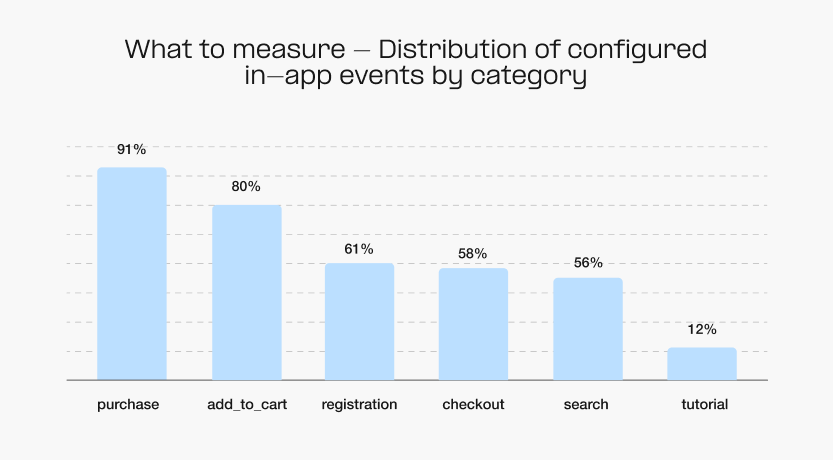
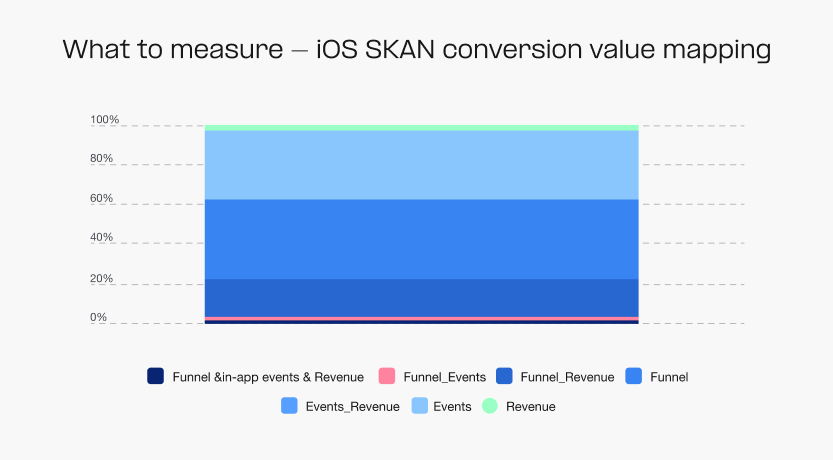
The why and how of rich in-app events
The depth to which we can gather the right data in order to optimize campaigns towards high quality customers, and boost engagement and revenue along the way, is significant.
That also means the amount of data we need to handle and analyze is massive, though with the right tech stack, setup, and attribution platform, marketing analytics can be made much easier.
But still… Why do I need to measure rich in-app events and other granular data?
Highly effective UA, engagement, and remarketing strategies are fundamentally driven by audience building and the ability to optimize media sources, channels, campaigns, and creatives based on rich in-app events. These granular events add critical layers of parameters that map out ideal user behavior.
For example, you might discover that customers who buy from your “home decor” category in their first week have twice the 90-day LTV of customers who only buy from the “sale” category. That then opens the door for you to bid more aggressively on that higher-value audience.
With the raw data you receive from a measurement and attribution provider, you will literally be able to see user trends and patterns you might otherwise miss, and get a complete picture of their activity and behavior, no matter the platform, channel, device, and the time at which they perform actions.
Let’s look at two examples to illustrate the difference between standard in-app events versus rich in-app events:
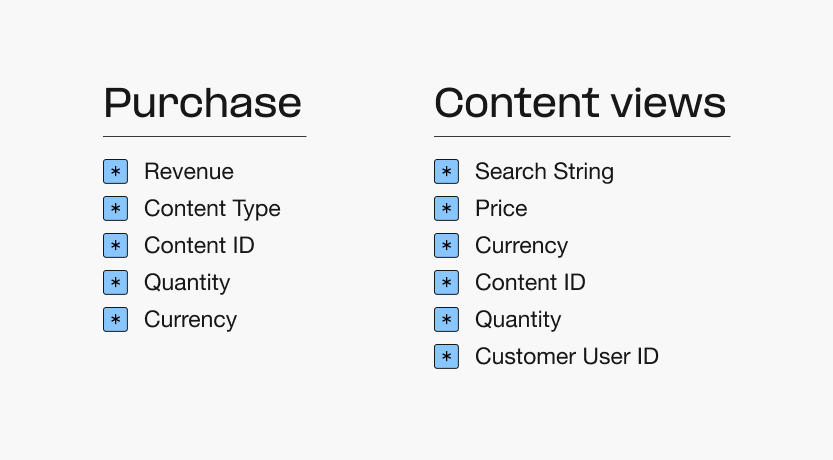
Here’s what that looks like in practice: instead of simply logging a purchase, you now log details like category, product ID, quantity, currency, and revenue.
All of these parameters can then be sliced and diced to target audiences who behave similarly to current customers who may view a specific type of content, have a specific cart quantity, or that have paid in a certain currency — in order to reach different demographics, regions, or valued purchasers.
The granularity of rich in-app events can also be applied to other events, such as Search, Content View, Sign-up / Login / Register, Add to Wishlist, or Add to Cart. This will be based on where in the conversion funnel you are attempting to engage or re-engage customers, as well as your ultimate conversion goals.
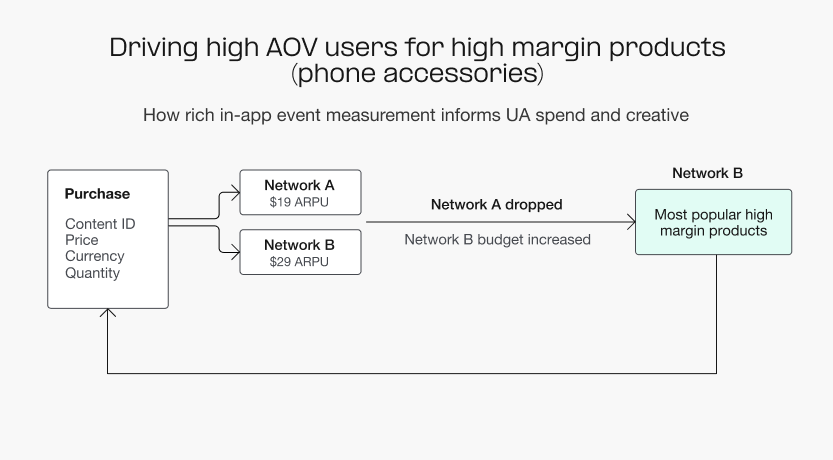
2. Deep linking
One of the most powerful tools in the app marketing tech stack is deep linking, facilitating a contextually-relevant user experience across all channels, platforms, and devices.
How does it work? A deep link carries embedded information that takes the user straight to a specific product page or campaign landing page inside the app. This creates a smooth jump from promotion to in-app content with a higher chance of conversion.
In the eCommerce vertical, deep links are most often used to guide customers to product pages based on their previous viewing or purchase behavior. Customers can move seamlessly from desktop or mobile web into the most relevant in-app content. Deep linking strengthens long-term retention and helps brands communicate key deals and promotions that drive in-app conversion.
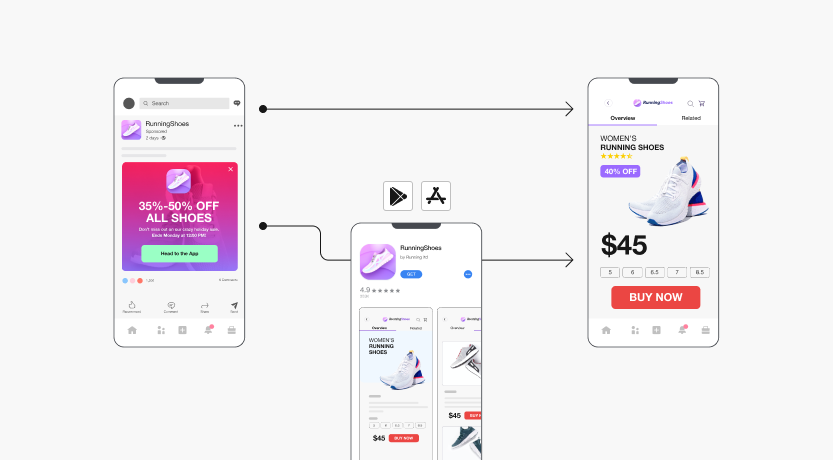
To get started, your mobile team or agency needs to configure deep links in your app – this is usually a one-time setup supported by your measurement partner or deep-linking provider.
Also pay attention to the fact that deep linking is needed for both specific product pages, or product detail pages (PDPs), as well as broader category pages, or product listing pages (PLPs).
The destination to which a user is brought is primarily dependent on:
- The deep linking campaign goals.
- The consenting user information previously gathered (i.e. content viewed, purchase history, location, etc.), which must be decided and understood ahead of time.
For more information about deep linking and how it can dramatically affect CX, read our Return on experience guide
Advanced deep linking strategy
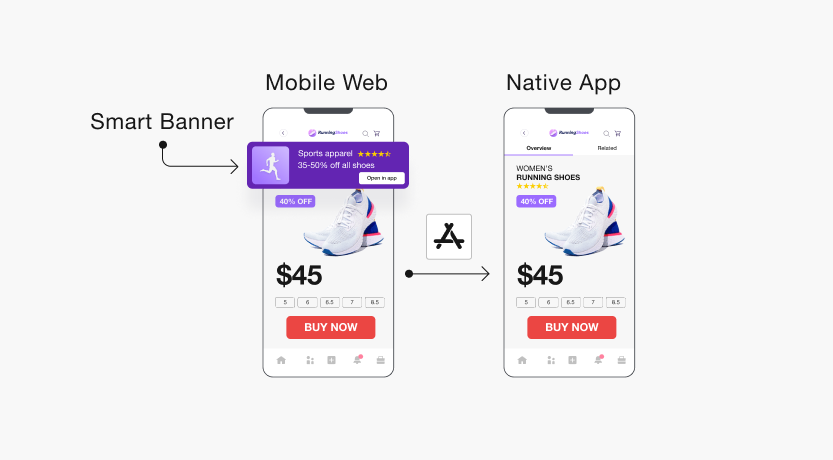
Well-rounded eCommerce marketers use deep links to bring customers specifically from mobile web to their apps using an ‘Open in App’ call-to-action smart banner.
These call-to-actions (CTAs) often go hand-in-hand with campaigns offering promotions and deals for in-app customers. For example, a 5-10% discount for purchasing in the app rather than the website.
Through the deep links placed in these banners, marketers can bring customers to install their app (if not yet already), get smoothly routed to the same product or category page previously viewed, and later to a checkout page for purchase.
But why would you want to reroute customers to their app from mobile web in the first place? Simply put, the app is the ultimate destination because of the unmatched data insights and massive brand impact it can provide.
When a user clicks on a smart banner popup and follows it to a page in the app, you can receive data on the user’s subsequent in-app activities, the IDs of product and category pages visited, and even, retroactively, the attribution data from the user’s journey to your mobile website.
Beyond the valuable data gathered, however, smart banners also contribute to an improved user experience, increasing the potential of greater brand loyalty and engagement overall.
When choosing a deep linking solution, make sure that it not only supports your growth needs, but is also in sync with the latest privacy and security guidelines, and your campaigns comply with the most up-to-date user privacy and security regulations.
If you’re not the one making the technical choice, your role is to make sure your solution can:
- Take customers to the right screen in one tap
- Measure what happens next
- Work across key channels (email, social, paid ads, SMS)
3. Uninstall measurement
It’s not enough to bring customers smoothly to your app, and personalize their experience within it to optimize conversion rates. Brands must also address the inevitable segment of customers who will uninstall their app completely, and either build a strategy to bring those customers back to active engagement, or exclude these customers from future campaigns.
Reasons that a user might uninstall your app include:
- Poor in-app functionality and experience
- Excessive or impersonal onboard process
- Irrelevant or overwhelming notifications
- Device storage / WiFi network limitations
Given that customers can uninstall your app for one or a combination of many reasons, it should be clear that understanding your app’s uninstall rate is important.
But what exactly are the main benefits of uninstall measurement for marketers?
- Compare the quality of customers from each media source: if customers from Partner A uninstall 3x more than Partner B, you know where to cut budget.
- Protect privacy and reduce wasted spend by excluding uninstalled customers from remarketing.
4. Fraud protection
Fraud is simple in principle: it means you pay for installs or conversions that never turn into real shoppers. Left unchecked, it inflates your CAC (cost per acquisition – how much you have to spend to win a single new customer) and misleads your optimization.
For eCommerce apps, fraud is a huge concern due to their scale and relatively high CPI and CPA rates compared to other verticals. AppsFlyer’s 2023 report on the state of mobile app fraud shows that eCommerce is one of the hardest hit app categories, with financial exposure to fraudulent installs surpassing USD 400 million in 2023 alone.
Increased fraud attention has led to much stronger protection measures, which in turn led fraudsters to up their game with increasingly more sophisticated fraud tactics. This is especially evident in the rise of advanced bots designed to mimic real user behavior in order to bypass protections. A similar pattern can be seen with device farms, both physical setups using thousands of real devices mounted on racks, and virtual farms relying on emulated devices.
Given the continued resurgence of bots and increasingly advanced fraud tactics, real-time protection should actively flag behavioral anomalies, helping uncover new bot signatures and fraud patterns that would otherwise remain undetected.
A strong anti-fraud solution is therefore a blend of supervised and unsupervised machine learning, driven by a large scale of data. And since fraud is an ever-evolving threat, this means that not all of it can be identified in real time. New fraud patterns, model modifications, and variations constantly appear, as fraudsters try to gain the upper hand.
Post attribution fraud analysis is therefore necessary, as it provides a much needed retrospective look at installs that were attributed and were not identified as fraud in real time.
For more information about how AppsFlyer uses both machine learning and big data to combat fraud, read here.
For advanced measurement teams
The rest of this section is intended for performance, development and analytics teams.
A common misconception is that CPA-modeled eCommerce app campaigns experience little to no fraud due to the lack of install-focused incentive, or the difficulty of generating an in-app event / purchase for fraudsters.
That simply is not true. For this reason, savvy marketers look at the following measurements:
Cancellation rate
The ratio of cancellation events to installs is highly relevant to advanced fraud detection. In CPA fraud, an ad network (or one of its publishers or sub-publishers) places an order, receives the CPA payment, and later cancels the order. Unfortunately, this behavior is legitimate, since most eCommerce platforms allow cancellations for a certain period if clients are not satisfied or if the product is damaged, etc.
Since there is usually a steady cancellation rate for most apps, higher rates from specific media sources or site IDs typically signal that these orders are not genuine and only exist to collect CPA payouts.
To minimize damage, eCommerce app marketers should negotiate a penalty clause for networks in lieu of fraudulent activity directly in the contract.
Install-to-purchase time
For eCommerce apps, there tends to be an acceptable limit in the time between an install and purchase. Less than that is cause for suspicion. Because each app’s needs are different, however, it’s suggested to use attribution data to understand that limit on an individual basis and create boundary conditions accordingly.
5. Mapping a holistic customer journey
The reality is that a significant divide between user behavior and marketing measurement still exists in our day and age.
On one hand, shopping end customers have increasingly more complex conversion journeys involving multiple devices and touchpoints — desktop web, mobile web, apps, and even in stores.
The difficulty with understanding the complex path to conversions remains a stumbling block for marketers. In fact, according to research by eMarketer, a lack of standardization across platforms is the biggest challenge for more than half of US advertisers.
A typical shopper might click a Meta ad, then a Google Shopping ad, then finally convert after an email. Last-click measurement in this example gives all the credit to the email, while multi-touch attribution (MTA) would spread credit across all three interactions.
MTA is a key tool for mapping the customer journey and building a marketing strategy as it takes every online and offline touchpoint along the customer journey into account, and then assigns credit to each based on varying logic per business.
There are different ways to split that credit (linear, U-shaped, W-shaped, full path etc). The exact model matters less than making sure you’re not blindly crediting only the last click, and missing out on a full understanding of the impact and value of each touchpoint.
For more information about MTA read our blog Multi-touch attribution: Success is a journey
6. Incrementality
Incrementality gives you the necessary insights to determine the real value of your marketing efforts. This is done by measuring which conversions were the result of a specific campaign, and which would have happened organically on their own.
For instance, if you’re running an app install campaign on top of strong brand demand, you might see great volume – but an incrementality test can show that many of those customers would have installed anyway, even without the campaign.
Bear in mind that proper incrementality testing could be a long and complicated process, prone to poor execution and interpretation. It requires knowledge, expertise, and a robust testing environment to ensure that the right insights are derived and the right decisions are driven. If you don’t have an in-house data science team, consider working with a provider or partner that can design and interpret these tests for you (or check out our Incrementality solution).
7. Predictive analytics
Predictive modeling helps marketers understand consumer behaviors and trends, anticipate future actions, and plan campaigns based on data-driven decisions.
With privacy, or the lack of it, taking center stage, the average app user is no longer in a hurry to share their data in order to use an app. But, nowadays, are advertisers really left in the dark when it comes to access to quality data?
The short answer is no. By incorporating predictive modeling into their tech stack, brands can make informed decisions while upholding the strictest user privacy standards.
By leveraging machine learning and AI to examine historical campaign performance, user behavior patterns, and transactional data, predictive analytics are a powerful tool that allow you to:
- Identify which new customers are likely to become high-value buyers, and bid more for them early.
- Spot customers likely to churn before they do, and trigger timely, proactive offers.
- Estimate long-term value from short-term behaviors, which is crucial under SKAN and other privacy-related limitations.
Creating different behavioral characteristic clusters allows your audience to be categorized not by their actual identity, but by their interaction with your funnel in its earliest stages.
eCommerce app user acquisition: 7 best practices
User acquisition (UA) for eCommerce apps doesn’t stop at the install. The goal for eCommerce brands is to understand every signal a customer shares, and turn those insights into meaningful outcomes: registrations, purchases, newsletter sign-ups, and more.
With an MMP like AppsFlyer, acquisition data can be connected to lifecycle metrics such as retention, revenue, and uninstalls. This creates a clear, end-to-end view of the customer journey and highlights where optimization matters most. And since every journey starts with a first step, let’s look at some best practices for effective user acquisition for eCommerce apps.
1 – Conduct Day 7 and 30 cohort analysis
With increasing pressure in the eCommerce space and a constant need to optimize marketing spend, teams rely on Day 7 and Day 30 cohort analysis reports to check the number of purchasers acquired 7 or 30 days after install.
Cohort analysis takes a large group of customers and breaks it into smaller segments based on shared characteristics. These may include region, language, acquisition date, purchasing history, or other relevant variables. It allows brands to gain deeper insight into how specific groups of customers engage with your eCommerce app. Combined with AI-powered insights, cohort analysis can go even further, using predictive analytics to uncover deeper patterns and anticipate future outcomes.
2 – Consider long-term ROI
In addition to day 7 and 30 cohorts, check cohorts and LTV for the long term to detect high quality media sources and customers.
For example, media source A may drive a high number of purchases in the first 30 days, but show a low repeat purchase rate over time. Media source B, on the other hand, may drive less purchases in the first 30 days, yet deliver more repeat buyers in the long run. In some cases, this can result in a higher overall ROI than source A.
If performance analysis stops at day 7 or day 30, these higher-quality customers can easily be overlooked.
Keep in mind that LTV measurement remains a weak point within SKAdNetwork, which means advertisers need to intentionally allocate part of their conversion values to measuring longer term KPIs.
3 – Explore seasonal shopper audiences
Some customers may only shop during holidays, given the increased availability of sales and incentives during that time. During your next holiday campaign, focus your remarketing efforts on seasonal-only shoppers, or customers that bought over the last holiday.
The goal is to re-engage these customers and encourage more consistent, year-round activity.
4 – Balance UA vs. CPI/CPM
To take full advantage of eCommerce app demand and save more for your marketing budget, it’s best to time larger user acquisition investments with periods of lower acquisition costs, and fewer CTAs for customers to deal with.
For example, September often sees all-time low costs and high install-to-purchase rates, meaning customers are more likely to install and convert when exposed to well-timed, but not overly aggressive, acquisition campaigns.
5 – Personalize, personalize, personalize
Especially critical to retail apps, personalization of your UX should be a priority, both in and out of the app. Emphasize a contextually relevant onboarding process that encourages customers to create a profile and set their own preferences.
When applicable, you can also use granular in-app event data to populate the home screen with items similar to previously purchased brands or styles for greater upsell and cross-sell opportunities.
Luxury fashion brand MyTheresa has implemented extensive personalization in their app to deliver a polished, curated experience. A message center delivers curated alerts, personalized item listings and customized in-app messaging that combines to provide a “members-only” feel for customers.

One of Europe’s largest online fashion marketplaces, Zalando takes personalization even further, deploying an AI assistant that can deliver personal, intuitive recommendations. This gives customers a more seamless experience than tapping through nests of search filters.
6 – Audience segmentation
After gathering data about your consenting customers’’ pre- and post-acquisition activity, it’s important to move from insight to action and prepare specific audience segments that will define your most valuable customers and then serve as a basis for future acquisition.
Audiences can and should be used for many purposes. For example, as an eCommerce app, you might:
- Build lookalike audiences: Improve your user acquisition by focusing on prospects who “behave” like your best customers — e.g. those that purchased more than 3 times in the last 30 days.
- Segment based on exclusion parameters: Remove customers that you’re reaching out to on Network A, and would not like to reach out to on Network B. Or, create an audience segment of inactive customers and exclude them from your re-engagement campaigns.
7 – Increasing ATT opt-in rates
App Tracking Transparency (ATT) is Apple’s opt-in privacy framework that requires all apps to ask customers for permission to share their data. Gaining permission is immensely valuable to brands, and while ATT opt-in rates continue to increase, there’s always room for improvement.
Here are two ways to increase your ATT opt-in rates, and reap the rewards of greater quantities of user level data and attribution:
1. Offer a post-ATT reminder to engaged customers who are yet to opt-in
If customers decline permission at the ATT prompt, it doesn’t have to be the end of the road. They can still enable tracking at any time, and disable it again if they choose, through their device’s Settings.
Your customers might not know this, so this is your chance to remind them. Just like the pre-ATT prompt, target engaged customers with a clear, value-led message that explains the benefits of opting in. This reminder can then deep-link directly to the app’s settings, making it easy for customers to enable permissions in just a few taps.
2. Timing is everything – show the prompt to installers on 1st launch
You have control over when to show the ATT prompt (or if to show it at all) – and your decision can have a massive impact on opt-in rates.
According to AppsFlyer data, opt-in rates are at their highest when customers launch an app for the first time – likely alongside other in-app notifications which pop up at this time. On one hand, this increased engagement can make them more likely to opt-in if the prompt appears later. On the other hand, your potential audience may shrink over time due to churn, which can limit overall opt-in volume.
Re-engagement: The why, what and how of measurement
Acquisition is only the first step in the customer lifecycle. Later stages in the funnel are at least as important to eCommerce brands. With advanced marketing measurement, it’s possible to derive even greater value from later points in the customer journey.
Re-engagement and remarketing are all essential ingredients to maximizing a customer’s LTV. Where eCommerce marketing was once limited to actions taken in your own app or CRM, engagement of today extends into retail media ecosystems via Data Collaboration Platforms (DCPs). We’ll explore DCPs in more detail in Chapter 6. First, let’s cover the fundamentals of measuring re-engagement in eCommerce apps.
Why re-engagement matters in mobile eCommerce
Having a successful eCommerce app is not only about acquiring new customers and driving them to conversion. It’s also about keeping them engaged over time, ultimately driving revenue, repeat purchases, and boosting LTV.
This is especially true for eCommerce apps, which need to bring lapsed customers back to trigger a first purchase, while also re-engaging customers before they lapse (usually within the first week after install, often referred to as the “7-day slump”) in order to maximize long-term retention.
The numbers show that around 25% of all app installs are only ever used once, and by day 30, about half will have been uninstalled. Growth and marketing teams are fighting an uphill battle, but re-engagement is the game-changing advantage that eCommerce apps can deploy.
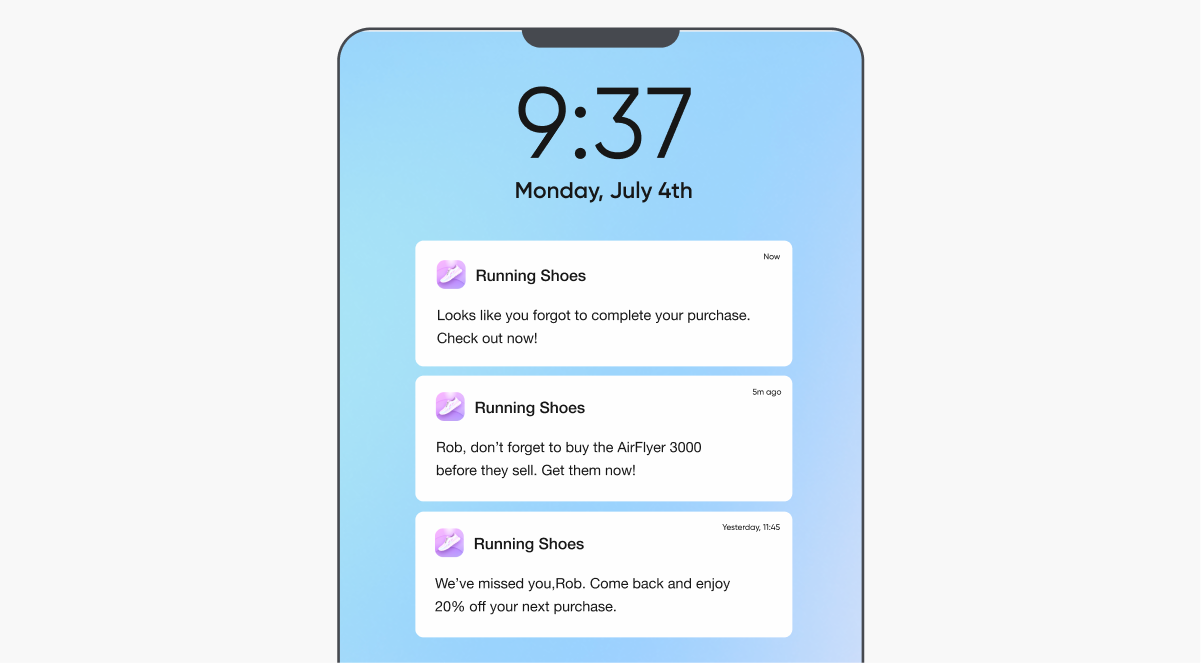
Re-engaged shoppers are more likely to remain loyal and make repeat purchases over time. Re-engaging an existing user also typically costs less than acquiring a new one, especially when that user is already familiar with your brand. Channels like email and push notifications cost little to nothing once customers have opted in. This gives marketers a powerful lever to impact revenue and performance without relying on large acquisition budgets.
Then there is privacy. Apple’s privacy-first approach has fundamentally reshaped the app ecosystem. Mobile marketers now need to rethink how they measure, attribute, and optimize campaigns in the face of limited data for targeting and optimization, and the need to rely on aggregated data instead of user-level data.
Now, marketers have shifted away from the user-level data-centered technologies of the past. Instead, brands are making use of the likes of SKAdNetwork, user-level deterministic attribution, aggregated probabilistic modeling, predictive analytics, Data Clean Rooms, and other solutions.
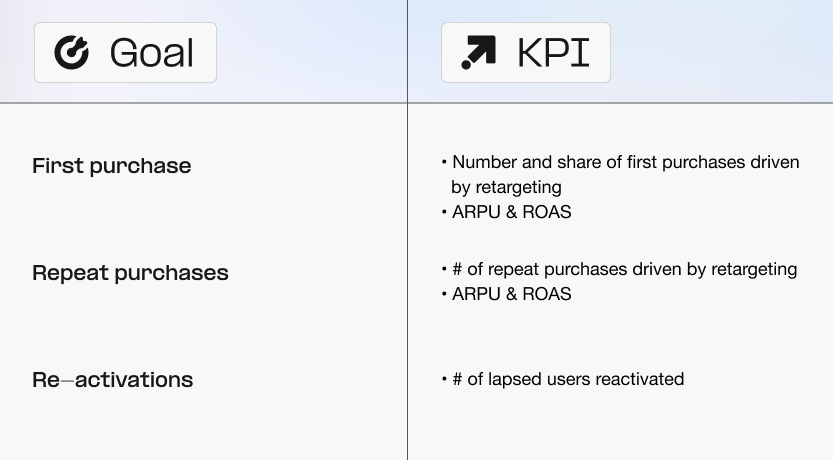
1 – Re-engagement KPIs
Below are the main metrics top eCommerce apps include in effective re-engagement. You can see that the left column contains vertical-specific goals, while the right column contains the metrics that would indicate and drive these objectives.
2 – ROX, deep linking, and great CX
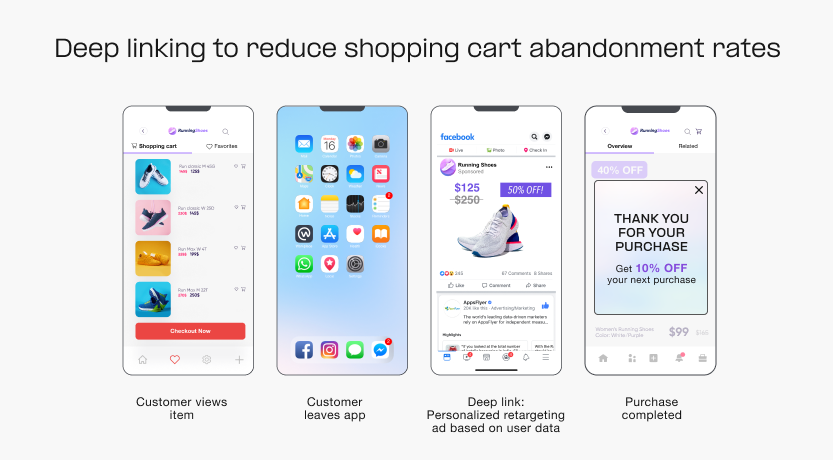
We addressed earlier the why and how of deep linking in acquisition, but in the eCommerce vertical, deep linking is just as, if not more, vital for re-engagement and remarketing.
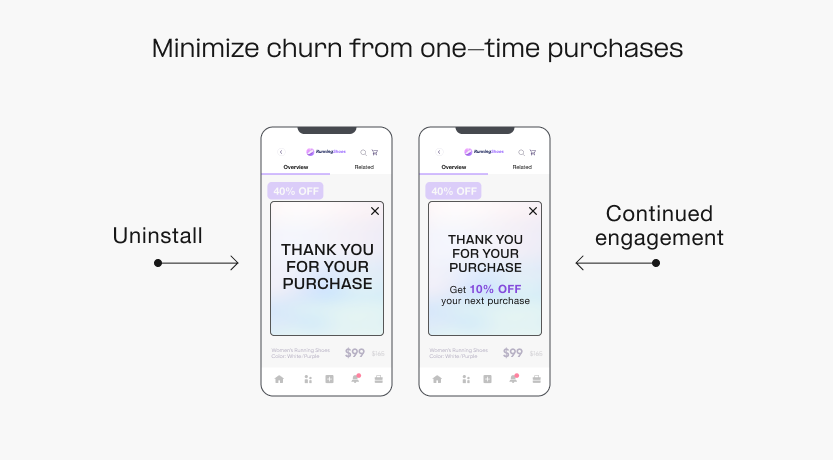
For eCommerce apps that tend to have longer and higher-value conversion cycles, it is easy for customers to become inactive, or even uninstall, before, and sometimes after a single purchase.
eCommerce apps must therefore be especially proactive and keep customers steadily engaged after install, rather than face the more difficult task of trying to win them back after leaving.
Deep linking is frequently used alongside email, where personalization of both content and links is critical. For example, you can send emails with deep-linked CTAs to category X product pages for customers who browsed category X in the app but didn’t purchase. Customers who did purchase from category X can receive deep-linked emails that take them to complementary or related product pages.
By enabling seamless, easy-to-build customer experiences, deep linking helps brands increase conversions by driving new and existing customers into the app from any channel.
Strong CX means guiding customers directly to their intended destination and widening the bottom of the funnel. For product managers, deep linking also becomes a powerful tool to drive engagement and retention.
Great customer experience leads to measurable business outcomes. The impact of investing in CX is known as return on experience, or ROX. To learn more about ROX and how it can accelerate app engagement, take a look at our ROX guide.
To learn more about ROX and how it can propel your app engagement forward, have a look at our ROX guide.
3 – Owned media
Owned media is any marketing asset directly controlled by a company and which requires little to no additional cost to access and use. Most relevant to mobile re-engagement are push notifications, emails, and SMS messages, but also webinars and tweets.
Owned media allows you to create free, contextual content that drives engagement across active, idle, and lapsed customers, while building a more personal and long-lasting relationship. In an era of heightened user privacy, where user-level data is harder to come by, this connection is nothing short of critical.
Let’s look at how this typically works. Most brands rely on a CRM to run owned media campaigns. These systems receive data in two ways. Either through their own SDK, or via an attribution and measurement provider.
The latter typically has pre-built integrations with the most popular tools worldwide, enabling organizations to export their data directly.
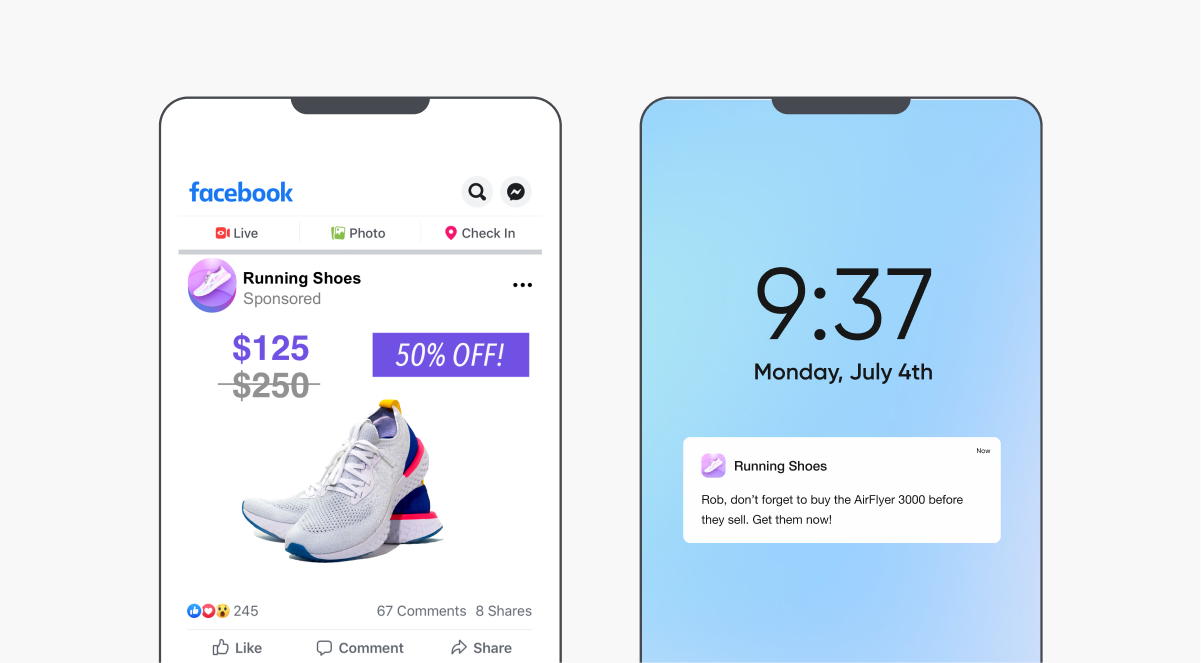
Imagine that a user added 3 items to the cart but didn’t make a purchase. Based on these in-app events, the marketer runs both a push and email campaign, but there is still no conversion. At this point, the marketer would typically begin remarketing via paid sources in an attempt to convert the user.
If the team is savvy, they’ll use different parameters to run diverse campaigns across push, email, and paid channels.
For low-ticket items, push and email make complete sense since they’re practically free. For high-ticket items, however, brands will also use paid media on top of their owned-media efforts.
Interestingly, despite their widespread use, many teams are still not fully aware of the long-term value that owned media channels inevitably provide.
Why leverage owned media?
- Utilizing the marketing “hierarchy” – Given the little to no cost of owned media channels, especially compared to paid campaigns, re-engaging customers via these channels should be the focus and priority as much as is possible and appropriate.
- Full control over every aspect of your content.
- It’s free – aside from the internal resources you’ve put in to create it.
- Low risk – with paid media you could find you’ve wasted your budget if a campaign proves to be unsuccessful, and with earned media (the equivalent to digital word of mouth) you lack control over comments or potential inaccuracies. Owned media avoids both completely.
- Contextuality – owned media allows you to build content strategy that addresses each stage of your user journey, including your uninstallers or dormant customers.
4 – Remarketing
Because eCommerce apps face longer and higher value conversion cycles, re-engaging lapsed or uninstalled customers (or at times excluding uninstallers from these campaigns) is necessary for ensuring long-term retention and lifetime value.
Additionally, given the challenge of increasing UA costs, it’s cheaper to proactively re-engage your existing customers rather than acquire those that are lapsed or new.
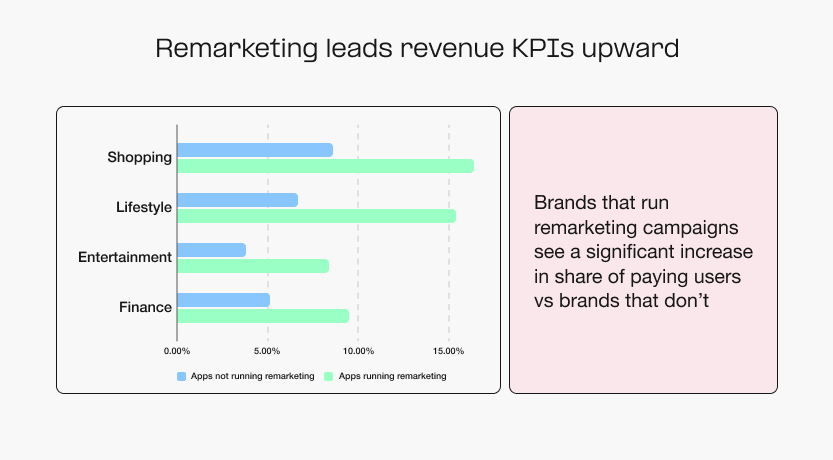
In fact, data shows that apps running remarketing campaigns have, on average, twice as many paying customers.
Timing remarketing campaigns
Deciding when to launch remarketing campaigns depends on several factors, including the audience segment, level of engagement, whether the goal is recovery or re-engagement, available budget, and more.
Remarketing can start at different points. Immediately or 24 hours after install, within the first week, or much later. There is no one-size-fits-all approach.
Knowing when to stop a campaign is just as important. This decision should be guided by your marketing objectives and budget constraints. In eCommerce, campaigns are commonly paused after 7, 14, or 30 days. That said, some practitioners argue that most meaningful activity happens within the first 14 days.
It’s therefore important to define a clear campaign duration. Run campaigns long enough to achieve impact, but stop them within a reasonable timeframe to avoid wasted spend (excluding evergreen campaigns).
Dynamic ad remarketing
Dynamic remarketing ads use existing user data to deliver contextually relevant messages. These ads can feature products a user has already viewed or similar items aligned with their interests. Launching dynamic ads requires the ability of your platform to sync with the following data:
- Event database: Information about the targeted product
- Product feed: Information about products, brands, prices, images, and product page links
- Advertising server: Hosts dynamic content and generates an HTML5 banner
Dynamic ads are part of a real-time bidding process (RTB), that takes place within a lightning fast 100 milliseconds, to be exact, in which:
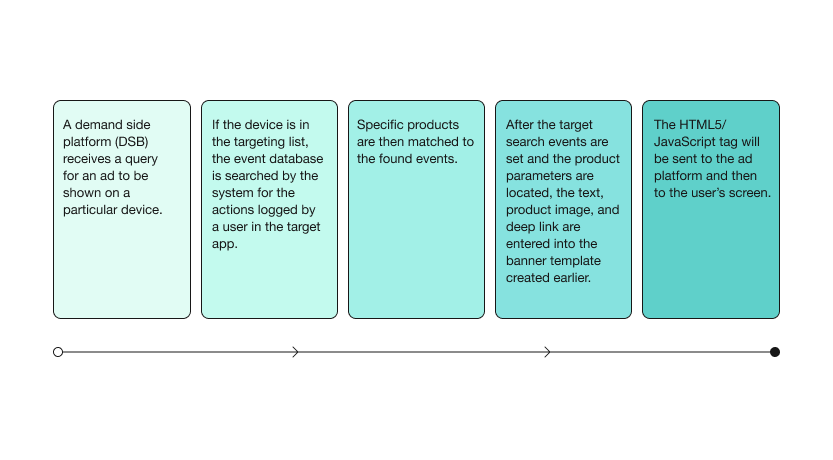
Dynamic ads allow marketers to display multiple relevant products or services, and are typically more cost-effective than standard banners.
Best practices for maximizing eCommerce re-engagement
1 – Personalization – not just for UA
With the sophistication of marketing tech and the volume of apps exploding, customers using apps, especially in eCommerce, expect customized experiences from start to finish.
Use purchase or view histories to cross-sell and upsell lapsed customers. Pair deep links with other in-app event data to reduce shopping cart abandonment rates.
Choose ad partners that offer behavior or intent personalization and make this process part of your marketing routine.
2 – Preventive remarketing
Remarketing campaigns should not only prioritize the classic lapsed customers, but also function preventatively to keep customers engaged before they actually jump ship.
When customers are effectively engaged through remarketing within the first week after install, they are more likely to stay active and convert. That said, preventative remarketing should be carefully capped to drive engagement without overwhelming customers.
3 – Simultaneous creative testing
To optimize ad and creative performance, testing 3 to 5 creative sets simultaneously provides the most profound performance analysis within a reasonable and efficient time period.
However, as a general rule, it is more effective to test several different creatives more frequently than to perform tests on large amounts of creative sets at the same time.
4 – Long-term LTV segmentation for remarketing budgeting
To determine the quality of your re-engaged customers relative to your goals, create LTV segments for days 30 and 60, measuring for long term value and revenue.
Since 30 days is the likely maximum cap for most purchases, these segments will also help you test whether or not to re-engage within this 30 day period (if not, then no remarketing will likely occur after 30 days).
Remember that the remarketing window for larger eCommerce brands is likely to be longer than for smaller brands.
5 – Reattributed vs. new customers
Understand the user-level value of your reattribution efforts by comparing reattributed customers to new customers.
There are two main quality metrics to measure, ARPU and frequency of purchases, which are analyzed in windows of either 30, 60, and 90 days, respectively. This comparison can also be used to determine remarketing spend.
6 – Re-engagement and audience segmentation
Just as with acquisition, granular in-app event user data can be leveraged to build precise audience segments for re-engagement.
Push notifications, emails, and other owned media are most often used first in re-engagement campaigns — given their low costs and ability to reach customers more easily than paid methods.
Below are some examples of audience segments for re-engagement:
Remarket and re-engage
Improve your re-engagement by targeting high-value customers who, for example, made multiple purchases last month, but were inactive this month.
Recover uninstalled customers
Target customers who made a purchase above $50 but who recently uninstalled your app, using custom creative to drive re-installs.
Cross-sell and upsell
Encourage customers with high-purchase intent to complete checkout on items within the same brand or category as others added earlier to the cart.
Remarketing exclusion
An audience who has engaged with a specific owned media source (push, email, SMS, other) should be excluded from paid customer re-engagement.
Category mixes
If you own an eCommerce platform selling multiple brands, optimize the brands displayed to high-paying customers to drive more purchases of your most profitable brand(s).
Use audience segmentation to identify customers who are not yet purchasing these brands and target them accordingly.
Another important use of audience segmentation is the creation of split audiences for determining the incremental performance and growth of each media source, as well as performing A/B testing and pushing product features.
For incremental and A/B testing, split audiences can be created based on several factors, including but not limited to the following.
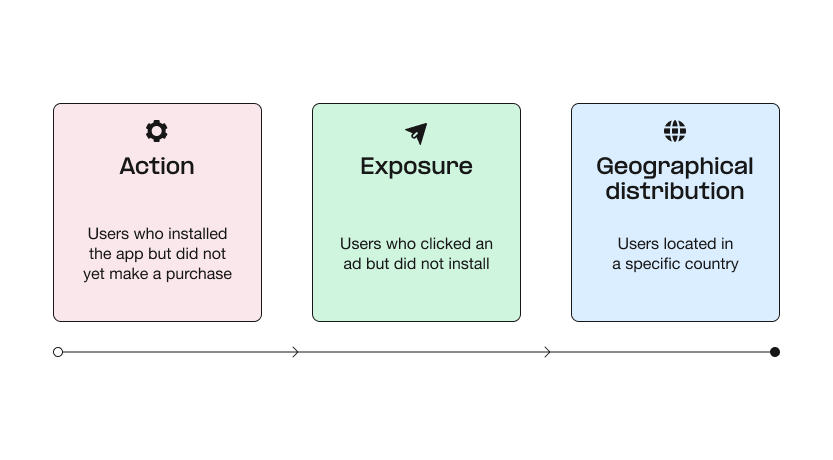
With incrementality and A/B testing, you can split customers into two groups. a test group and a control group. across different networks. This allows you to identify which network, campaign, ad, or creative delivers the strongest business impact.
Incrementality testing also helps determine whether adding a new network to your existing mix generates true incremental value, rather than simply redistributing existing conversions.
The AI layer: From insight to action
AI is revolutionizing the marketing measurement industry, empowering growth and marketing teams in new ways and with greater efficiency. It’s the next era of marketing analytics, removing the bottlenecks of manual processes and giving strategy and creativity room to breathe and flourish.
Marketers benefit from:
- Faster planning
- Smarter execution
- Precise measurement
- Continuous optimization
AppsFlyer AI is built to amplify the capabilities of eCommerce marketers. Its three AI layers integrate seamlessly with AppsFlyer’s attribution, deep linking, and data collaboration suites. Performance is enhanced through unified data, real-time insights, and automated strategic workflows.
The 3 pillars of AppsFlyer AI
AppsFlyer AI is structured around three complementary pillars that support every stage of eCommerce marketing. From always-on models to a context-aware copilot and a hub of autonomous AI agents, these pillars address decision-making, execution, and optimization at scale.
Let’s take a closer look at each of the three AI pillars.
1. Core AI
Core AI consists of native, always-on models that ensure decision-making data is accurate, clean, granular, and actionable right out of the box. Its capabilities include:
- Single Source of Truth (SSOT), which consolidates and deduplicates attribution data into one reliable, unified view.
- Fraud Protection AI Layer, which combines behavioral analysis and AI to proactively detect and block sophisticated fraud tactics in real time.
- Creative Optimization, which uses AI to automatically analyze creative assets across campaigns and channels, identify winning creative patterns, and maximize ROI.
2. Assist
Assist is an always-available marketing companion, built to help eCommerce marketers ideate and strategize in real-time. It can instantly turn complex data into actionable ideas and strategic insights – through natural conversation. Instead of waiting on a BI analyst, a marketer can ask questions like “which channels drove the most repeat purchases last month?” in plain language, and get an answer in seconds.
Assist brings:
- Instant insights via AI, breaking down complex data and providing clear answers in seconds.
- Faster decision-making enabling you to sharpen your strategy and drive better marketing results.
- Flexible setup allowing for configurable AI assistance that makes it simple to connect partners, define in-app events, and implement best practices.
3. Agent Hub
AppsFlyer AI’s Agent Hub is a library of digital teammates. These pre-built agents can perform full workflows and expand the power of marketing and growth teams, and include:
- Suggested Audience Builder that finds high-value segments you wouldn’t have otherwise discovered.
- Media Mix Recommendation Agent that shows you where to cut and where to add budget, based on performance data.
- Executive Summary Generator to save you from manually building weekly reports for leadership.
In 2024, fashion brand Zalando reported a 4.2% revenue lift as part of a strategy that uses AppsFlyer’s AI Agent tool to make shopping on their app conversational and personal.
These three pillars ensure that AppsFlyer’s AI is about more than insights: it’s also a tool for action. As AI agents carry out marketing tasks and routine workflows, you can keep your eCommerce growth initiatives moving at machine speed.
No more manual process bottlenecks, just amplified strategy and creativity for your marketing efforts.
The data collaboration era
Owned media is undoubtedly valuable in eCommerce marketing, but has its limitations compared to the richness of opportunities provided by an omnichannel media strategy.
Retail media networks, sometimes referred to as commerce media networks (CMNs) are taking on a central role for brands. Think of CMNs as ad platforms owned by retailers, where you can reach shoppers close to the point of purchase by using the retailer’s first-party data.
Crucially, CMNs enable brands to confidently and accurately measure ROI – without technical expertise. It’s one of the fastest-growing advertising ecosystems, with the commerce media market projected to breach $100 billion in the US alone by 2027.
CMNs integrate ads across multiple online and offline channels, pulling data from various user interactions to deliver targeted advertising and promotions. While incorporating CMNs in your marketing mix can bring high rewards, it also adds an additional level of challenges for marketers:
- Understanding the true impact of CMN campaigns can be difficult.
- Building segments within CMNs often requires data specialists.
- Maintaining full privacy and control over data can be challenging.
- Connecting with multiple retailers and tech providers can be complex and restrictive.
AppsFlyer’s Data Collaboration Platform (DCP) empowers brands to overcome these challenges, and realize the maximum benefit of folding retail media networks into their omnichannel strategy. It’s a bridge between advertisers, CMNs, and customers.
AppsFlyer DCP lets you build and measure audiences at a very granular level, while still protecting individual identities through privacy-safe matching. Marketers can independently build and activate audiences across CMNs and external channels, with full privacy and transparency.
DCP seamlessly integrates with other data clean rooms, data environments and tech providers. The challenges of managing CMNs can be overcome without the need for technical expertise:
- Gain clear insights into the true impact of your CMN campaigns.
- Use a visual audience builder to create high-intent audiences without needing SQL or a data engineer.
- Maintain full privacy and data control while enhancing your targeting through lookalike modeling and suppression lists.
- Collaborate with multiple retailers and tech partners without building one-off integrations for each.
DCP empowers collaboration between eCommerce brands and CMNs without dependency. It’s self-service, interoperable and scalable, and can future-proof your retail media strategy.
To learn more about how AppsFlyer’s Data Collaboration Platform can level up a brand’s performance marketing strategy, check out our DCP guide.
The connected commerce stack
The future of eCommerce measurement is collaborative, intelligent and privacy first. Brands today are incorporating AI tools and embracing commerce media networks to unlock new opportunities and meet the demands of a customer base that expects personalized, tailored experiences.
The brands who thrive in this competitive environment will be those that connect: building efficient pathways between data, teams and partners so that actionable insights flow freely between them.
Granular measurement remains at the core of mobile marketing analytics, but it’s connecting those various stages of the commerce stack that will see your brand rise to the top.
If you remember only four things from this guide, make them these:
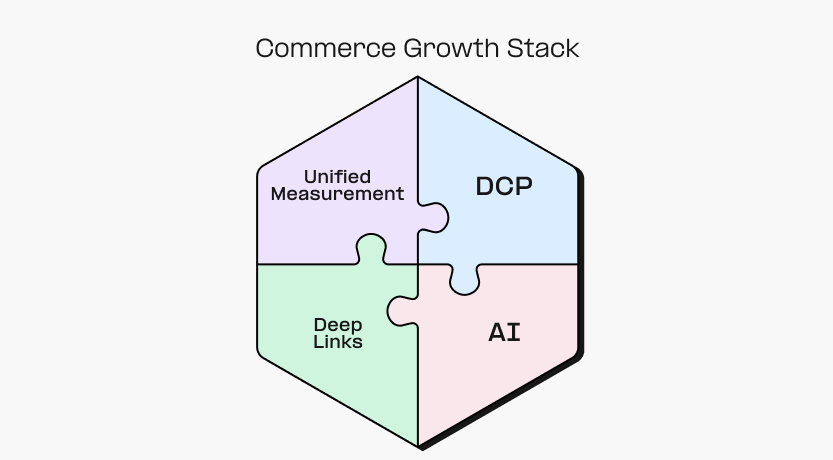
- Adopt a robust, unified measurement solution: to succeed in eCommerce marketing, you need to be able to measure every step of the user journey without blind spots. A measurement suite like AppsFlyer consolidates fragmented touchpoints across mobile, web, CTV and more to give a unified, customer-centric view that allows brands to understand ROI with precision.
- Provide a seamless user experience with deep linking: a comprehensive deep linking solution powers frictionless owned media journeys, ensuring that the engagement of your customers doesn’t drop between clicks and conversions. AppsFlyer’s deep linking suite underpins everything from basic redirects to complex routing logic, enabling brands to scale deep linking confidently across owned and paid channels.
- Embrace data collaboration: in today’s privacy-centric landscape, unlocking the full potential of first-party data requires secure, privacy-preserving partnerships. Solutions like AppsFlyer’s Data Collaboration Suite provides a trusted environment for partners to analyze combined datasets while maintaining strict privacy, and offers a foundation for collaborative growth strategies.
- Deploy powerful AI tools: AI helps marketers go beyond insight and into execution, by automating key workflows and enhancing performance through intelligent, autonomous systems. AppsFlyer’s Agentic AI suite can manage media mix recommendations, suggest creative optimizations, and surface meaningful insights in real time. Powerful AI tools like this are ushering in a new era of autonomous marketing execution to help brands scale faster and move smarter.
The future of measurement and marketing analytics for eCommerce doesn’t stop here, though. To stay on top of the latest trends, check out AppsFlyer’s guides to retail media, AI personalization, owned media, and more.