
Why attribution fails: How to fix it


If you have ever sat in a reporting meeting where Meta, Google, and your finance team all showed different revenue numbers for the same month, you already know the problem this article is about.
Everyone looks at each other. Someone picks the number that makes the most sense. A decision gets made anyway. And nobody is quite sure whether to trust it.
It’s not a coincidence and it’s not a data export issue. Every platform is designed to claim as much credit as possible, and none of them have any reason to agree with each other.
This guide breaks down exactly why attribution breaks, what it actually costs, and what fixing it looks like, so you can walk into that meeting with one number everyone can trust.
TL;DR
- Attribution fails for structural reasons, not technical ones. Platforms have a financial incentive to overclaim credit.
- A single purchase is routinely claimed by three or four platforms simultaneously, making your total attributed revenue 2 to 4 times actual revenue.
- The problem hits every vertical: in ecommerce, a shopper sees a Meta ad, browses on desktop, and purchases on mobile. The campaign gets zero credit. The purchase looks organic. The team cuts the spend that was actually working.
- The problem compounds with every surface added: CTV, retail media, and AI surfaces each introduce a new identity silo and a new self-reporting platform.
- Fixing attribution requires an independent measurement layer, separate from any platform selling you ads.
- Every automated bidding system is only as good as the attribution signals it trains on. Broken attribution means broken AI decisions; wrong spend, wrong channels, at scale.
Why does marketing attribution fail?
The core marketing attribution challenges stem not from bad data, but from systems that have more incentive to claim credit than to report accurately.
Every major ad platform, including Meta, Google, TikTok, and Amazon, operates its own attribution engine. Each one uses its own lookback window, its own definition of a touchpoint, and its own logic for deciding what counts as a conversion. The company selling you the ads is also the one telling you how well those ads performed. There is no independent auditor in that arrangement, and the numbers reflect it. Meta claims $400K. Google claims $350K. Your finance system shows $310K. All three are measuring the same customers, the same campaigns, the same month. None of them agree because none of them were designed to.
The result: the same customer’s purchase gets claimed by multiple platforms simultaneously. Your total attributed revenue routinely exceeds actual revenue by a factor of two to four. And every budget decision you make is based on data that is structurally inflated.
It plays out the same way across verticals. In ecommerce, a shopper sees a Meta ad on Tuesday, browses on desktop on Thursday, and purchases on mobile on Saturday. Meta claims the conversion. Your web analytics assigns it to direct. Your mobile measurement partner (MMP) sees it as organic. The actual acquisition source, the Meta campaign that started the journey three days earlier, gets zero credit. You cut that campaign. You scale direct, which was never really direct. The misallocation compounds quietly until the numbers stop making sense at all.
Cross-platform measurement now spans mobile, web, CTV, retail media, and AI-driven discovery surfaces, each operating its own attribution logic, each with no obligation to reconcile with the others. Every surface you add is a new self-reporting platform and a new identity silo. The overclaim problem does not grow linearly. It compounds.
And as you move toward automated, AI-driven optimization, attribution failure becomes more expensive, not less. AI systems can only optimize toward what they can measure correctly. Feed them broken signals and they will scale the wrong thing, automatically and at speed.
There are four specific, diagnosable reasons attribution breaks. Here is each one.
What are the four reasons marketing attribution fails?
1. Platforms are their own judge and jury
Self-Attributing Networks, including Meta, Google, TikTok, and Amazon, do not share data with each other. Each one operates its own closed measurement environment and reports its own performance independently of any mobile measurement partner.
When a customer clicks a Google search ad, sees a Meta re-engagement ad two days later, and then converts, both platforms claim full credit for that conversion. So does TikTok if they saw an impression there. The same revenue event is counted three times across three dashboards, attributed three ways, and reported as three separate wins.
This is not a bug. It is the design. Self-reporting is how every walled garden operates. The platform selling you media is the same platform measuring whether that media worked. There is no neutral referee in that model.
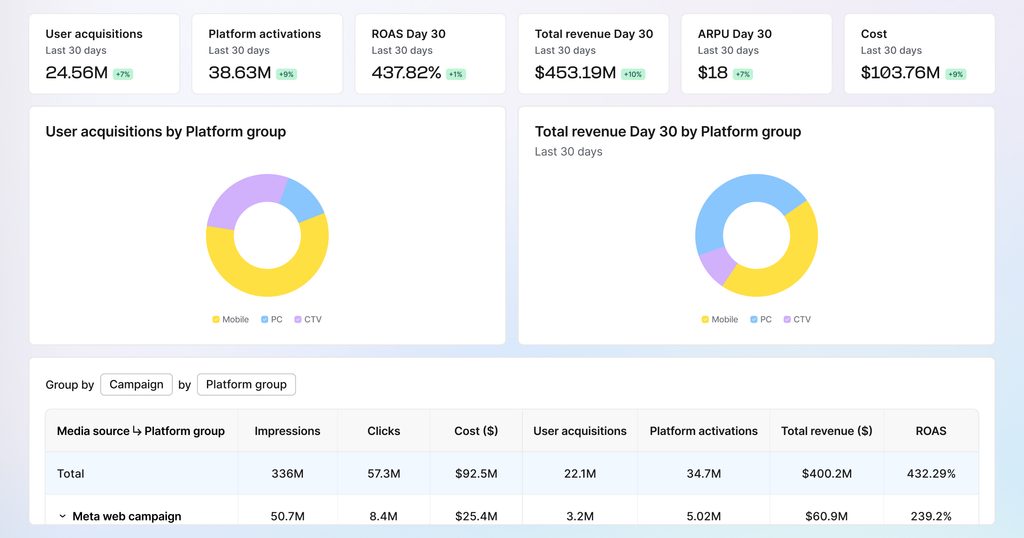
The problem now extends well beyond paid social and search. CTV DSPs self-report reach and frequency with no closed-loop attribution. Retail media networks, including Amazon, Walmart, and Target, each operate their own attribution logic, and a sale Amazon claims in its dashboard is frequently the same sale your MMP has already attributed to a mobile campaign. AI-recommendation engines have no attribution layer at all. Every new surface adds another party reporting in its own favor with no external check.
When your attribution data is fragmented across these platforms, any automated bidding or budget optimization system you run is working from corrupted inputs. An AI trained on last-click or platform self-reported data will systematically push spend toward the channels that claim the most credit, not the ones that actually earn it.
2. Data is siloed by design
Your web revenue lives in GA4 or Adobe Analytics. Your app revenue lives in the MMP. CTV impression data lives in the DSP. Retail media data lives in each retailer’s closed garden. Each of these analytics platforms was built to serve its own reporting environment, not yours. The result is fragmented data with no native path to reconciliation.
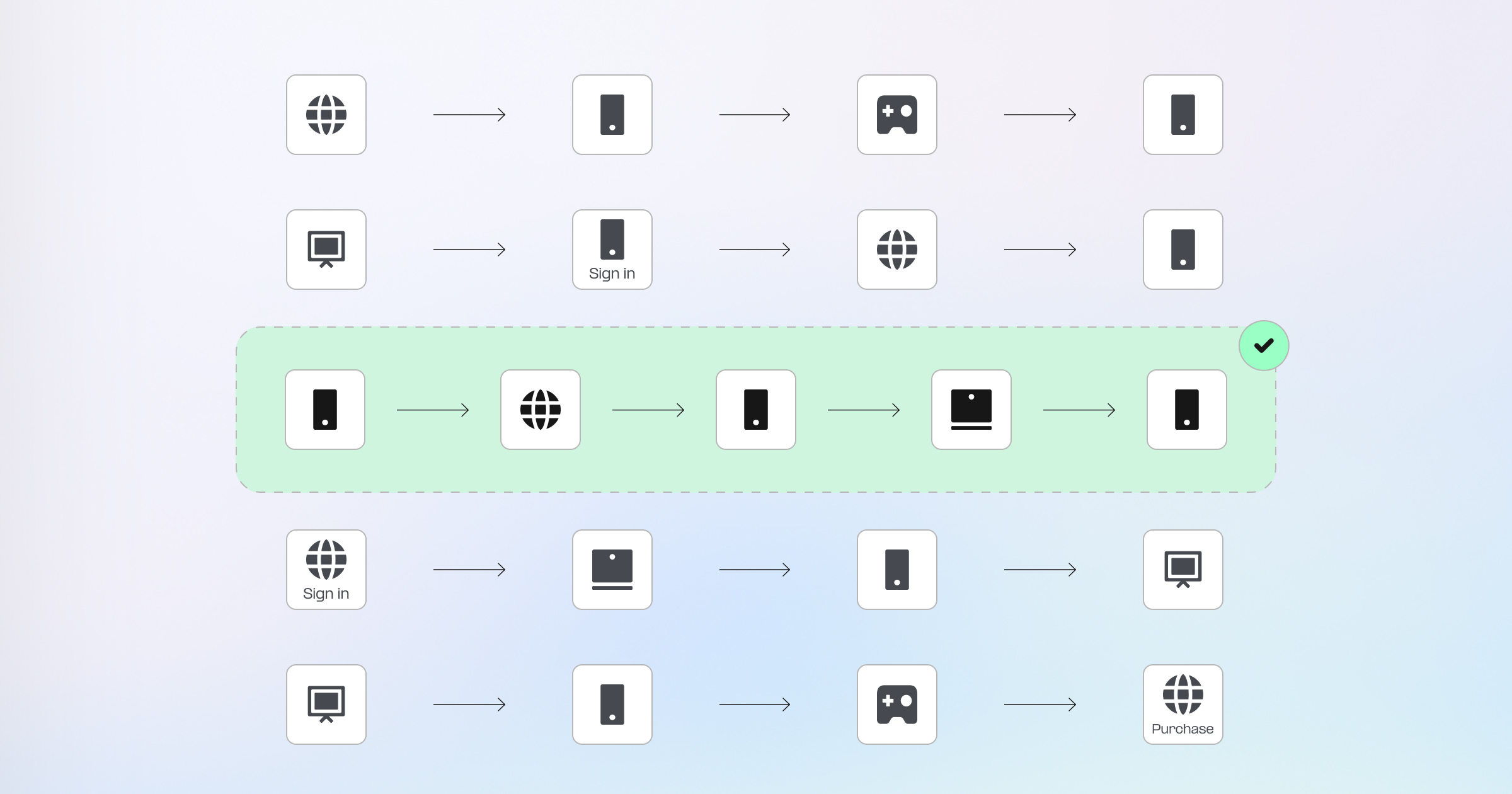
So no single system sees your full customer journey, and your attribution data reflects only the slices each platform can see. Take a common multi-surface journey: a customer sees a Meta ad on web, signs up, installs via YouTube, purchases $50 on iOS, then purchases $100 on PC. In siloed measurement, Meta reports $0, YouTube claims $100, and the $50 iOS purchase registers as organic. The actual first-touch acquisition source is invisible. The true $150 LTV is uncountable. The campaign that drove the customer gets cut.
So your team resorts to manual data merging in BI tools, pulling exports, normalizing field names, reconciling timestamps across systems that were never designed to be reconciled. It is slow, error-prone, and always behind the decision cycle. And any time a platform updates its API or changes its data structure, the entire process breaks and has to be rebuilt from scratch.
Each new surface makes it worse. Tablet data gets lumped into mobile despite meaningfully different usage patterns. CTV attribution sits in a DSP with no path to the downstream purchase. AI-influenced purchases have no attribution layer at all. Adding more data sources does not solve the silo problem. It deepens it.
3. Identity breaks across surfaces
Your customer on mobile web, your customer on iOS, and your customer on desktop are three different people in siloed measurement systems. Every surface runs its own identity framework: IDFA on mobile, cookie on web, connected TV device ID, retailer login ID. None of them map to each other natively. Without a consistent identifier following your customer across platforms, attribution cannot connect the dots, and the same person’s revenue gets counted multiple times, attributed to multiple sources, from multiple starting points.
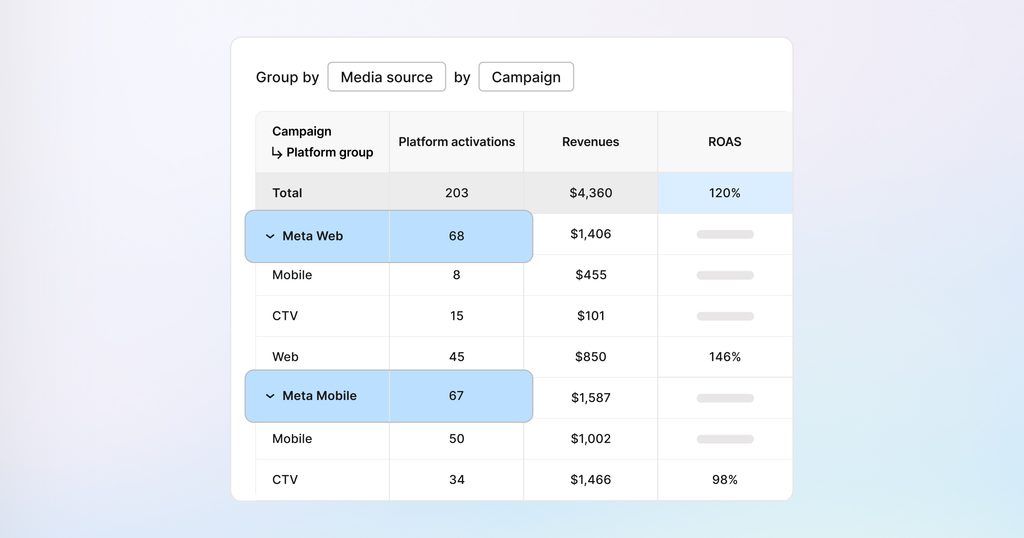
iOS 14.5 and App Tracking Transparency (ATT) made this significantly worse. When customers opt out of measuring, the IDFA, the identifier that powered deterministic mobile attribution, is unavailable. Probabilistic attribution fills the gap but it is an approximation, not a certainty. Without proper reconciliation, 35 to 45 percent of your paid installs can default to organic classification, invisibly distorting every ROAS calculation in your stack.
Cookie deprecation creates the same problem on web. The customer you identified in a previous session is an unknown visitor in the next one. Cross-session attribution breaks. Cross-device attribution breaks. The identity graph you built on cookie infrastructure is eroding, and most teams have not replaced it with anything that works across surfaces.
Every additional surface multiplies the fragmentation. IDFA, cookie, CTV device ID, and retailer login ID are four separate identity systems with no native connection between them. A customer journey that touches all four is four separate people in four separate dashboards, unless something deliberately stitches them together.
4. The attribution model is the wrong tool for the question
Traditional attribution models, whether first-touch, last-touch, or linear, share the same flaw: each one treats a simplified assumption about customer behavior as truth.
Last-touch attribution overcredits retargeting and branded search, the channels that showed up at the end of a journey they did not start. First-touch ignores everything that happened between initial awareness and conversion. Linear models treat a CTV impression and a bottom-funnel click as equivalent. None of these is wrong in isolation. They are each answering a specific question. The problem is that you are using them to answer a different one: which channels should get more budget?
And in a world of ATT, cookie deprecation, and walled gardens, a significant share of touchpoints are invisible to your model entirely. A model that can only see the touchpoints it has access to is not just simplified. It is working with an incomplete picture of the journey. Even a correctly applied attribution model produces the wrong answer when the underlying data has gaps.
Multi-touch attribution and data-driven attribution are more reliable alternatives, but both require sufficient signal volume and a platform capable of running them across all surfaces. If you are running models on a single platform or a single channel, you are measuring a fraction of the actual journey and treating that fraction as the whole.
What does siloed measurement actually cost?
The downstream consequences are specific and measurable.
Budget misallocation
You over-invest in channels that self-report well, bottom-funnel retargeting and branded search, and under-invest in channels that drive long-term value but are harder to attribute, top-of-funnel, CTV, and organic. The channels that look best in your attribution model are not always driving real marketing performance. They are often the ones that showed up last.
Inflated ROAS
When multiple platforms claim the same revenue, your reported ROAS is structurally higher than actual ROAS. A campaign that looks like it is returning $4 for every $1 spent may be returning $1.50 once duplicate claims are removed. Decisions made on inflated ROAS compound the error. More budget flows to channels that look better than they are, and the inflation keeps growing.
Loss of trust in data
When your marketing team, your finance team, and each platform all report different numbers, your leadership loses confidence in attribution data entirely. Decisions start getting made on gut feel. That is expensive in a different way.
Wasted spend
AppsFlyer data shows an average of 15 percent of ad spend is recoverable through proper attribution deduplication. Fraud protection adds a further 7 percent saving on average.
AI amplification
When your attribution data is wrong, AI-driven systems do not correct for it. They amplify it. Automated bidding scales spend toward the channels that claim the most credit, not the ones that drive the most real value. The more automation you run on top of broken attribution, the faster the misallocation grows.
What does accurate attribution actually look like?
Accurate attribution requires four things working together. Most teams are missing at least two of them.
1. A single deduplicated source of truth
One system that ingests attribution signals from every channel and surface, deduplicates competing claims, and applies a consistent model. Not a dashboard aggregator that shows platform-reported numbers side by side. A layer that resolves conflicts before reporting. The output should be one number per conversion event, not four platform numbers your team then tries to reconcile manually.
2. Customer-level identity across surfaces
A Customer User ID (CUID) that connects the same customer’s events across iOS, Android, web, PC, and CTV, so revenue events are counted once, attributed correctly, and traced back to the original acquisition source. Without it, every surface is an island. With it, the $150 a customer generates across three platforms is one journey, one LTV figure, attributed to the campaign that started it.
3. An independent attribution layer
Separate from any media-buying platform. The party doing attribution should not also be selling the ads being measured. Independence is not a nice-to-have. It is the baseline requirement for data you can actually trust. GA4 is Google measuring Google’s channels. Platform pixels self-report. Every network’s number is biased toward itself. An independent MMP applies your business logic, not the platform’s.
4. Model plus incrementality
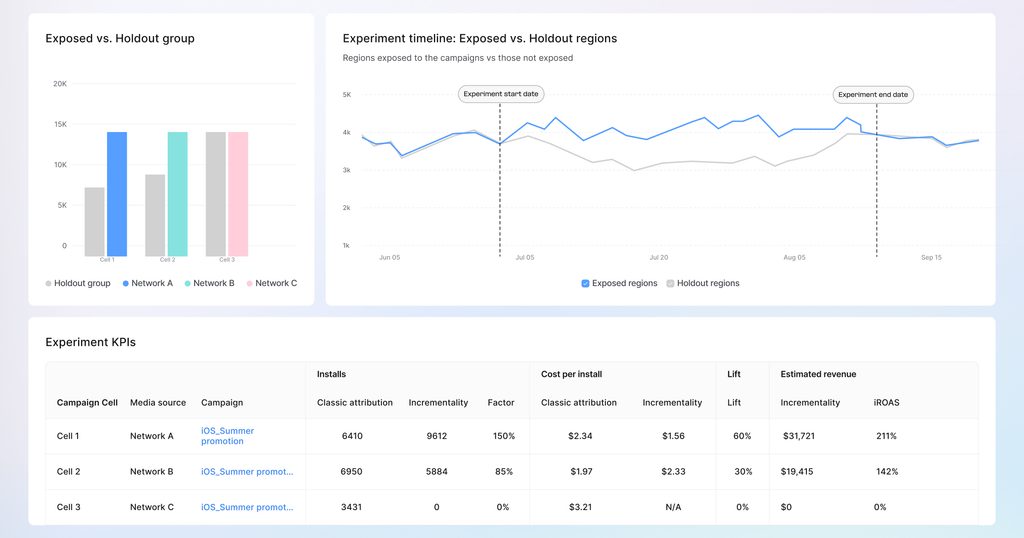
Attribution models tell you what happened. Incrementality testing tells you what would have happened without your campaign. Both are needed to make confident spend decisions. Attribution answers who got credit. Incrementality tells you whether the credit was earned.
The solution must cover all surfaces, not just mobile and web. A unified attribution layer that still leaves CTV, retail media, and AI surfaces as blind spots recreates the same silo problem with better branding.
And clean attribution is the prerequisite for AI that actually optimizes. An Agentic AI Suite adjusting bids, reallocating budgets, and triggering re-engagement flows is only as reliable as the data feeding it. Fix the measurement first. Then the automation works.
How does AppsFlyer fix the attribution failure points?
AppsFlyer is not a media-buying platform. It has no financial incentive to overclaim credit for any channel. That structural independence is what makes deduplication credible, and it is the one thing platform self-attribution can never offer.
Independent deduplication across 12,000+ networks
The operational problem most teams hit is this: you pull your attribution report and the numbers do not match your finance system. Meta claims one number, Google another, and your MMP shows a third. That discrepancy exists because every platform is counting the same customer differently. AppsFlyer sits between your apps and 12,000+ integrated ad networks, applies your attribution logic consistently, and deduplicates competing conversion claims so each install is credited once, to the right source. Brands using SSOT see up to a 34% lift in attributed installs, a 70% lift in attributed revenue, and a 35% decrease in eCPI.
Single Source of Truth (SSOT) for iOS
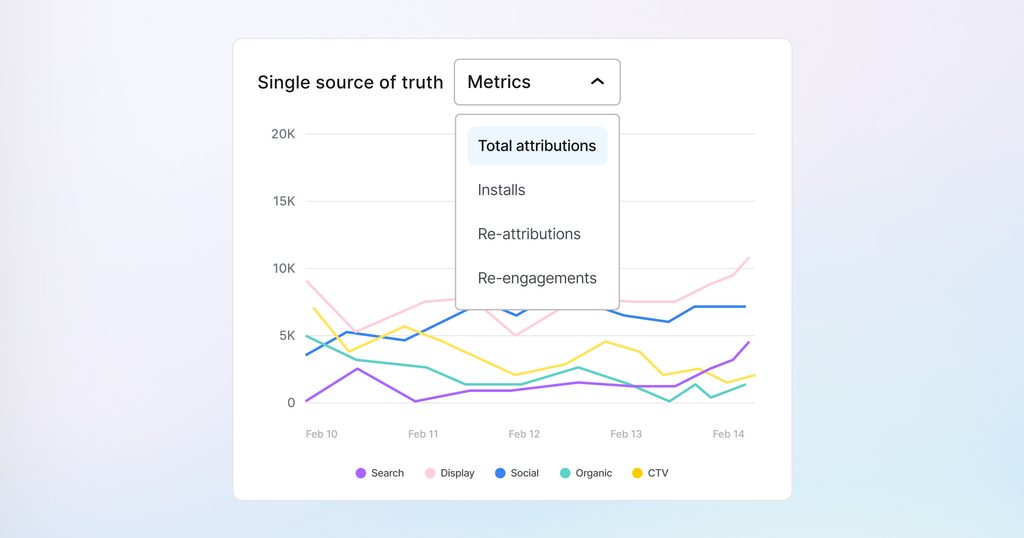
Post-ATT, in many measurement stacks, a significant share of iOS paid installs are being classified as organic. The paid campaign that drove them gets zero credit. Your ROAS looks lower than it is. You make cuts based on data that was never accurate. AppsFlyer’s SSOT combines deterministic data, SKAdNetwork postbacks, and probabilistic modeling into one deduplicated view, typically uncovering a 30 to 50 percent increase in accurately attributed paid installs that would otherwise disappear into the organic bucket.
CUID stitching across every surface

The reporting conflict that kills internal alignment is this: your mobile team says the campaign worked, your web team has no record of it, and your finance team sees revenue that nobody can attribute. That happens because the same customer is three separate people in three separate systems. AppsFlyer connects a customer’s events across iOS, Android, web, PC, and CTV into one continuous journey using a Customer User ID. The $150 a customer generates across three platforms is counted once, attributed correctly, and traced back to the campaign that started the journey. FuboTV used this to connect mobile acquisition to web subscriptions that were previously invisible, resulting in a 15 percent reduction in CPI and a 20 percent increase in budget allocation efficiency.
When deduplication works across every surface, the compound effect shows up in reporting alignment, budget confidence, and the cost metrics teams use to make decisions. eBay put it directly: “AppsFlyer is our source of truth when it comes to attribution. We have gained full 360-degree insight into our user acquisition activity, while lowering our costs. No marketing tech stack is complete without AppsFlyer.”
BitMango used AppsFlyer’s ROI360 to access real-time cost and ad revenue data across their mobile games portfolio. The result: Day 14 ROAS increased by 57% over two months, and their optimization cycle shortened from two to three weeks down to one week. As CEO Kisup Lee put it: “The accurate ROAS data in real time empowered us to quickly identify risks in early stages of the campaign. This advantage significantly boosted our long-term ROAS and improved our efficiency.”
Full surface coverage: mobile, web, CTV, and retail media
Most measurement stacks were built for mobile or web, not both, and certainly not CTV or retail media on top. That leaves your team building workarounds for every new surface you activate. AppsFlyer attributes across mobile, web, CTV, and retail media from a single platform. For surfaces that cannot be closed-loop attributed, including some CTV placements, offline, and OOH, incrementality testing and Marketing Mix Modeling (MMM) fill the gap with causal lift data rather than leaving a blank in your reporting.
Attribution that powers AI, not just reports

Every automated bidding system, every AI-triggered re-engagement flow, every autonomous budget reallocation decision is only as reliable as the data feeding it. AppsFlyer is the source of truth for attribution, which makes it the foundation for the Agentic AI Suite: automated budget reallocation, AI-triggered re-engagement, and real-time ROAS optimization built on data that has been deduplicated and unified across all surfaces.
Visa and their media agency Assembly saw this directly. After implementing AppsFlyer’s full-funnel measurement for the Visa Pay App launch, they shifted from optimizing to surface-level install metrics to making budget decisions based on actual conversion outcomes. The results over 12 weeks: a 155% increase in app downloads, an 85% reduction in cost per registration, and a 114% improvement in acquisition rate. As Shubham Gaur, Performance Director at Assembly, put it: “AppsFlyer enabled us to shift from install-centric reporting to a true full-funnel acquisition model, giving us unified visibility into every stage from install to wallet creation. With a single source of truth, we optimized budget toward high-value audiences and scaled efficiently.”

AppsFlyer has measured 100,000+ apps worldwide, serves 15,000+ brands globally, and operates in 190+ countries.
The table below compares what breaks under siloed, platform-reported attribution against what changes once measurement is unified and deduplicated.
How does broken attribution compare to unified attribution?
| Dimension | Broken/siloed attribution | Unified attribution (AppsFlyer) |
|---|---|---|
| Who does the measuring | Each platform self-reports independently | Independent third-party, no media-buying conflict |
| Revenue counting | Same event claimed by 3 to 4 platforms | Single deduplicated event per customer |
| Customer identity | Breaks across surfaces, same customer appears as multiple IDs | CUID, consistent across all surfaces |
| Cross-surface coverage | Mobile or web, rarely both | Mobile, web, CTV, retail media, PC, gaming |
| CTV attribution | DSP self-reports reach, no conversion path | Incrementality and MMM fill the gap |
| Retail media deduplication | Retailer-reported ROAS conflicts with MMP data | SSOT deduplication across walled gardens |
| Attribution model | Last-click by default, platform-favoring | Configurable: MTA, DDA, incrementality |
| Data freshness | Delayed, manual BI merging | Hourly unified dataset, 170 fields |
| Walled garden deduplication | No | Yes, SSOT across all networks |
| AI optimization compatibility | Fragmented signals corrupt AI inputs | Clean data feeds Agentic AI Suite |
| Incremental lift measurement | No | Yes |
Fix the attribution problem, not just the report
Attribution failure is a solvable problem. The root causes are structural: platform incentives, identity fragmentation, surface silos. But each one has a specific fix. Identifying which of these failures apply to your current setup is the first step. Fixing them is the second.
Fix attribution and every automated system you run gets more reliable. Automated bid calibration, AI-triggered re-engagement, agentic budget reallocation. None of it works correctly on broken inputs. As AI agents begin making autonomous spend decisions across surfaces, the brands with clean, unified attribution will optimize faster and waste less than those still reconciling dashboards manually.
Talk to our team to see where your current attribution is breaking and what unified measurement looks like for your specific stack.
Frequently asked questions
Because each platform measures its own performance using its own rules. Meta, Google, and TikTok all have different lookback windows, different definitions of a conversion, and no obligation to reconcile with each other. The same customer’s purchase gets claimed by all three simultaneously. Your total attributed revenue ends up two to four times higher than what actually came in. The fix is an independent measurement layer that sits outside all of them and applies one consistent set of rules.
It gives all the credit to whichever channel the customer touched last, which is almost always retargeting or branded search. Those channels did not drive the customer. They showed up at the end of a journey someone else started. Last-click makes them look like your best performers and makes your awareness and top-of-funnel channels look like they do nothing. Budget follows the model, and the model is wrong.
A self-attributing network is a platform like Meta, Google, or TikTok that measures its own ad performance rather than sharing that data with an independent third party. They set their own attribution windows, run their own models, and report their own numbers. The conflict of interest is obvious: the same company selling you ads is also grading their own homework. That is why their numbers rarely match your MMP.
As a directional signal, yes. As a basis for budget decisions, no. Both platforms report in their own favor. Meta’s view-through window claims credit for any conversion that happened after someone saw an ad, whether they engaged with it or not. Google does the same. You need an independent layer to deduplicate those claims before you act on the numbers.
Deduplication means making sure each conversion is counted once, attributed to one source. Without it, every platform that touched the customer claims full credit, and your reported ROAS ends up inflated across the board. An independent MMP applies your business logic to resolve the competing claims and gives you one accurate result per event instead of four conflicting ones.
When iOS customers opt out of monitoring, the IDFA disappears. That is the identifier most deterministic mobile attribution runs on. Without it, a significant share of your paid installs get classified as organic, your ROAS looks worse than it is, and you make cuts based on data that was never accurate. AppsFlyer’s SSOT combines what deterministic data remains with SKAdNetwork postbacks and probabilistic modeling to recover what ATT hides, typically surfacing 30 to 50 percent more accurately attributed non-organic installs.
Attribution tells you which channel got credit. Incrementality testing tells you whether that channel actually changed behavior or just happened to be there at the right moment. You run a holdout test: some customers see the campaign, some do not. The difference in conversion rate is the true lift. Attribution and incrementality answer different questions, and you need both to make confident spend decisions.
It’s a measurement platform that does not sell ads. That matters because any platform selling you media has a financial incentive to show that media in the best possible light. A neutral provider like AppsFlyer has no stake in which channel gets credit. It applies your rules, not the platform’s, and deduplicates across all networks without bias.